Different Types of Invoices Explained for Business Owners
By Alfaa Team
Stay in the loop
Get finance tips delivered to your inbox.
A freelancer billing a single logo project, a SaaS company charging the same client every month, and an exporter shipping furniture to Germany all send something called an "invoice." None of them should be sending the same document.
Send the wrong type and you get real consequences: a shipment held at customs because you sent a standard invoice instead of a commercial one, a client confused about whether they owe you money or you owe them, or a project that runs three months without a single payment because nobody thought to bill at the halfway mark.
Here are the 10 invoice types every business owner runs into, what each one is for, and a real example of each.
What Is an Invoice? (Quick Recap)
An invoice is a formal document a seller sends a buyer to request payment for goods or services. It states what was sold, how much is owed, and when payment is due. If you're new to electronic invoicing as a concept before diving into types, start there.
Why Different Types of Invoices Exist
A one-time project and a monthly subscription don't bill the same way. Neither do a domestic sale and a shipment crossing a border, where customs paperwork adds requirements a standard invoice was never built to handle.
Rather than force one document to cover every situation, businesses match the invoice type to how, when, and why they get paid.
The 10 Most Common Types of Invoices
1. Standard Invoice
The default invoice type. Issued for a one-time sale or service, itemized, with a total due and payment terms.
Best for: Freelancers, small businesses, service providers.

Example: A graphic designer finishes a logo project and sends a standard invoice for the full amount, due in 30 days.
2. Proforma Invoice
Sent before a sale happens. It's a price estimate, not a payment demand, and it doesn't count as income on your books.
Best for: International trade and client cost approvals before work begins.

Example: An exporter sends a proforma invoice to confirm pricing and shipping cost with an overseas buyer before goods leave the warehouse.
3. Recurring Invoice
Issued automatically on a fixed schedule, weekly, monthly, or yearly, with the same line items and amount each time. Recurring billing tools handle this without you touching it every cycle.
Best for: SaaS companies, agencies, and retainer-based work.

Example: A marketing agency's client gets billed the same $3,000 retainer invoice on the 1st of every month, generated automatically.
4. Credit Invoice (Credit Note)
Issued when you owe the customer money back, whether from a return, a billing error, or a discount applied after the fact. It carries a negative value against what they owe.
Best for: Refunds, overcharges, applied discounts.

Example: A software company bills a customer twice by mistake and issues a credit note to cancel out the duplicate charge.
5. Debit Invoice (Debit Note)
The opposite of a credit note. Used when the original invoice undercharged the client, and you need to bill the difference.
Best for: Scope changes, missed line items, pricing corrections.

Example: A consultant forgets to bill for travel expenses on the original invoice and sends a debit note for the difference.
6. Past Due Invoice
Sent once a payment deadline passes without payment. Usually references the original invoice, notes how many days overdue it is, and adds a late fee if your terms include one. Automated payment reminders can trigger this before you have to think about it.
Best for: Any business chasing a late payment.
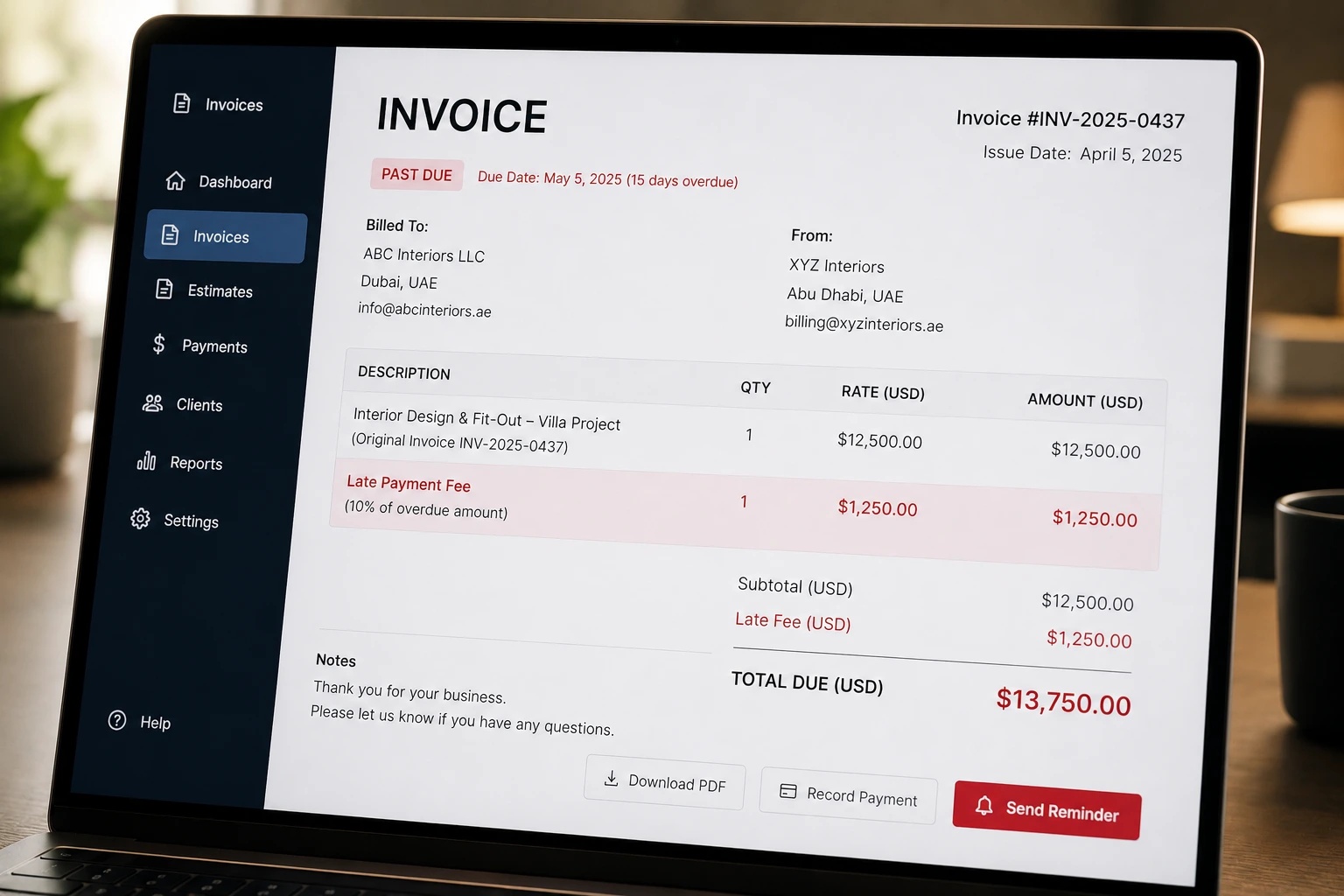
Example: A freelance writer sends a past-due notice 7 days after the deadline, with a 1.5% late fee added.
7. Interim Invoice
Bills for partial payment at set milestones during a long project, instead of waiting until the whole thing wraps.
Best for: Construction, consulting, and multi-month projects.

Example: A web development agency invoices 40% upfront, 40% at the midpoint, and holds the final 20% for delivery.
8. Final Invoice
Sent once a project is finished, covering whatever balance remains after any interim invoices were paid.
Best for: Project-based businesses running staged billing.
Example: The same web agency sends a final invoice for the remaining 20% once the client approves the live site.
9. Commercial Invoice
Required for customs clearance on international shipments. Includes product details, declared value, and shipping terms customs authorities need to assess duties. Businesses billing across currencies should also look at how a multi-currency invoice generator prevents FX and rounding errors on these.
Best for: Import and export businesses.

Example: A clothing manufacturer shipping to Germany includes a commercial invoice listing quantities, declared values, and country of origin, or the shipment gets held at customs.
10. Timesheet Invoice
Billed on hours worked rather than a flat project fee, with time logs and hourly rates itemized.
Best for: Freelancers, consultants, lawyers, and contractors.

Example: A freelance developer bills 32 hours at $75/hour at the end of the month.
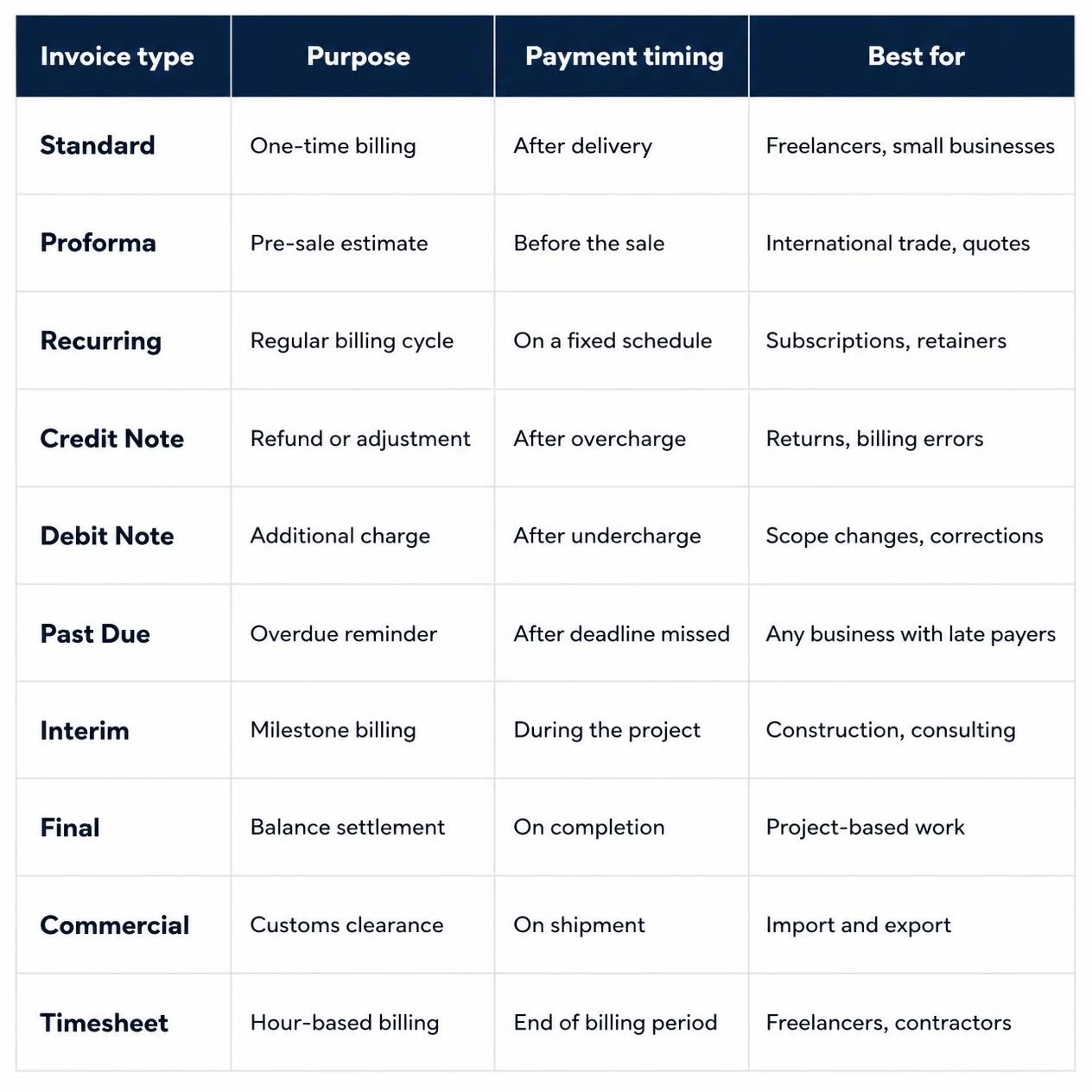
Types of Invoices: Comparison Table
How to Choose the Right Invoice Type
One-time sale or service? Standard Invoice.
Ongoing retainer or subscription? Recurring Invoice.
Long project with staged delivery? Interim, then Final.
Shipping goods internationally? Commercial Invoice, likely preceded by a Proforma.
Billing by the hour? Timesheet Invoice.
Fixing a billing error? Credit Note if you were overcharged, and Debit Note if you were undercharged.
Enterprise and international clients sometimes have their own documentation requirements on top of this, so check before you assume standard terms apply.
Common Invoice Mistakes to Avoid
Sending the wrong type for the situation. A standard invoice won't clear customs. A commercial invoice will be.
Missing payment terms. No due date or late-fee policy means no leverage when payment slips.
Unclear labeling. A credit note that isn't labeled as one gets mistaken for a regular invoice, and now your client thinks they owe you more than they do. This is the same confusion that shows up between invoices, receipts, and bills generally.
No follow-up on past due invoices. The invoice type exists for a reason; use it.
How Invoicing Software Handles Multiple Invoice Types
Managing 10 invoice types by hand, across spreadsheets and email threads, is where mistakes happen. A single platform lets you generate any type from one dashboard, automate recurring billing on schedule, track paid versus overdue in real time, and keep every record stored for tax season.
Alfaa supports standard, recurring, credit, debit, interim, and final invoices from one system, with built-in payment tracking so you're not reconciling anything by hand.
Frequently Asked Questions
Standard invoices are the most suitable for small businesses handling one time sales or services.
The standard invoice is the most widely used across industries.
Recurring invoices should be used for subscriptions, retainers, and ongoing services.
Interim invoices followed by a final invoice are ideal for long term projects.
Yes, modern invoicing software supports creating and managing multiple invoice types from one system.

Olivia Bennett
Content Writer @ Alfaa
Olivia is a content writer at Alfaa who specializes in invoicing, small business, and productivity topics. She enjoys simplifying complex ideas into clear, practical insights that help business owners save time, get paid faster, and stay organized.