Invoice Requirements by Country: A Complete Guide for Global Businesses
By Alfaa Team
Stay in the loop
Get finance tips delivered to your inbox.
If you work with international clients, invoicing is not just about getting paid. It is about staying compliant.
Different countries have different rules for invoices. Missing a required detail can lead to payment delays, rejected invoices, or even tax penalties. For consultants, agencies, and small businesses expanding globally, understanding these rules is critical.
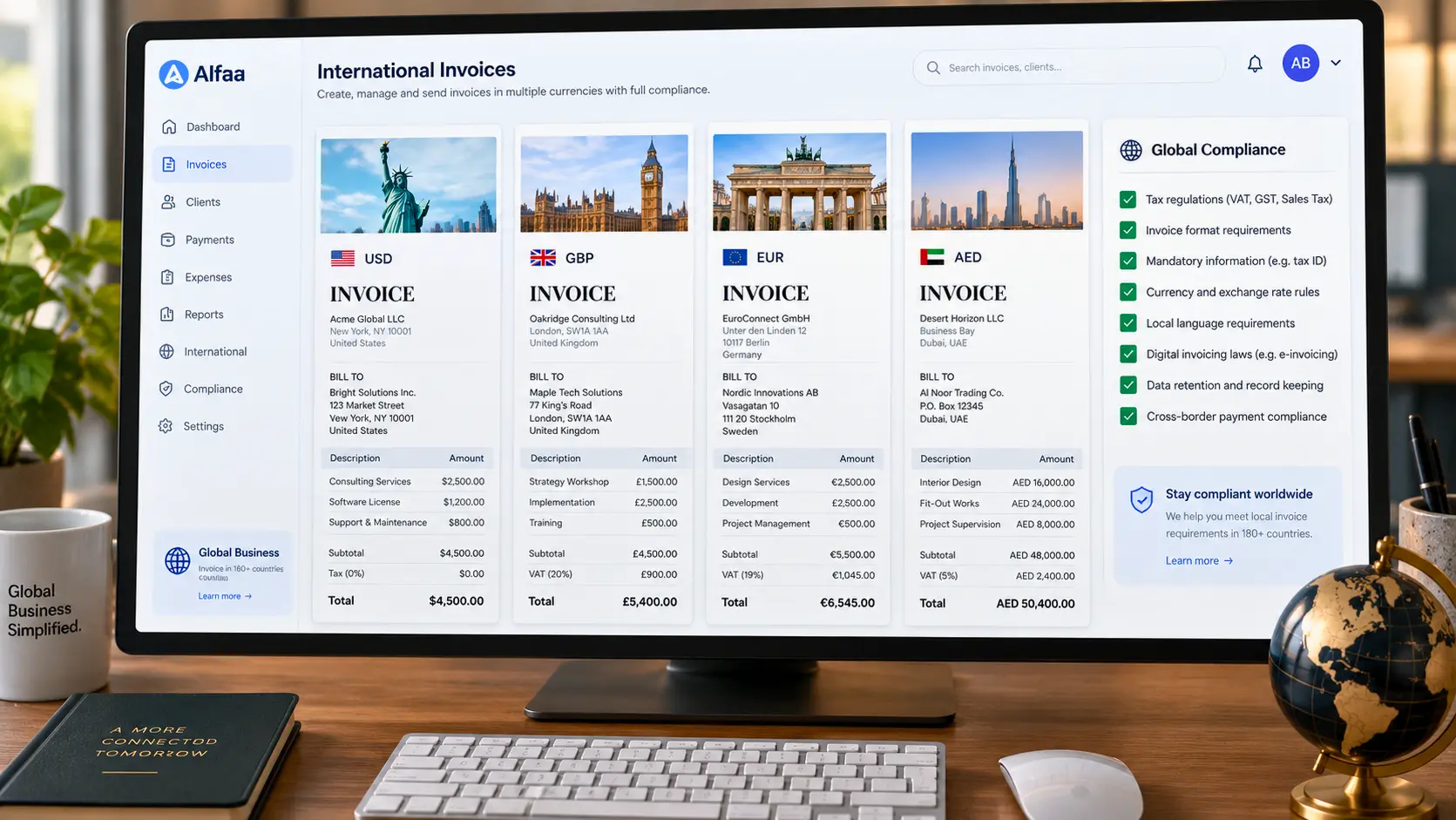
Using invoice management software or an online invoice generator can help standardize invoices, but you still need to understand what each country requires.
In this guide, we break down key invoice requirements across major regions and how to stay compliant.
Why Invoice Requirements Differ by Country
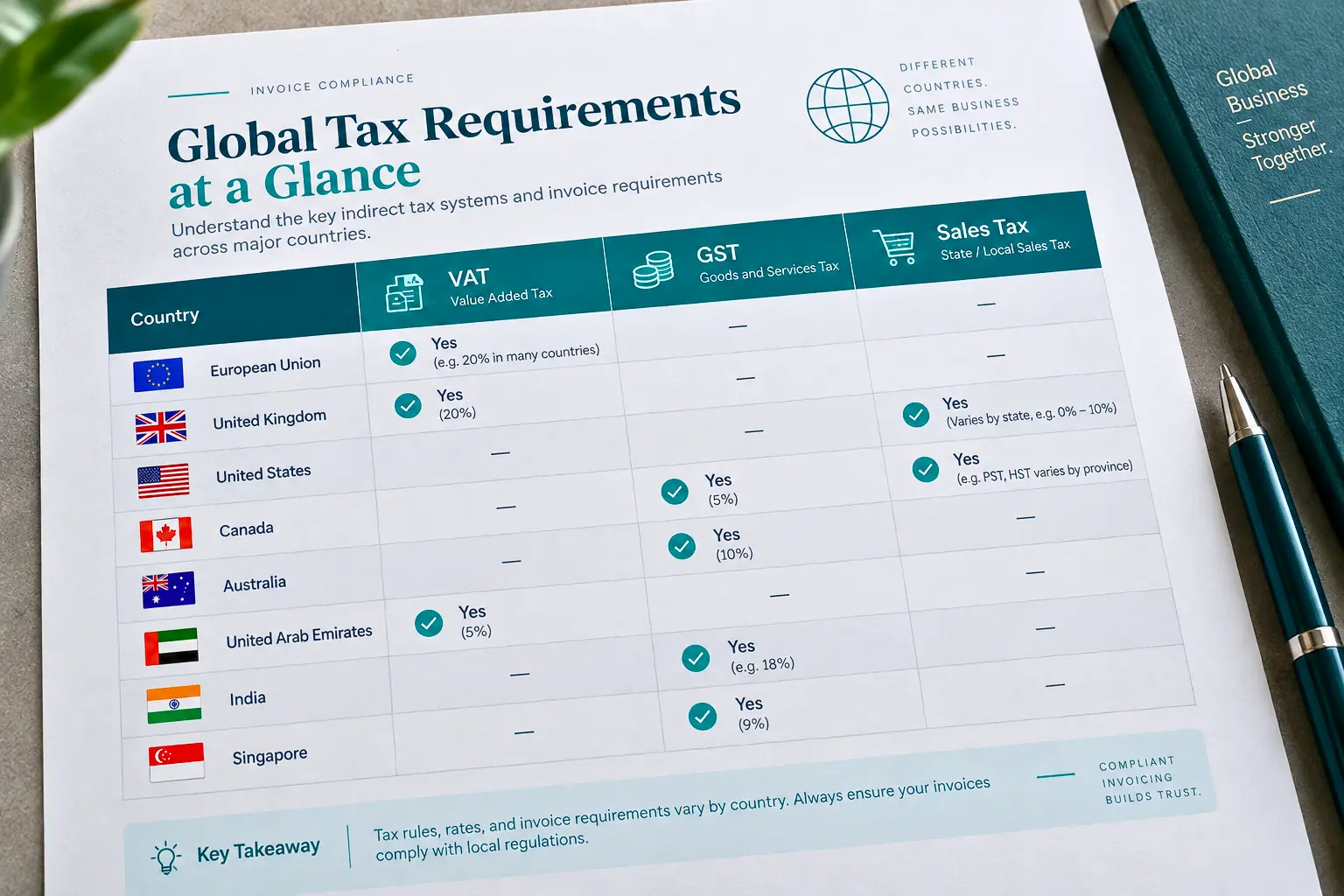
Invoice requirements vary because each country follows its own tax and regulatory systems.
Some countries use VAT, others use GST, and some rely on sales tax systems. Each structure comes with different documentation needs.
Local accounting regulations also influence invoice formats. Governments may require specific fields, formats, or reporting standards.
In many countries, digital invoicing is becoming mandatory. Governments are introducing e-invoicing systems to improve tax reporting and reduce fraud.
This makes it essential to use invoicing software that adapts to country-specific rules.
Key Elements Required on Most Invoices
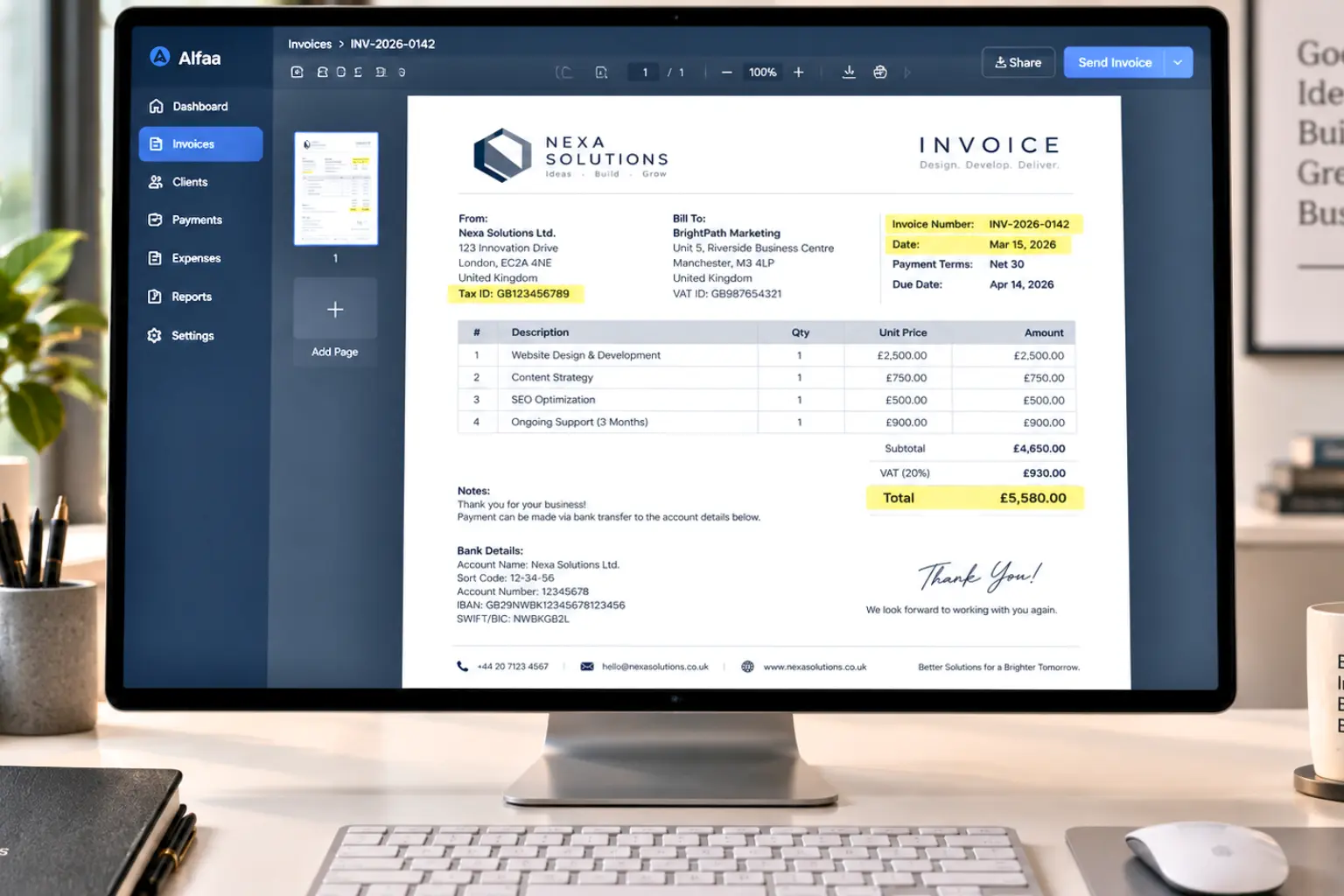
While requirements vary, most countries expect certain standard details on invoices.
These include:
Invoice number
Invoice date
Seller's business name and address
Buyer's name and address
Tax identification number such as VAT, GST, or TIN
Description of goods or services
Quantity and unit price
Tax rate and tax amount
Total amount payable
Currency used
Invoice automation software ensures these fields are consistently included every time you generate invoice documents.
Invoice Requirements in Major Countries
United States
The United States does not have a single federal invoice format.
Sales tax rules vary by state, so tax requirements depend on where the transaction occurs.
Invoices typically include seller and buyer details, : charges, and tax information where applicable.
Invoice numbering is not legally required but strongly recommended for accounting and audit purposes.
United Kingdom
VAT-registered businesses must issue VAT-compliant invoices.
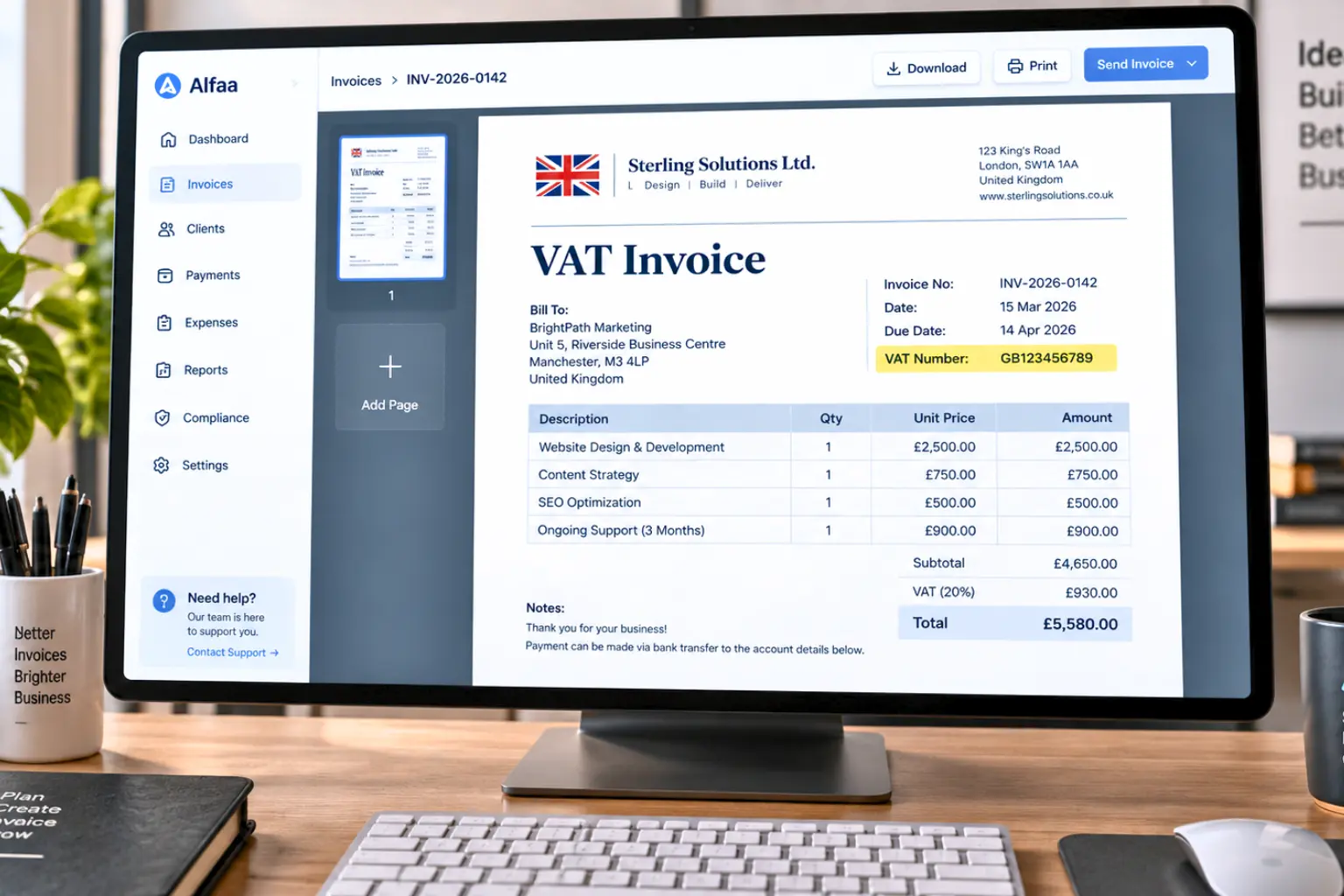
Invoices must include:
VAT number
Tax breakdown
Invoice date and number
There are different invoice formats, including full, simplified, and modified VAT invoices, depending on transaction value.
European Union
EU countries follow the EU VAT Directive.
Invoices must include VAT identification numbers for both seller and buyer in cross-border transactions.
The reverse charge mechanism applies in certain B2B transactions, shifting tax responsibility to the buyer.
Compliance is critical for cross-border services within the EU.
Canada
Canadian invoices must include a GST or HST registration number.
Tax must be clearly separated from the total amount.
Additional information requirements depend on invoice value thresholds.
Accurate tax calculation is essential for compliance.
Australia
Businesses must issue tax invoices for GST claims.
Invoices must include the Australian Business Number and clearly show GST amounts.
Specific wording such as "Tax Invoice" is required.
Invoice automation tools help ensure these details are consistently applied.
Middle East, UAE, and Saudi Arabia
VAT has been introduced in recent years.
Invoices must comply with VAT regulations and often require bilingual formats in Arabic and English.
E-invoicing is becoming mandatory, especially in Saudi Arabia, where businesses must comply with government-approved digital invoicing systems.
Latin America
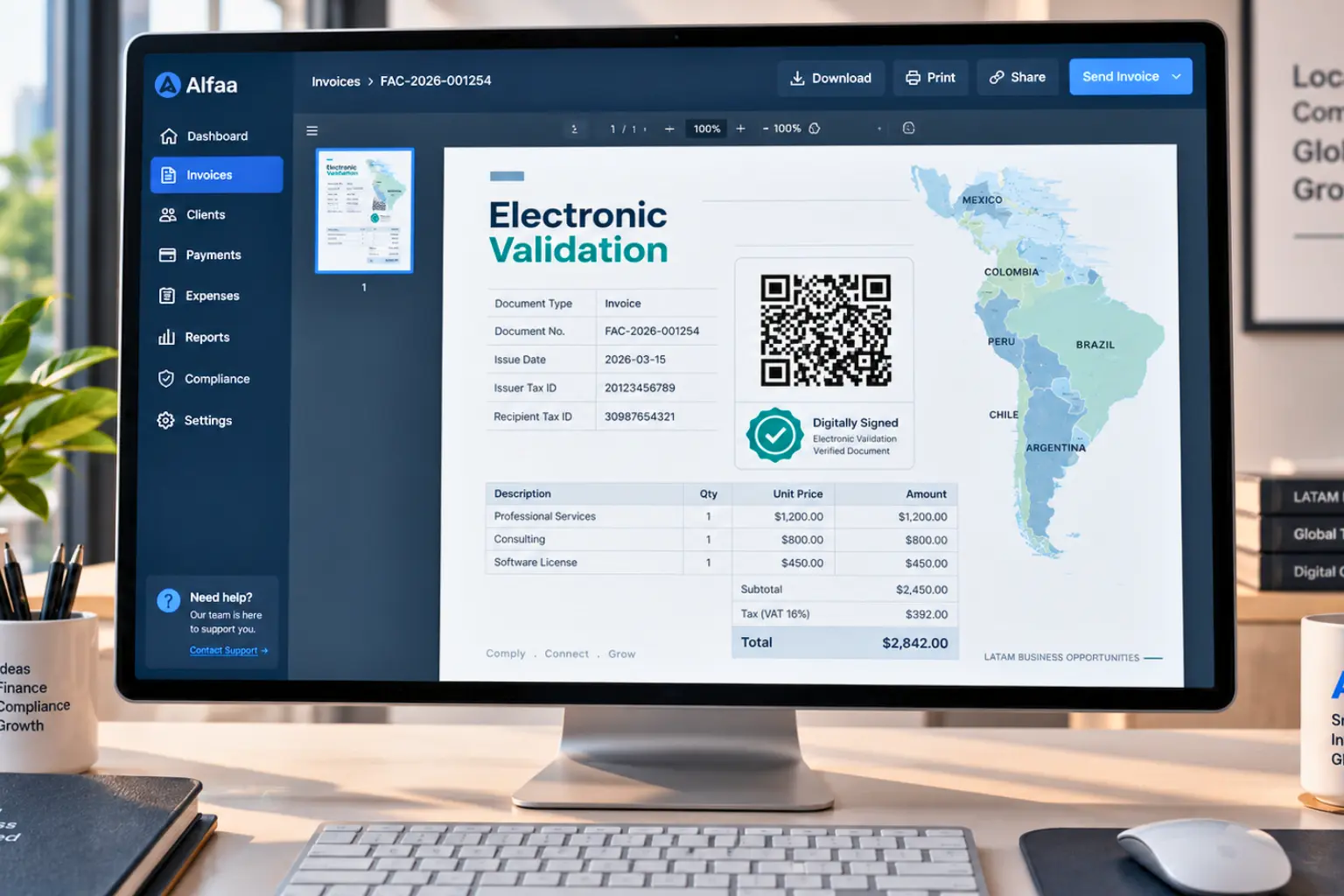
Latin America runs ahead of most of the world on invoicing, not behind it. Nearly every country in the region has moved to mandatory, government-cleared electronic invoicing, and each runs its own platform, its own tax-ID format, and its own rejection rules. A commercial invoice from a mid-sized business rarely passes as a compliant document without a government-issued clearance stamp first.
Panama
Panama's SFEP (Sistema de Facturación Electrónica de Panamá) has applied to all new RUC registrations since 2022, extending to independent professionals such as lawyers, accountants, and consultants in 2024. [CONFIRM] Businesses issuing more than 100 invoices a month or earning above B/.36,000 annually must route invoices through a DGI-authorized PAC (Proveedor Autorizado de Comprobantes) starting January 2026. Required invoice fields include the RUC and verification digit (DV) of both parties, sequential numbering, and a breakdown of the ITBMS (Panama's VAT equivalent). The validated invoice carries a CUFE authorization code and a human-readable CAFE copy with a QR code; the underlying XML, not the printed copy, is the legally valid document.
Ecuador
Ecuador requires an active RUC and SRI authorization before a business can issue electronic comprobantes. Each invoice is validated in real time; a rejected submission ("RECHAZADO") is fiscally void, and the issuer must correct and retransmit, typically within 24 hours. [CONFIRM] Common rejection causes include a suspended RUC, a closed business establishment, or a sequential invoice number already used. Authorized invoices must be archived electronically for seven years. [CONFIRM] Failure to issue a valid comprobante carries penalties of up to 30 basic salaries under SRI regulations.
Peru
Peru's SUNAT oversees several types of comprobantes de pago electrónicos (CPE), not a single invoice format the correct one depends on the transaction (standard invoice, purchase settlement for unregistered sellers, withholding certificate, credit/debit note). Unlike Ecuador's real-time validation, Peru doesn't require SUNAT or an OSE (Operador de Servicios Electrónicos) to approve a CPE before it reaches the buyer it can be sent simultaneously or even after delivery. [CONFIRM] If a recipient doesn't formally acknowledge receipt, the invoice is treated as accepted eight days after delivery.
Guatemala
Guatemala's FEL (Factura Electrónica en Línea) system has no exceptions: since March 2023, every taxpayer, from multinational subsidiaries to single-person businesses, must issue Documentos Tributarios Electrónicos (DTE) through a SAT-certified provider. The NIT (tax ID) is required on every DTE, and a fraudulent invoice issued under a stolen NIT can't be deleted, only offset with a credit note for the same amount. [CONFIRM] DTEs must be archived for a minimum of five years by both issuer and recipient.
Costa Rica
Costa Rica uses a pre-clearance model similar to El Salvador's: the compliance record starts as a signed XML document, not a PDF, and Hacienda (the tax authority) must validate it before it has legal standing. The API returns a status of recibido, procesando, aceptado, or rechazado, only "aceptado" is legally usable. [CONFIRM] Beyond the standard invoice, the system covers electronic credit/debit notes, an electronic payment receipt (Recibo Electrónico de Pago), and a receiver-response document (Mensaje Receptor) that records whether the buyer accepted or disputed the invoice. Treat the whole thing as a document lifecycle, not a single file.
El Salvador
El Salvador's Documentos Tributarios Electrónicos (DTE) also run on pre-clearance through the Ministerio de Hacienda. A DTE has no legal standing until the Ministry issues a Sello de Recepción (a UUID acting as an official receipt stamp) without it, the document can't support a tax deduction or serve as proof of a transaction. The invoice type differs by buyer: a CCFE (code 03) is issued to a business holding an active NRC (VAT registration number) and carries the full NIT/NRC of both parties so the buyer can claim input tax credit; a standard Factura Electrónica (code 01) goes to final consumers and carries no reclaimable tax detail.
Argentina
Argentina's invoice type depends on the seller's tax regime, not just the transaction. A Monotributista (Argentina's simplified regime for freelancers and small businesses) issues Factura C for domestic sales and Factura E specifically for exported services to foreign clients. A Responsable Inscripto (VAT-registered business) instead issues Factura A (to other VAT-registered businesses) or Factura B (to final consumers), with VAT itemized separately, is a distinction the Monotributista invoice types don't carry. Every invoice requires the issuer's CUIT, a sequential number tied to a specific punto de venta, and for Factura C/E a CAE authorization code with a validity window.
Paraguay
Paraguay requires a timbrado, an official numbering authorization from the DNIT, before any invoice, electronic or not, can be issued validly. Electronic documents (DE) are submitted in XML to SIFEN for real-time validation; only once approved does a DE become a DTE with full legal, accounting, and fiscal standing. [CONFIRM] Mandatory adoption is rolling out by taxpayer groups through 2026, with government suppliers required to invoice electronically as a current phase.
Bolivia
Bolivia's Sistema de Facturación Electrónica (SFE) is mandatory for every VAT-registered NIT holder, with the rollout organized into taxpayer groups, the last groups received a final extension to October 2026, and the tax authority (SIN) has indicated no further postponements. [CONFIRM] Electronic facturas require XML 1.0 UTF-8 format, a digital signature, an embedded QR code, and real-time transmission to SIN before the buyer receives the document. Non-compliant businesses face fines and, in some cases, forced closure of the premises.
Turkey
Turkey has run mandatory e-invoicing since 2014 and is one of the more mature systems outside Europe. There are two distinct document types depending on who's on the other end of the transaction:
e-Fatura: For B2B and B2G transactions where both parties are registered with the Turkish Revenue Administration (GİB). [CONFIRM] Mandatory for companies with annual turnover exceeding TRY 3 million.
e-Arşiv Fatura: For transactions with buyers not registered on the e-Fatura system (most B2C and some B2B). [CONFIRM] Required above TRY 5,000 for non-taxable buyers or TRY 2,000 for taxable ones; below those thresholds, paper invoices remain acceptable.
Both run on a centralized B2B2G model: the issuer cannot send an invoice directly to the buyer. It goes to the GİB platform first, gets validated, and only then is forwarded on direct delivery is not a compliant path. Required identifiers are the 10-digit VKN for companies or the 11-digit TCKN for individuals, plus the buyer's registered tax office (Vergi Dairesi). You can bill in any currency, but the tax base and VAT amount must also be shown in Turkish Lira. Export invoices use a specific UBL-TR 1.2 format variant separate from the domestic one. Both invoice types must be digitally archived for 10 years.
E-Invoicing Regulations Around the World
Many countries are moving toward mandatory e-invoicing.
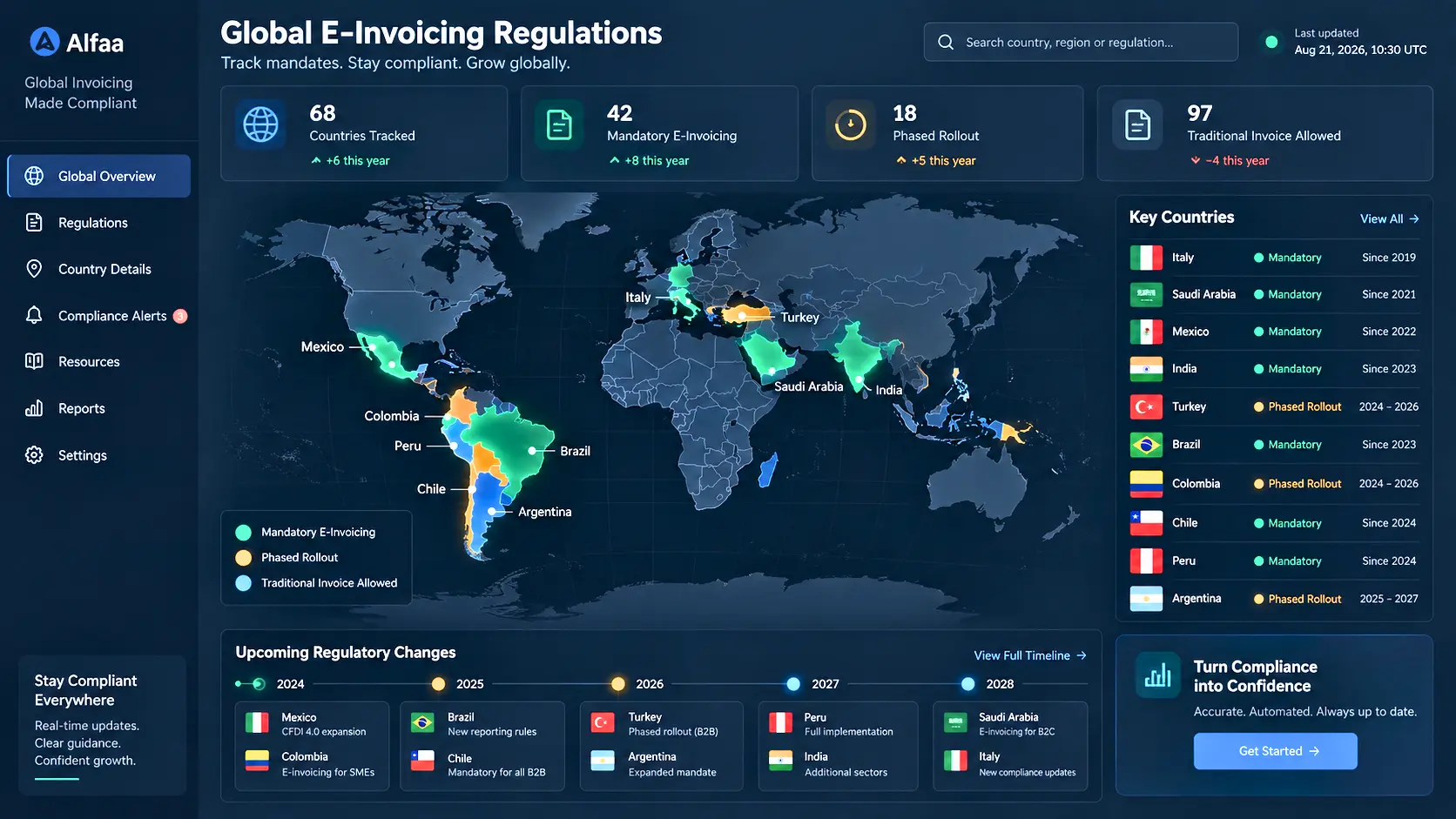
Examples include:
Italy with centralized e-invoicing systems
Saudi Arabia with phased e-invoicing mandates
Mexico with strict digital invoice validation
India with e-invoicing requirements for certain businesses
E-invoicing improves transparency, reduces fraud, and simplifies reporting for tax authorities.
For businesses, using invoice automation software with built-in compliance support makes adapting to these regulations easier.
Common Invoice Compliance Mistakes
Businesses often make avoidable errors when invoicing internationally.
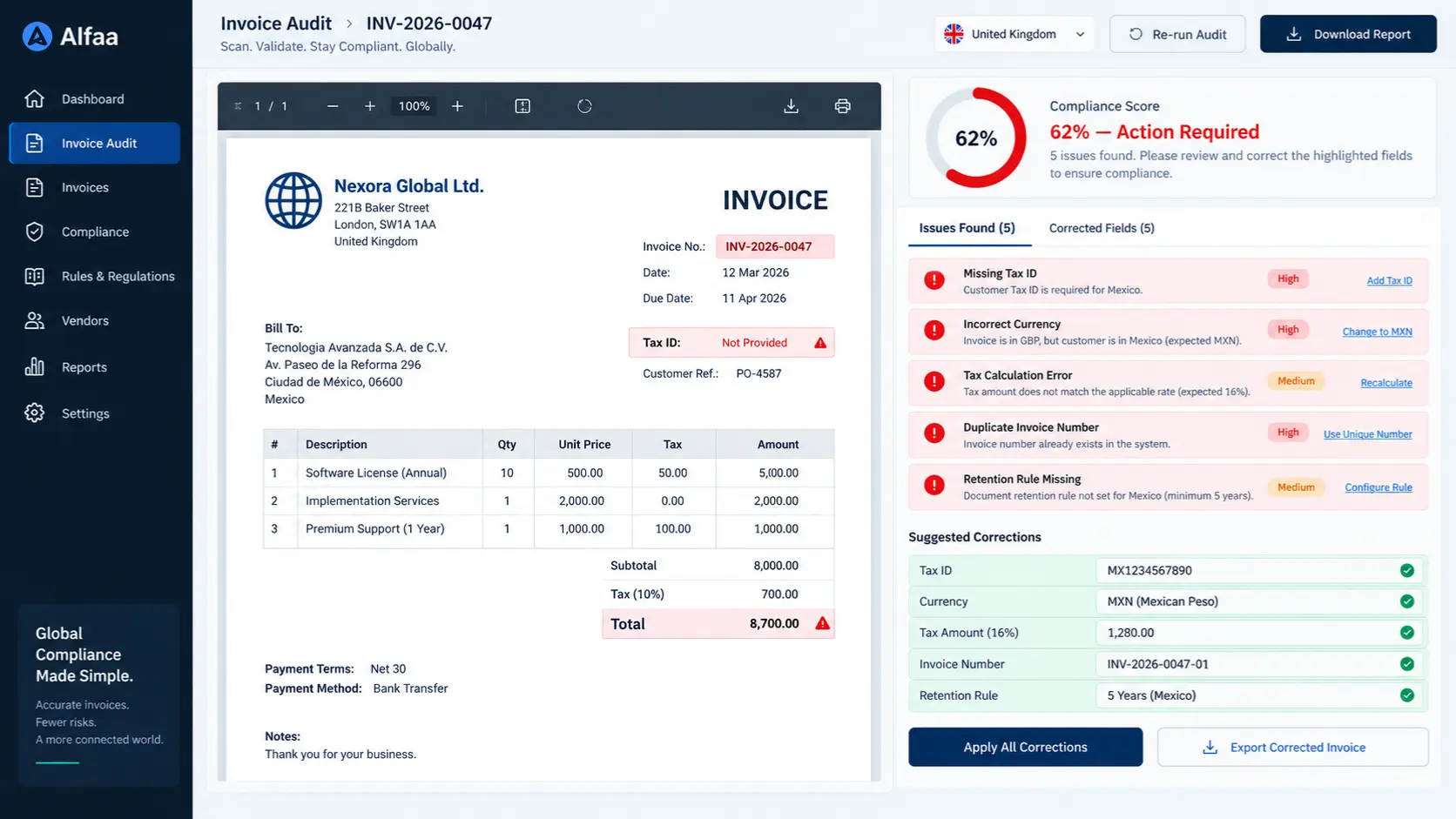
Common mistakes include:
Missing tax identification numbers
Incorrect tax calculations
Skipping invoice numbering
Using incorrect currency
Not storing invoices for required retention periods
These mistakes can lead to delayed payments or compliance penalties.
Best Practices for Managing Global Invoices
To stay compliant across countries, follow these best practices:
Use standardized invoice templates
Automate tax calculations
Stay updated on country-specific regulations
Maintain organized invoice records
Using professional invoicing software reduces manual errors and improves consistency.
Choosing Invoicing Software for Multi-Country Billing
Given how much invoice requirements vary by country, most businesses invoicing internationally reach the same conclusion: manually tracking VAT rates, tax-ID formats, and e-invoicing mandates for every country you bill doesn't scale past a handful of clients. The question becomes what to look for in software that handles it for you.
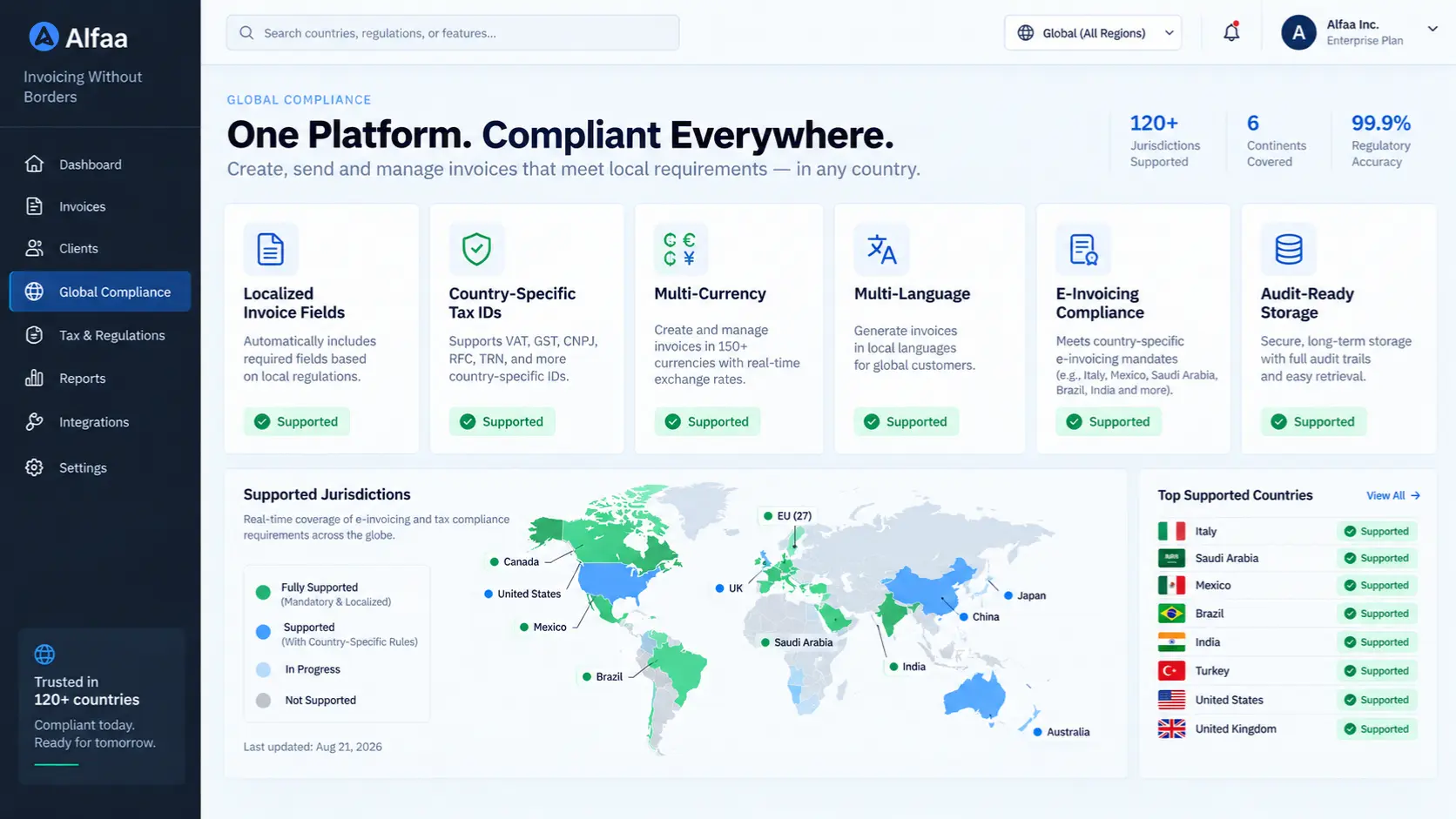
Localized formatting, not just translation: A compliant invoice needs the right fields in the right places for the destination country. A Turkish invoice needs a Vergi Dairesi field, and a UK invoice doesn't. Software that only translates a fixed template into another language will produce a document that looks right and still fails a compliance check.
Correct tax-ID labeling per country: The same concept goes by different names depending on jurisdiction VAT number, GSTIN, Partita IVA, RFC, TRN, or VKN and using the wrong label or leaving the field generic is one of the more common reasons invoices bounce back from a client's accounts payable team.
Multi-currency and multi-language output from a single source: For a business billing clients across regions, the requirement isn't just "supports multiple currencies" it's whether the platform can generate the invoice in the buyer's required language and currency while keeping your own records in your base currency for accounting.
Awareness of e-invoicing mandates, not just PDF generation: A growing share of the world (Italy, Saudi Arabia, India, most of Latin America, and now Turkey since 2014) requires invoices to be cleared or reported through a government platform before they're legally valid. A tool that only produces a polished PDF doesn't solve for a market where a PDF alone has no legal standing.
Audit-ready record retention: Retention periods range from three years in parts of the US to ten years in Germany, Italy, and Turkey. Software that stores invoices indefinitely by default removes one more thing to track manually per jurisdiction.
Consistent application of registration thresholds: VAT/GST registration thresholds differ by country and change periodically. The point isn't that software should replace your accountant's judgment, but that it should flag when a transaction crosses into new tax obligations rather than applying a single fixed rule everywhere.
For agencies, consultants, and small teams billing clients in a handful of countries rather than dozens, the practical bar is narrower: consistent required-field formatting, clear tax breakdowns, and records that hold up if a client's finance team asks a question. Start with a free invoice generator that gets those basics right before evaluating anything more complex.
How Technology Helps with Global Invoice Compliance
Modern invoicing software simplifies compliance across regions.
Key benefits include the following:
Automated tax calculations based on location
Built-in country-specific invoice fields
Integration with accounting and tax systems
An online invoice generator combined with invoice automation software ensures every invoice meets required standards.
Conclusion
Understanding invoice requirements by country is essential for any business working internationally.
Compliance is not optional. Incorrect invoices can delay payments, create tax complications, and damage credibility.
By using structured processes and modern invoice management software, businesses can ensure accuracy, consistency, and compliance across regions.
Staying updated with regulations and leveraging automation will help you scale globally without financial friction.
Frequently Asked Questions
Each country has its own tax system, legal framework, and reporting requirements, which influence how invoices must be structured.
Most invoices require details such as invoice number, date, seller and buyer information, tax identification numbers, itemized charges, tax breakdown, and total amount.
Yes, in most cases. VAT, GST, or TIN numbers are required for compliance, especially in cross border transactions.
Yes, and in many countries they are becoming mandatory as part of government tax compliance systems.
The best billing system is one that can handle country-specific invoice fields, tax calculations, currencies, compliance requirements, and organized invoice records. For businesses operating across multiple jurisdictions, automation can help maintain consistency while adapting invoices to local requirements.
Invoicing requirements vary because countries have different tax systems, legal frameworks, accounting regulations, and reporting standards. Some use VAT, others GST or sales tax, and governments may also require different invoice fields or digital reporting formats.
A suitable multi-region invoicing or compliance system can help businesses apply country-specific invoice fields and tax requirements. The article notes that invoices in the UAE and parts of the Middle East may require bilingual Arabic and English formats.
Yes. Invoice requirements can include legally relevant information such as invoice numbers, dates, seller and buyer details, tax identification numbers, tax amounts, and totals. The exact requirements depend on the country and transaction type.
The article does not provide statistics comparing the number of invoices issued by individual cities or countries. It focuses on invoice requirements and compliance rules across major regions rather than invoice-volume data.
An international invoice typically includes the invoice number, invoice date, seller and buyer details, tax identification numbers, itemized goods or services, quantities, unit prices, tax information, total amount payable, and the currency used.
A CFO should evaluate whether the platform supports country-specific invoice fields, automated tax calculations, compliance tracking, organized records, multiple currencies, and integrations with accounting or tax systems. Automation should also reduce manual errors and improve consistency across jurisdictions.

Olivia Bennett
Content Writer @ Alfaa
Olivia is a content writer at Alfaa who specializes in invoicing, small business, and productivity topics. She enjoys simplifying complex ideas into clear, practical insights that help business owners save time, get paid faster, and stay organized.