Invoice vs Receipt vs Bill: Key Differences Every Business Should Know
By Alfaa Team
Stay in the loop
Get finance tips delivered to your inbox.
Invoices, receipts, and bills are everyday business documents, yet they are often misunderstood or used interchangeably. Many business owners assume they all mean the same thing because they are connected to payments. In reality, each serves a very specific purpose at a different stage of a transaction.
Using the correct document improves payment clarity, strengthens record-keeping, and presents a more professional image to customers and clients. It also reduces accounting errors and avoids unnecessary disputes.
In this article, we will clearly explain what invoices, receipts, and bills are, how they differ, and when businesses should use each one in real-world scenarios.
What Is an Invoice?
An invoice is a formal request for payment sent by a seller to a buyer. It lists what was sold, how much is owed, and when payment is due.
When you use an invoice:
Before payment is made
In B2B transactions, freelancing, and consulting
When payment is expected after you deliver goods or finish a service
What an invoice needs:
A unique invoice number
Seller and buyer details
An itemized list of products or services
Payment terms and a due date
Total amount due, taxes included
Example: A freelance designer finishes a branding project and sends an invoice requesting payment within 15 days.
What Is a Receipt?
A receipt proves payment already happened. It confirms the buyer settled what they owed for specific goods or services.
When you use a receipt:
After payment completes
For the buyer's records, your accounting, and tax filing
In both B2B and consumer transactions
What a receipt needs:
A receipt number
The date payment was made
Payment method used
Amount paid
Seller information
Example: A customer pays for groceries and gets a receipt at checkout seconds later.
What Is a Bill?
A bill requests immediate payment, usually presented at the point of sale or right after a service is delivered. People often use "bill" and "invoice" as synonyms, but a bill implies the money is due now, not in 15 or 30 days.
When you use a bill:
During or just before payment
In retail, restaurants, utilities, subscriptions, and hospitality
What a bill needs:
A description of goods or services
Total amount payable
A payment deadline, usually immediate
Example: A restaurant hands you the bill after your meal and expects payment before you leave.
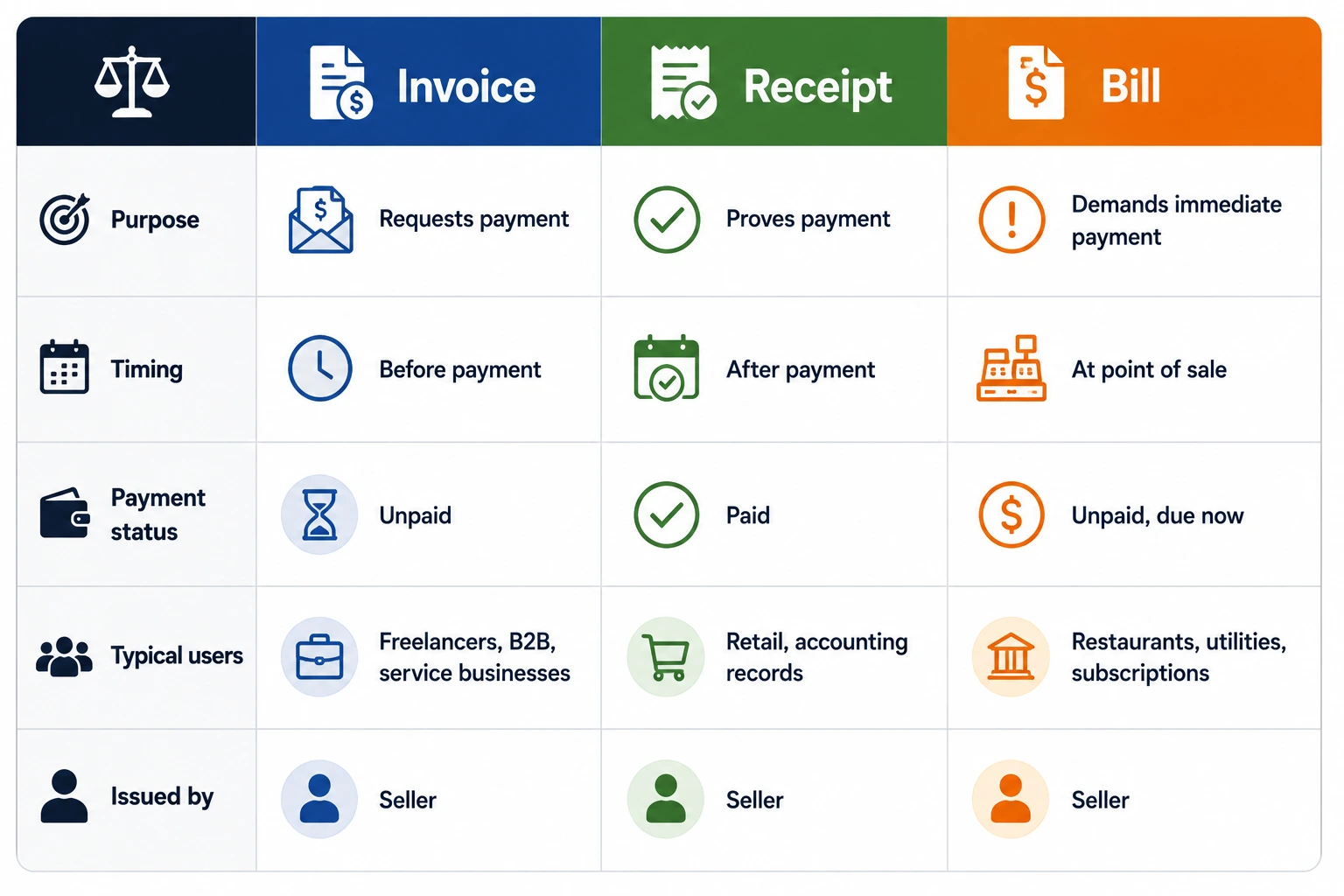
Invoice vs Receipt vs Bill: Side-by-Side Comparison
Why the Difference Matters for Your Business
Using the correct document does four things: it keeps your books accurate, speeds up payment because terms and due dates are clear, cuts down client confusion about what's paid versus owed, and makes tax season and audits considerably less painful.
The costliest mix-up is sending a receipt when you meant to send an invoice. That tells a client they've already paid you when they haven't, and that conversation is never fun to have.
Which One Should Your Business Use?
Service-based businesses issue an invoice first, then a receipt once payment lands.
Product-based businesses issue a bill at checkout, then a receipt once payment clears.
Freelancers and agencies lean almost entirely on invoices and receipts, since most of their work runs on delayed payment terms.
Most businesses end up using all three. The distinction is knowing which one fits which moment in the transaction.
How Digital Invoicing Tools Simplify the Process
Manually managing three different documents across email and spreadsheets is where errors creep in. An invoice application handles the whole cycle in one place: you generate the invoice, the client pays through a link, and the system marks it paid and generates the receipt automatically. No manual reconciliation.
That same system gives you dashboard analytics so you can see, at a glance, which invoices are outstanding and which are settled, and client management tools so every document tied to a client lives in one record instead of scattered across email threads.
For businesses on retainers or subscriptions, recurring billing automates the invoice-to-receipt cycle every month without you touching it.
Common Mistakes Businesses Make
Sending a receipt instead of an invoice, which signals a payment that hasn't actually happened.
Skipping payment terms on an invoice, leaving the due date ambiguous and payment delayed as a result.
Confusing bills with invoices, especially in service businesses where "bill" gets used loosely for something that's really a 30-day invoice.
No digital record-keeping, which turns tax season into a scramble through old emails.
Ready to Stop Managing These Manually?
Alfaa generates the invoice, takes the payment, and issues the receipt automatically, all from one dashboard. Start Invoicing for Free
Frequently Asked Questions
A business should issue an invoice when requesting payment before it has been made, especially for services or B2B transactions.
Yes. Even small businesses benefit from using the correct documents to maintain accurate financial records and comply with regulations.
In many countries, invoices are legally required for tax and accounting purposes, especially for registered businesses.
Yes. Most modern invoicing tools automatically generate receipts once an invoice is marked as paid.
Digital invoicing improves accuracy, saves time, ensures secure storage, and provides real-time visibility into payments and records.

Olivia Bennett
Content Writer @ Alfaa
Olivia is a content writer at Alfaa who specializes in invoicing, small business, and productivity topics. She enjoys simplifying complex ideas into clear, practical insights that help business owners save time, get paid faster, and stay organized.