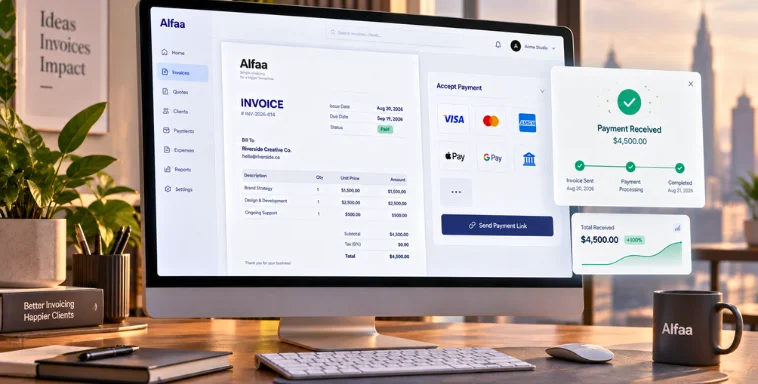
Invoice vs Receipt: Differences, Examples & When to Use Each
By Alfaa Team
Stay in the loop
Get finance tips delivered to your inbox.
Most freelancers and small business owners use the words "invoice" and "receipt" interchangeably. That single mistake can create confusion with clients, disrupt your records, and even create issues during tax filing.
The difference between an invoice and a receipt is more important than most businesses realize. One document requests payment. The other confirms that payment has already been made.
Both play completely different roles in your billing process, and understanding when to use each is essential for maintaining professional financial records.
In this guide, you will learn exactly how invoices and receipts differ, when to use them, examples of each, and how to manage both efficiently without manual admin work.
Quick Summary
An invoice is sent before payment to request money owed for goods or services
A receipt is issued after payment to confirm the transaction is complete
Both documents serve different purposes in accounting and client communication
Mixing them up can create bookkeeping errors and payment disputes
Most consultants, freelancers, and agencies need both in their invoicing workflow
Invoice vs Receipt: The Quick Answer
An invoice requests payment. A receipt confirms payment.
If you complete a project or deliver a service, you send an invoice to inform the client how much they owe and when payment is due.
Once the client pays, you issue a receipt confirming the payment was received.
Think of it this way:
The invoice asks for payment
The receipt confirms payment happened
Both documents are important for maintaining accurate financial records and professional communication.
What Is an Invoice?
An invoice is a formal billing document sent before payment is received.
It outlines:
Services or products delivered
Total amount due
Payment deadline
Payment terms
Invoices are commonly used when:
A project has been completed but payment is still pending
A consultant bills clients monthly
Businesses offer Net 15 or Net 30 payment terms
A formal financial record is required
What Should an Invoice Include?
A professional invoice should contain:
Invoice number
Invoice date
Due date
Business details
Client details
Itemized list of services or products
Tax breakdown such as GST or VAT
Total amount due
Payment methods or payment links
If your business is GST registered in India, invoices must also include GSTIN numbers and tax breakdown details.
Example
A freelance designer completes a branding project and sends the client an invoice for ₹25,000 payable within 15 days.
At this stage, payment has not been made yet. The invoice acts as a formal payment request.
What Is a Receipt?
A receipt is a document issued after payment has been received.
It confirms that money changed hands and the transaction is complete.
Receipts are commonly used when:
Clients pay immediately
Outstanding invoices are settled
Clients request proof of payment
Businesses need records for accounting or tax purposes
What Should a Receipt Include?
A standard receipt usually contains:
Receipt number
Payment date
Business details
Client details
Description of products or services paid for
Amount paid
Payment method
Signature or company stamp if required
Example
The same designer receives ₹25,000 from the client and issues a receipt confirming payment was received on that date.
The client now has formal proof of payment.
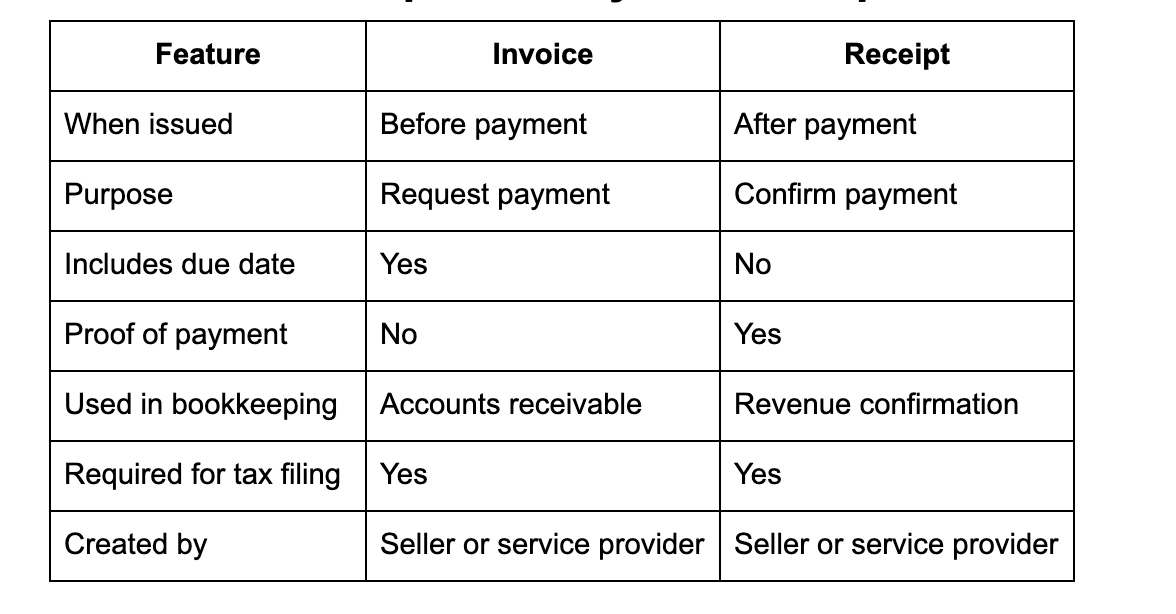
Invoice vs Receipt: Side-by-Side Comparison
When to Send an Invoice vs a Receipt
Understanding timing is where many freelancers and small businesses get confused.
Send an Invoice When:
You complete a project and need payment
You bill clients on a monthly retainer
You deliver services before payment
You want formal payment terms
You need accounts receivable records
Issue a Receipt When:
A client pays immediately
An invoice is fully paid
A client requests proof of payment
You complete a retail-style transaction
The Most Common Workflow
Step 1: Complete the work
Step 2: Send the invoice
Step 3: Client pays
Step 4: Issue the receipt
Step 5: Mark invoice as paid
This workflow keeps your records organized and your payment trail clean.
Can an Invoice Act as a Receipt?
This is a common question.
Technically, a standard invoice cannot act as a receipt because invoices are issued before payment is made.
However, once an invoice is marked as “Paid” and includes the payment date and method, it can function as a combined billing and payment record.
This often happens when:
Clients request a paid invoice instead of a separate receipt
Invoicing software automatically timestamps payment confirmation
Businesses use digital invoicing systems with payment tracking
Best practice is still to issue a separate receipt when clients explicitly request proof of payment.
With Alfaa, invoices can automatically update to paid status while maintaining a clear payment history.
What Happens If You Mix Them Up?
Using invoices and receipts incorrectly creates real operational problems.
Sending a Receipt Before Payment
Clients may assume payment has already been processed, which delays collections.
Not Issuing Receipts
Clients lose formal proof of payment, increasing the risk of disputes.
Using Invoices as Receipts for Tax Records
This can create confusion during audits, especially if payment dates are unclear.
Missing Invoice Numbers
Without structured invoice numbering, reconciliation becomes difficult.
Using invoice management software helps avoid these issues entirely.
How to Create Professional Invoices Instantly
Managing invoices manually through Word documents or spreadsheets quickly becomes inefficient.
Alfaa is built for freelancers, consultants, agencies, and small businesses that want a simpler invoicing workflow.
With Alfaa, businesses can:
Generate professional invoices instantly
Mark invoices as paid automatically
Instead of juggling spreadsheets and email threads, everything stays organized in one platform.
Conclusion
The invoice vs receipt difference becomes simple once you understand their purpose.
Invoices request payment. Receipts confirm payment.
Both are essential for maintaining professional financial records, improving client communication, and simplifying tax reporting.
The easiest way to manage both documents is through invoicing software that tracks the full payment lifecycle automatically.
With the right system in place, businesses can eliminate confusion, reduce manual admin work, and maintain a clean financial workflow.
Ready to simplify your invoicing process? Alfaa makes it easy to create, send, track, and manage invoices and receipts from one place.
Frequently Asked Questions
An invoice requests payment before money is received. A receipt confirms payment after the transaction is completed.
Not exactly. A paid invoice can function similarly if payment details are included, but a separate receipt is still recommended for clear proof of payment.
Yes. Invoices request payment, while receipts confirm payment. Using both keeps records accurate and professional.
Invoices show what payment was requested. Receipts provide proof that payment was actually completed.
Clients may lack formal proof of payment, which can create disputes or accounting complications later.

Olivia Bennett
Content Writer @ Alfaa
Olivia is a content writer at Alfaa who specializes in invoicing, small business, and productivity topics. She enjoys simplifying complex ideas into clear, practical insights that help business owners save time, get paid faster, and stay organized.