
Recurring Invoices vs. One-Off Billing: Which Is Right for Your Retainer Clients?
By Alfaa Team
Stay in the loop
Get finance tips delivered to your inbox.
Introduction
Winning a client is only half the battle. Choosing the right way to bill them is just as important.
The billing method you choose directly affects your cash flow, client experience, and the amount of time you spend on administration every month.
Many agencies, consultants, independent contractors, and service businesses struggle with a common question:
Should I create invoices manually every month, or should I automate recurring billing?
The answer depends on the type of work you're doing.
Project-based engagements usually require one-off invoices, while long-term client relationships often benefit from recurring invoicing.
Understanding when to use each approach can save hours of administrative work while creating a more predictable revenue stream.
What Is One-Off Billing?
One-off billing means creating a new invoice manually every time work is completed.
Each invoice is unique and typically reflects the scope of an individual project.
The invoice amount may vary depending on:
Hours worked
Project scope
Deliverables completed
Additional revisions
Clients usually review and approve the work before the invoice is issued.
Common Examples of One-Off Billing
One-off billing works well for businesses providing unique or project-based services such as:
Website design
Logo design
Photography
Business consulting projects
Home repairs
Construction work
Each engagement is different, making manual invoicing the more practical option.
What Are Recurring Invoices?
Recurring invoices are invoices that are automatically generated and sent at predefined intervals.
Instead of creating the same invoice every month, the invoicing system handles it automatically.
Recurring billing can be scheduled:
Weekly
Monthly
Quarterly
Annually
This works best when pricing and services remain consistent over time.
Common Examples of Recurring Invoices
Recurring billing is ideal for businesses offering ongoing services such as:
Marketing retainers
SEO services
Bookkeeping
Virtual assistant services
IT support
Website maintenance
Subscription services
Once the recurring invoice is configured, billing continues automatically until the schedule is updated or stopped.
A Third Option: Installment Billing
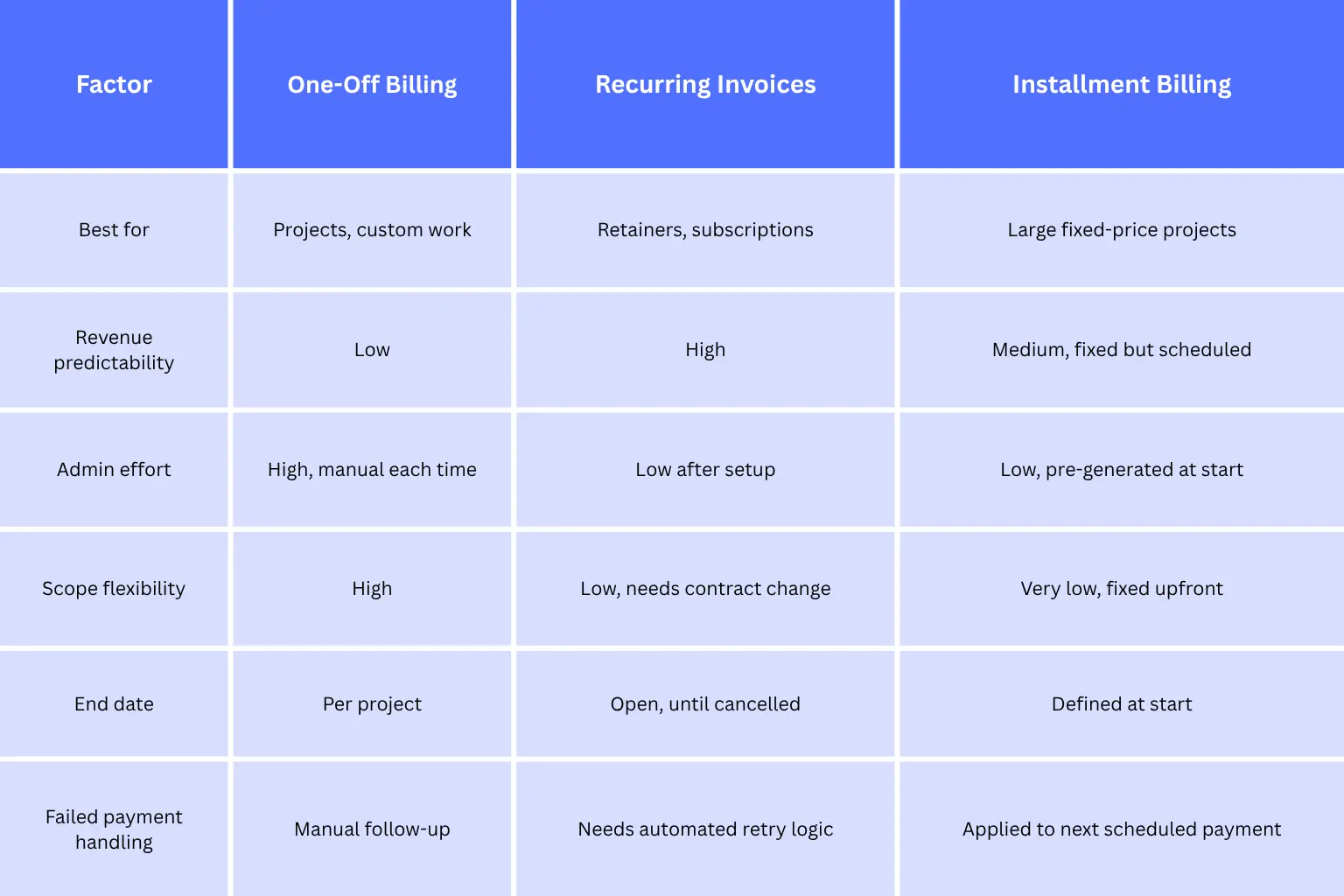
Most comparisons stop at recurring versus one-off, but a third model solves a specific problem neither handles well: a large, fixed-price project that needs to be paid in structured pieces rather than one lump sum or an open-ended recurring schedule.
Installment billing splits a fixed total amount into scheduled partial payments across a defined period, the contract amount, number of payments, and end date are all set upfront. Unlike recurring billing, which is open-ended until cancelled, installment billing has a known finish line. This fits large website builds, big consulting engagements, or any project where a client needs payment flexibility but you need the full amount guaranteed rather than billed and collected ad hoc as work progresses.
Recurring Invoices vs. One-Off Billing: The Key Differences
The biggest difference between these billing methods is how invoices are created.
With one-off billing, every invoice is prepared manually after work is completed. This offers maximum flexibility because pricing and project scope can change with each engagement. However, it also requires more administrative work and increases the risk of forgetting to send invoices.
Recurring invoices work differently. Once the billing schedule is configured, invoices are generated automatically at regular intervals. They are ideal for retainers, subscriptions, and ongoing service agreements where pricing remains consistent. This approach reduces manual work, minimizes billing errors, improves cash flow predictability, and lowers the risk of missed invoices.
Why the Cash Flow Difference Is Bigger Than It Sounds
"Recurring billing improves cash flow" is true, but the actual effect is easier to see with numbers than as a general claim. Picture two businesses billing $180,000 a year, one entirely through one-off project invoices, the other with 60% of revenue on recurring retainers. The project-only business might see months where revenue lands at $9,000 and others at $34,000, with the same annual total, wildly different monthly experiences. Fixed costs like payroll and software subscriptions don't fluctuate with that swing, which is what actually creates the cash flow stress people associate with project-based billing. The recurring-heavy business sees the same annual total arrive in far more even monthly amounts, which is the real argument for recurring billing beyond "clients pay more reliably."
When Should You Use One-Off Billing?
One-off billing is the better option when every project is different.
Unique Projects
Projects with custom pricing should always be invoiced individually.
Milestone-Based Work
Large projects are often billed after completing specific phases or milestones.
Variable Scope
If the amount of work changes frequently, manual invoices allow pricing to remain accurate.
Custom Consulting
Consulting engagements where hours vary significantly each month are generally better suited for one-off billing.
When Are Recurring Invoices the Better Choice?
Recurring invoices work best when businesses deliver ongoing services for a fixed fee.
Examples include:
Monthly marketing retainers
SEO services
Ongoing consulting
IT support
Managed services
Accounting
Virtual assistant services
Membership programs
Maintenance contracts
Because invoices are generated automatically, businesses eliminate repetitive administrative work while maintaining consistent billing schedules.
Clients also appreciate receiving invoices on predictable dates every month.
Benefits of Recurring Invoices
Save Hours Every Month
Recurring billing removes the need to recreate the same invoice repeatedly.
Once configured, invoices are generated automatically.
Improve Cash Flow
Invoices are sent on time every billing cycle.
This creates more consistent payment schedules and healthier cash flow.
Reduce Billing Errors
Automation reduces manual data entry, calculation mistakes, and forgotten invoices.
Improve the Client Experience
Clients receive professional invoices consistently without delays or inconsistent formatting.
Easier Revenue Forecasting
Businesses with recurring retainers can predict monthly revenue much more accurately.
Advantages of One-Off Billing
Recurring billing is not always the right answer.
One-off billing provides several important benefits.
Greater Flexibility
Every invoice can reflect the exact work completed.
Easier Scope Changes
Additional work, revisions, and project changes can be billed without modifying recurring schedules.
Better for Custom Pricing
Businesses charging different rates for every engagement benefit from manual billing.
Ideal for Occasional Clients
One-off billing keeps invoicing simple for clients who only require services occasionally.
What Happens When a Recurring Payment Fails?
This is the operational question every recurring billing setup eventually runs into, and it's genuinely different from a one-off invoice simply being late. A card on file can expire, a bank account can have insufficient funds, or an authorization can lapse without any action from the client at all.
The difference in handling matters:
A one-off invoice going unpaid is a collections conversation, you follow up, possibly apply a late fee, and the invoice stays open until resolved.
A failed recurring charge needs a retry sequence, attempt the charge again after a few days, notify the client of the specific reason it failed (expired card versus insufficient funds calls for different messaging), and flag the account if it fails repeatedly rather than letting it silently skip a billing cycle.
Without this retry logic built in, a failed recurring payment can go unnoticed for a full cycle or more, quietly compounding into a larger collections problem than a single late one-off invoice would have been.
Pausing and Cancelling Recurring Arrangements
Recurring billing needs answers to two questions before the first invoice ever generates, not after a client asks: what happens if the client wants to pause, and what's the required notice period to cancel?
Handle both by adjusting the billing schedule directly rather than manually skipping or deleting an invoice, a paused recurring profile should resume cleanly on the agreed date, and a cancelled one should stop generating without leaving a gap or duplicate in your invoice numbering. Alfaa's guide to invoice types covers how to keep numbering clean when a recurring sequence is interrupted rather than running straight through.
Scope Creep on a Fixed Retainer
The most underappreciated risk in recurring billing isn't a failed payment, it's scope creep that never gets billed. When a client knows the invoice arrives on the first of the month regardless of what they ask for, there's a natural tendency to ask for more over time. If the retainer scope isn't clearly defined and reviewed periodically, you can end up doing meaningfully more work for the same flat fee, month after month, without ever formally renegotiating it.
A quarterly review of what's actually being delivered against what the retainer was originally scoped for catches this before it becomes a pattern rather than a one-off favor.
Keeping Invoice Numbering Clean Across Mixed Billing
Once a client base mixes one-off, recurring, and installment invoices, numbering can get messy fast, especially if a recurring sequence pauses, a project invoice gets issued out of order, or you're running more than one billing type through the same client record. Alfaa's invoice automation guide covers keeping a single, consistent numbering scheme across every billing type rather than letting each one drift independently.
Recurring Billing for International Clients
A recurring arrangement with an international client needs periodic rechecking that a one-off invoice doesn't. If the client relocates, if exchange rates shift meaningfully between the setup and a later billing cycle, or if their tax registration status changes, a recurring invoice generated on autopilot can quietly carry forward outdated information for months before anyone notices. Alfaa's guides to invoicing an international client without a local bank account and multi-currency invoicing cover what needs to stay current on an ongoing cross-border billing relationship, worth a periodic check on any recurring international client rather than assuming the original setup still applies indefinitely.
Does Billing Structure Change the Client Relationship?
Worth naming even though it rarely gets discussed: a recurring arrangement can read to a client as more of a subscription commitment, something they'll periodically reconsider renewing, while a one-off invoice reads as pay-per-value, tied directly to a specific deliverable they already have in hand. Neither framing is inherently better, but it's worth being deliberate about which one you're setting up, since a client who feels like they're "subscribed" to a service they haven't actively evaluated in months is a real churn risk, while a client billed purely per-project may never get the chance to think of the relationship as ongoing at all.
Common Billing Mistakes Businesses Make
Choosing the wrong billing method often creates unnecessary administrative work. Some common mistakes include:
Forgetting to send invoices
Sending invoices several days or weeks after completing work
Using recurring invoices for projects with constantly changing pricing
Creating manual invoices every month for long-term retainer clients
Never reviewing recurring invoice schedules after pricing changes
Treating a recurring arrangement as "set and forget" without a periodic scope or price review
Avoiding these mistakes helps businesses improve both cash flow and client satisfaction.
How Automation Makes Retainer Billing Easier
Managing multiple retainer clients manually quickly becomes difficult. Invoice automation simplifies the entire process by handling repetitive billing tasks automatically. Modern invoice management software can:
Generate recurring invoices automatically
Schedule invoice delivery
Manage client information centrally
Provide revenue visibility through dashboards
Instead of spending hours every month recreating invoices, businesses can focus on serving clients while the billing process runs automatically. Platforms like Alfaa make recurring billing simple by automating invoice generation while giving businesses complete visibility into every billing cycle. For a deeper look at the fundamentals of how recurring invoices actually work, Alfaa's recurring invoices guide covers the setup mechanics in more detail.
Should You Combine Both Billing Methods?
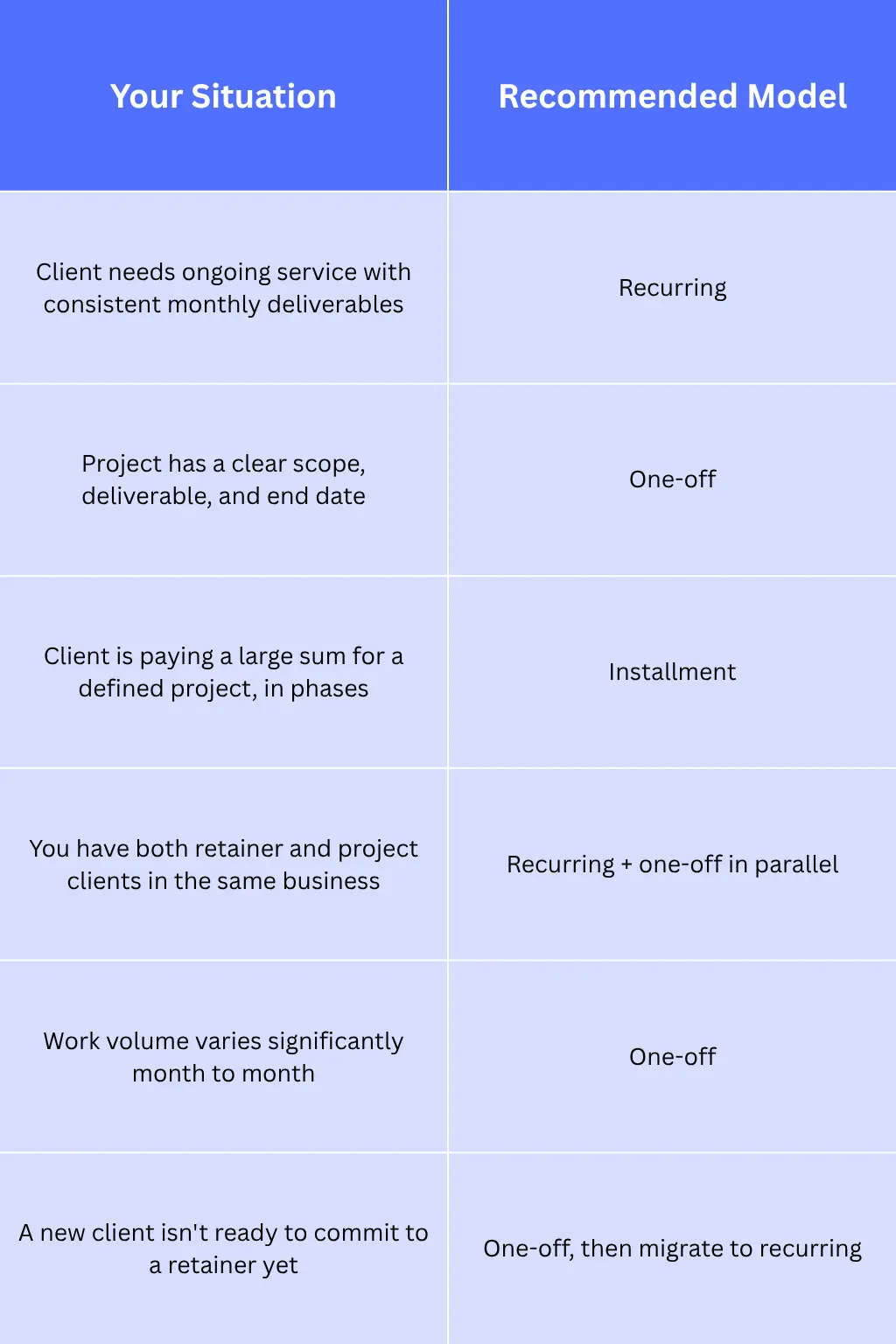
Absolutely. Many businesses use both billing methods depending on the client relationship.
For example:
A marketing agency might send a one-off invoice for an initial website redesign before moving the client onto a recurring monthly marketing retainer.
A consultant may invoice separately for a strategy workshop but use recurring invoices for ongoing advisory services.
A software developer might charge a one-time development fee while using recurring invoices for maintenance and support.
An accountant may create one-off invoices for annual tax filing while billing bookkeeping services monthly.
Using both methods allows businesses to remain flexible while automating repetitive billing wherever possible. If a client is coming back for repeat work, the conversation about moving them onto a retainer is worth having during or right after the project wraps up, not months later once the pattern of repeat one-off invoices is already well established.
A Framework for Deciding
Conclusion
There is no single billing method that works for every business.
One-off billing is ideal for project-based work where pricing and scope change regularly. Recurring invoices are the better choice for ongoing services, retainers, and subscription-style engagements because they reduce administrative work, improve consistency, and create more predictable cash flow. Installment billing fills the gap for large, fixed-price projects that need structured payments without an open-ended commitment.
Many agencies, consultants, independent contractors, and service businesses benefit from combining all three approaches. The right invoice management software gives you the flexibility to handle custom projects while automating recurring billing, helping you save time, reduce manual work, and build a more efficient billing process.
Frequently Asked Questions
Yes. Most modern invoicing platforms allow you to review and edit recurring invoices before they are automatically sent to clients.
Yes. Independent contractors who work on monthly retainers or provide ongoing services can save significant time by automating recurring billing.
Yes. Recurring invoice schedules can usually be paused, updated, or cancelled whenever client agreements change.
If your pricing changes, simply update the recurring invoice template before the next billing cycle so future invoices reflect the new amount.
Yes. Because invoices are generated and sent consistently, recurring billing helps businesses maintain more predictable revenue and reduces the risk of missed invoices.
Absolutely. Many businesses use recurring invoices for ongoing services while issuing separate one-off invoices for additional projects, consulting sessions, or change requests.

Olivia Bennett
Content Writer @ Alfaa
Olivia is a content writer at Alfaa who specializes in invoicing, small business, and productivity topics. She enjoys simplifying complex ideas into clear, practical insights that help business owners save time, get paid faster, and stay organized.