Best Currency to Invoice In When Your Client Is in a Weaker-Currency Country
By Alfaa Team
Stay in the loop
Get finance tips delivered to your inbox.
Most currency advice for international invoicing assumes every client sits somewhere on the same mild spectrum: their currency might drift 2 or 3% against yours while an invoice is outstanding, so pick whichever currency is more convenient and move on. That advice works fine for a client in Germany or Japan. It breaks down completely for a client in a country where the currency can lose double-digit value in a single year, where a black-market exchange rate trades meaningfully apart from the official one, or where the government restricts how much hard currency anyone can legally convert and send abroad.
None of that is a variation on normal FX risk. It's a different risk profile, and it calls for a different answer than "bill in whichever currency you prefer".
What actually makes a currency "weaker," in a way that matters here
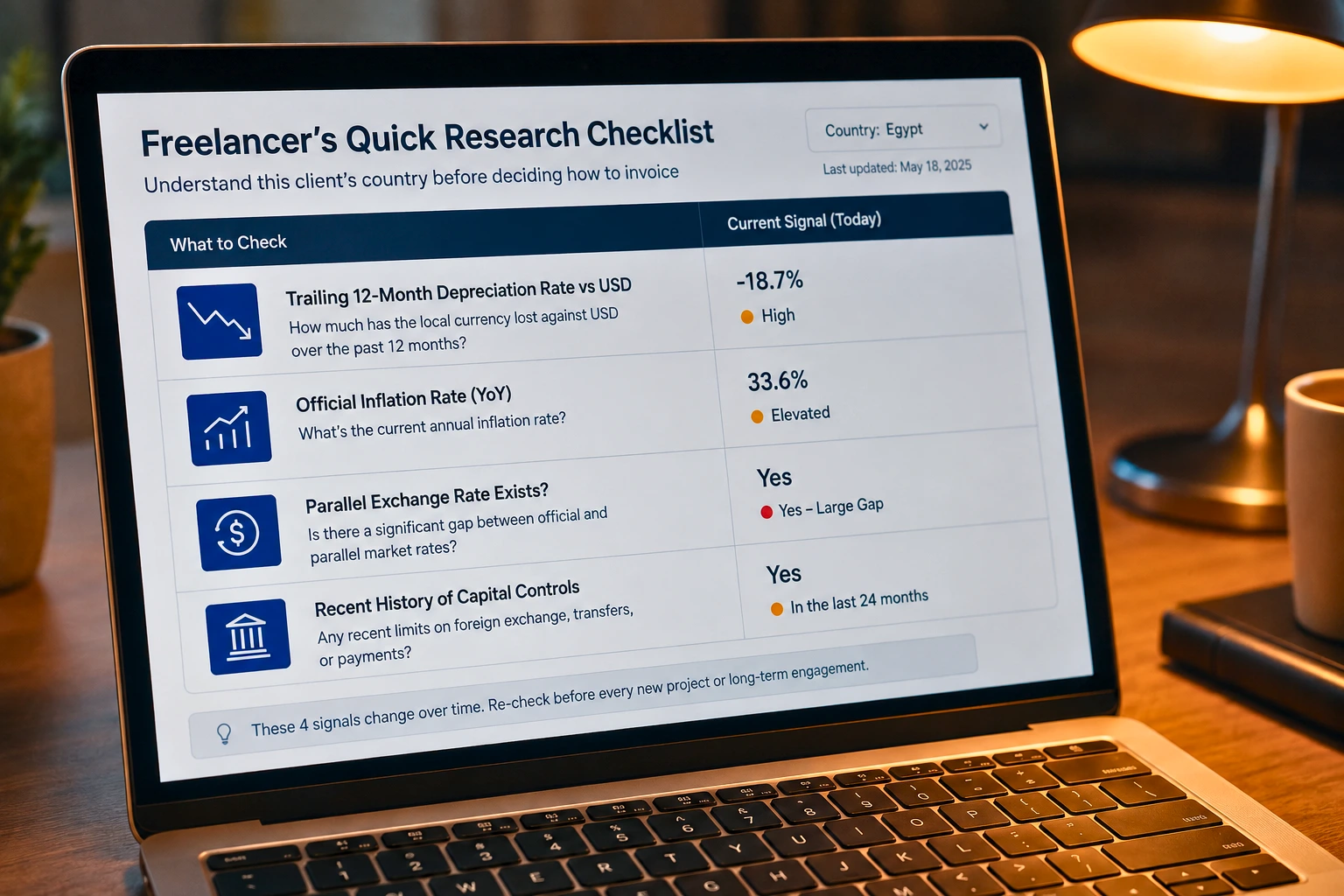
"Weaker currency country" isn't a fixed list, and any article that hands you one is giving you something that goes stale within a year, sometimes within months. What's worth checking instead, for any client's country, before you decide how to invoice:
Trailing 12-month depreciation against USD or EUR. A currency that's lost 10%+ of its value in the past year behaves differently from one that's held roughly flat.
Official inflation rate. High inflation and currency depreciation usually move together, and a country running 20%+ annual inflation is a signal on its own.
Whether a parallel or "black-market" exchange rate exists. If ordinary people and businesses in that country routinely reference an unofficial rate alongside the official one, that gap tells you the official number isn't the full story.
Recent history of capital controls. Has the government limited how much foreign currency individuals or businesses can legally buy or send abroad in the last few years, even if those limits are currently relaxed?
A quick search for "[country] currency controls" or "[country] inflation rate" alongside the current year answers all four in a few minutes. Do this before quoting a new client in an unfamiliar country, not after the invoice is overdue.
Why a fixed list of "risky countries" doesn't hold up: Argentina as the case study
Argentina is the clearest illustration of why checking current status matters more than memorizing a list. The country's currency controls, known locally as the cepo, had restricted access to US dollars for years. In April 2025, the government lifted most of those controls, and the official, MEP, and parallel "blue dollar" rates converged to within a few percentage points of each other for the first time in years. Then, in September 2025, the government partially reinstated restrictions for individuals. By early 2026, the exchange rate gap had stayed narrow, but annual inflation was still running above 30%.
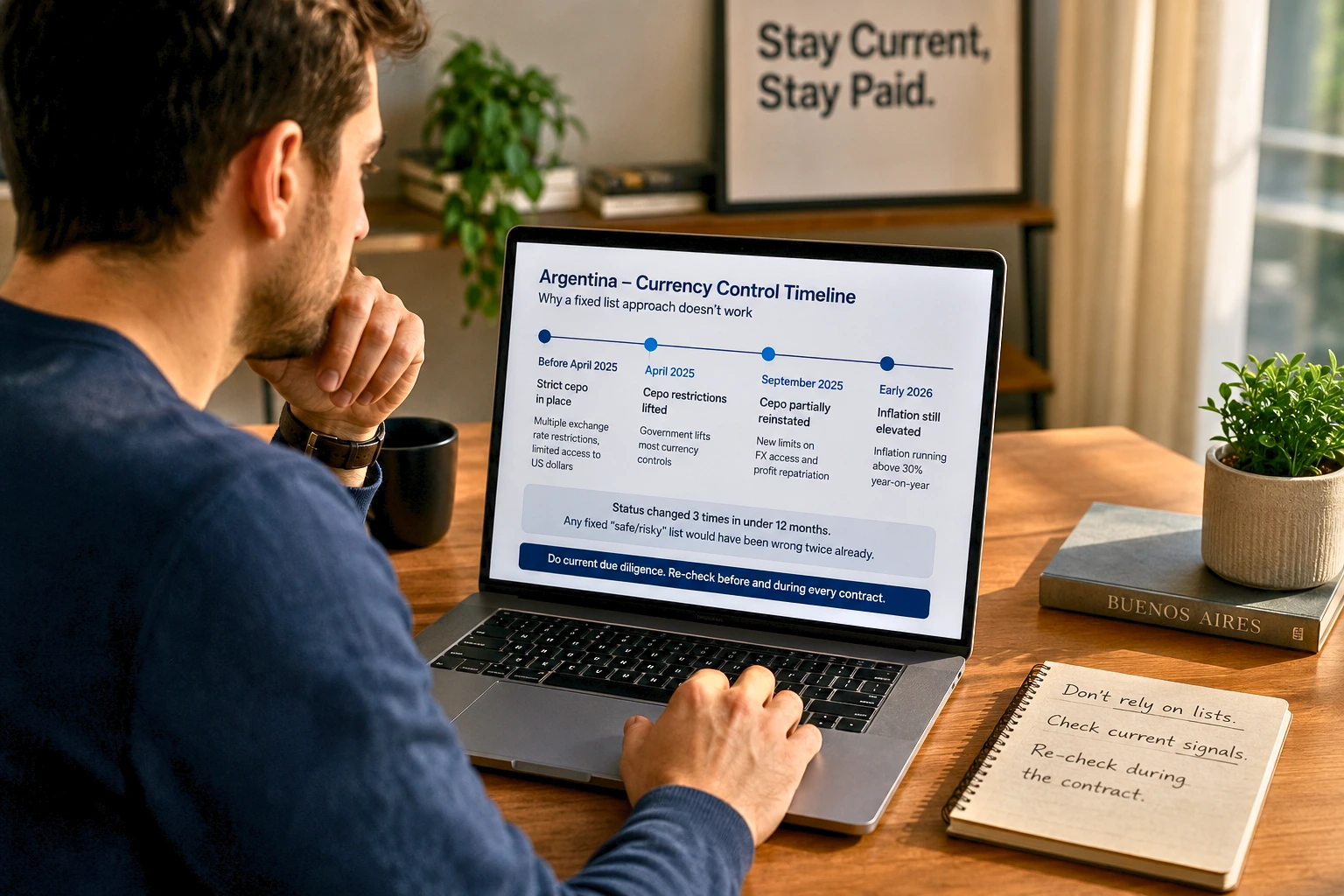
Strict controls, largely lifted and partially reinstated, still have high inflation, all inside about eighteen months. A country's status as "safe" or "risky" for this purpose can flip more than once while you're mid-contract with a client there. That's the actual argument for checking current conditions per client rather than trusting a static list, including any list in this article by the time you're reading it.
What real currency risk looks like, compared to the examples every guide uses
Most invoicing guides illustrate FX risk with a EUR/USD move of a few cents, a 2 to 4% swing over the life of an invoice. That's the right order of magnitude for two stable, freely traded currencies. It's the wrong order of magnitude once you're dealing with a currency running high annual inflation or depreciation.
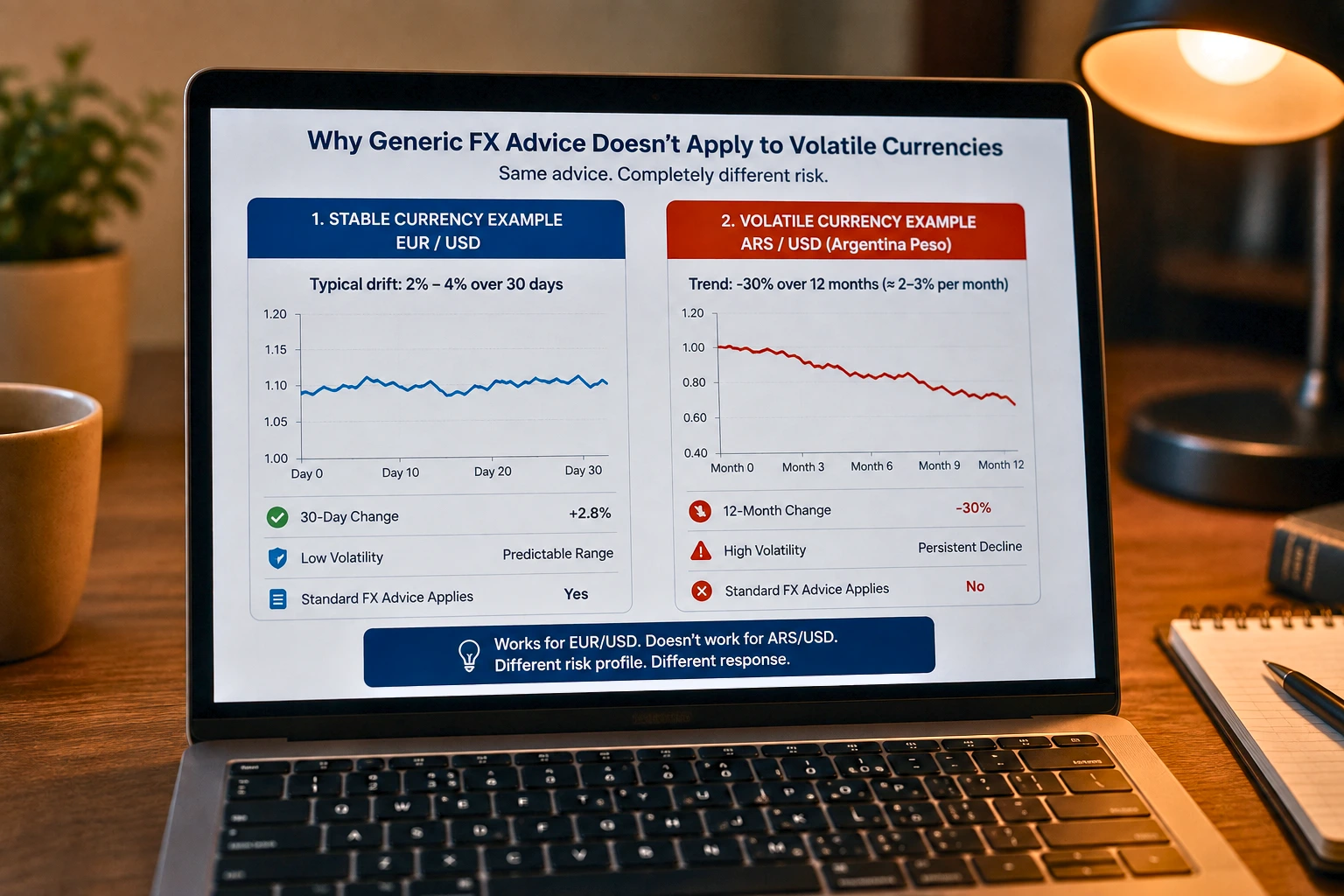
To put a rough number on it: a currency losing 30% of its value against the dollar over a year is losing roughly 2 to 3% of its value per month, all else equal. A Net 30 invoice sitting unpaid isn't risking a rounding error in that scenario; it's risking a meaningful chunk of the invoice's real value, and a Net 60 or a slow-paying client doubles that exposure. This is the gap that generic "state your exchange rate clearly" advice doesn't close, because it assumes the rate is moving gently, not sliding.
Does the client actually have a choice in what currency they pay you?
This is the question every generic currency guide skips entirely, and it matters more than which currency you'd prefer. In a country with active or recently active capital controls, a client may be legally restricted in how much foreign currency they can buy and send abroad, regardless of what you invoice in or what they'd prefer to pay you in. Asking "which currency works better for you" assumes the client is choosing freely between options. Sometimes they aren't.

Before assuming this is purely a negotiation, it's worth a direct, low-friction question to a new client in a country you're not familiar with: whether they can legally and practically send payment in USD or EUR, or whether local regulations make that difficult. Most legitimate clients running an international business already know the answer and won't find the question strange.
So which currency should you actually invoice in?
The standard framework (your currency, their currency, or a neutral reserve currency) still applies as a starting point, but a weaker-currency client adds a consideration none of the generic guides include: legal and practical access to hard currency.
If the client can freely access USD, EUR, or GBP: invoice in a stable reserve currency by default. The client-friendliness argument for invoicing in their local currency (reducing their conversion hassle) is real, but it's outweighed by the depreciation risk once the currency is genuinely volatile. This is the opposite of the generic advice most guides give, and it's the right call specifically because the risk profile is different.
If the client cannot easily access hard currency because of capital controls or a severely limited banking system, you may have no realistic choice but to invoice in their local currency or accept a payment method built for that corridor. In that case, the protections below (shorter terms, upfront payment, price buffers) matter more than the currency choice itself, because the currency choice is partly out of your hands.
A neutral reserve currency (USD/EUR) works as common ground in most cases where the client does have access, but it doesn't eliminate risk on its own. If the client has to source that currency through a parallel market at a worse rate than official, your "neutral" invoice just became more expensive for them than the number on the page suggests, which can quietly turn into a late payment or a difficult renewal conversation rather than a currency problem you can see coming.
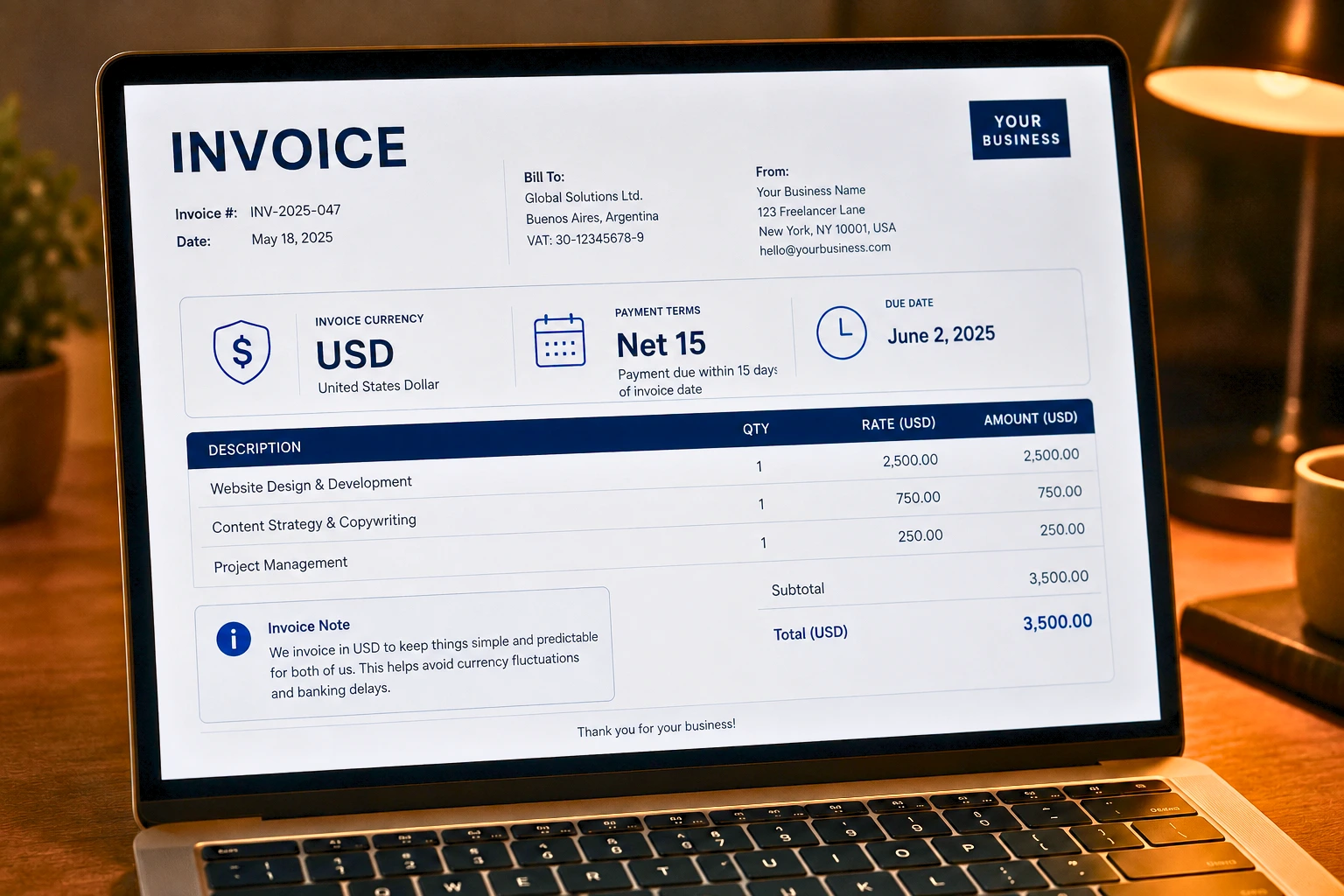
For the payment mechanics themselves, including which platforms actually clear reliably for a given corridor and what they cost, this guide on invoicing without a local business bank account covers that ground in more depth.
Shrinking the exposure window
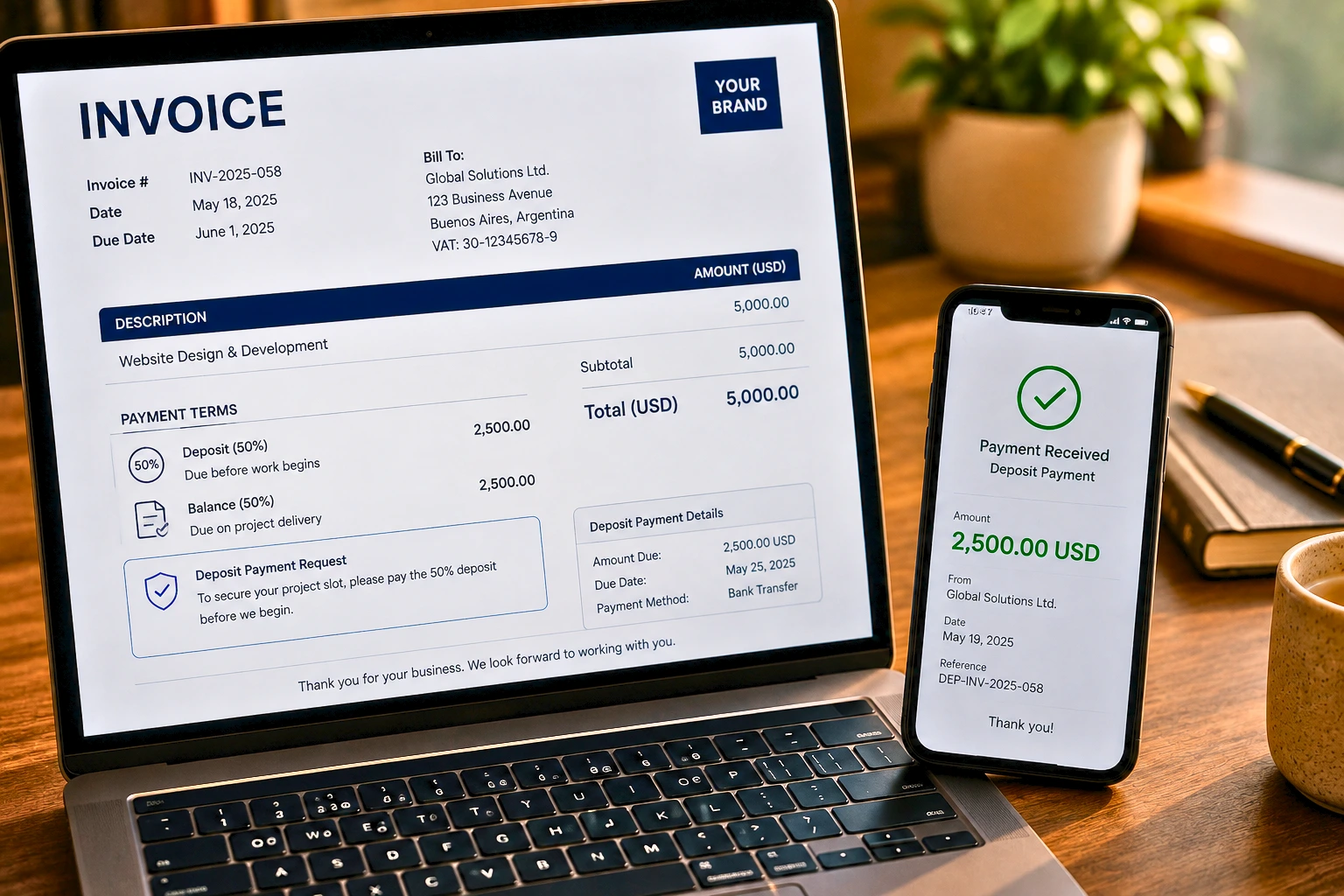
Since the core risk is time (value eroding while the invoice sits unpaid), the most reliable protection is reducing how long it sits unpaid at all:
Shorten payment terms. Net 30 is a reasonable default for a stable-currency client. For a client in a genuinely volatile-currency country, Net 7 or Net 15 meaningfully reduces exposure without being an unusual ask, especially if you explain why. Alfaa's glossary on invoice terminology covers how payment terms are typically structured if you want the exact phrasing.
Take an upfront deposit. A 30 to 50% deposit before work begins, with the balance due on delivery, cuts your exposed amount roughly in half and gets part of the payment locked in before much time has passed. For ongoing relationships, a deposit also gives you an early signal about whether the client can reliably access the currency you're invoicing in.
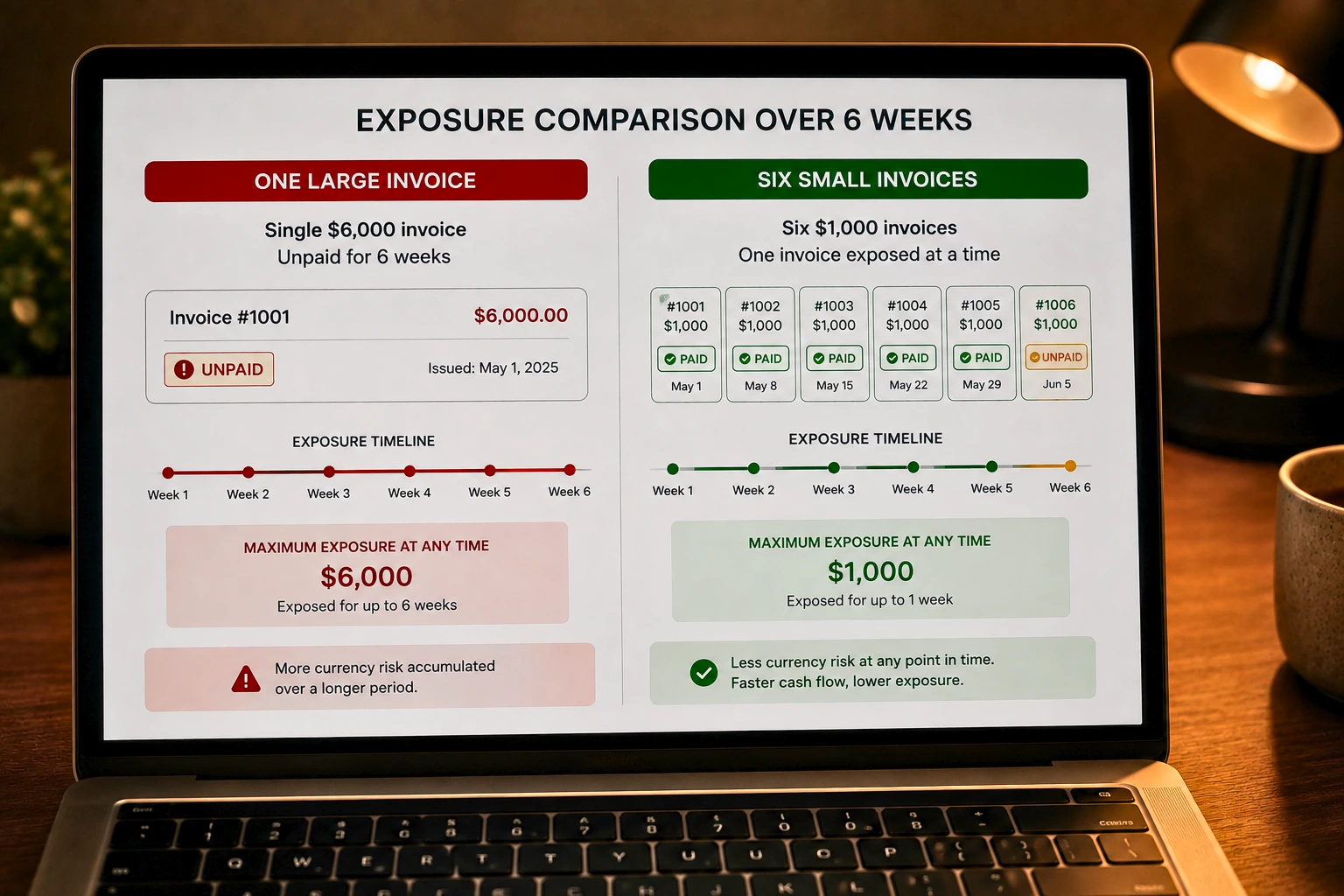
Bill more frequently, in smaller amounts, rather than one large invoice. A single $6,000 invoice sitting unpaid for six weeks carries more risk than six $1,000 invoices spread across the same period, since only a fraction of the total is ever exposed at once. Strategies for reducing late payments generally apply here too, and matter more when delay has a real cost attached beyond inconvenience.
Pricing retainers so they don't quietly erode
None of the standard guides address recurring work at all, and it's exactly where this problem compounds. A fixed monthly retainer priced in USD holds its value fine for you. But if the client's income is in a currency that's losing real value against the dollar, the effective local-currency cost of your retainer keeps rising even though your invoice number never changes. That's not immediately your problem until it quietly becomes one: budget pressure on the client's end that shows up months later as a scope renegotiation, a slow payment, or a client who simply doesn't renew.
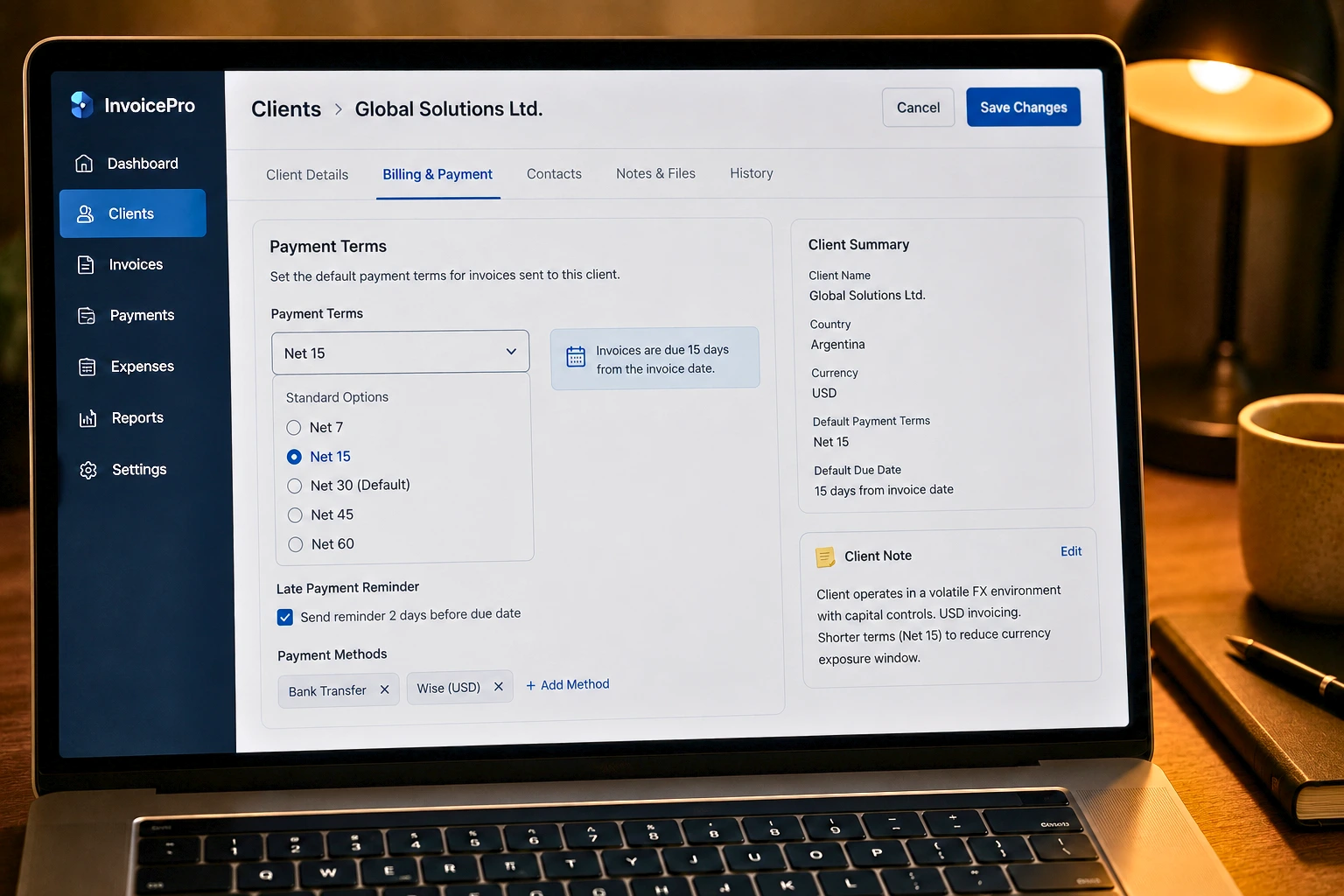
Building a periodic rate review into the contract, revisited every quarter or every six months rather than fixed for a full year, keeps both sides working from something closer to current reality instead of a number that made sense at signing and drifted away from it.
Raising the currency question without damaging the relationship
Every generic guide treats currency choice as a neutral logistics detail. With a client navigating real economic pressure in their own country, it isn't quite neutral, and how you raise it matters. A version that stays direct without being heavy-handed:
"For this project, I'll invoice in USD to keep things simple on both ends and avoid either of us absorbing exchange rate swings. If USD payments are difficult from your side for any reason, let me know and we can figure out what works."
This does two things: a flat "I only invoice in USD" policy doesn't; it states the reason plainly and it leaves room for the client to flag a real constraint (like restricted currency access) rather than reading the request as inflexible.
Keeping the rate documented, whichever way you land
Whatever currency you land on, write the exchange rate and its source directly on the invoice if there's any conversion involved, the same habit that protects both sides in ordinary cross-border billing. Alfaa's guide to multi-currency invoicing covers exactly how to document that rate and where the FX risk sits contractually between invoice date and payment date, which matters even more once the currency involved is a volatile one. Alfaa's client management tools keep a client's preferred currency and terms saved once you've worked this out, so a fast-moving situation with a specific client doesn't require re-deciding the approach on every new invoice.
Frequently Asked Questions
No, provided you explain the reason briefly. Most clients who work internationally already expect this and will find a short, direct explanation more reassuring than a policy stated without context.
Generally avoid it if the client has real access to a stable reserve currency. If they don't, because of capital controls or limited banking access, local currency may be the only workable option, in which case shorten payment terms and lean harder on an upfront deposit.
A quick, current search for "[country name] currency controls" or "[country name] capital controls" alongside the current year is the fastest check. Status changes often enough that anything older than a few months is worth re-verifying, as Argentina's history over the past two years shows.
It protects you from the currency depreciating in your hands after conversion, but it doesn't remove the client's side of the risk. If they have to source USD at a worse parallel-market rate, that cost lands on them, and it can turn into a late payment or a strained renewal instead of a currency loss you'd see directly.
No, they're unrelated questions. Currency choice is about exchange rate risk; tax treatment is about which jurisdiction's rules apply to the sale. This guide on sales tax for international invoices covers the tax question separately.

Olivia Bennett
Content Writer @ Alfaa
Olivia is a content writer at Alfaa who specializes in invoicing, small business, and productivity topics. She enjoys simplifying complex ideas into clear, practical insights that help business owners save time, get paid faster, and stay organized.