
Payment terms shape when money moves in a business deal. Clear terms help with cash flow management, lower risk, and make deals easier to close. They also affect early payment discounts, late payment fees, and payment method options.
From net 30 payment terms to flexible payment options, the right setup can support both buyer and seller. This guide covers common types, key risks, and simple payment term negotiation tips. It also shows what longer terms cost, which legal limits apply in the UK, EU, US, and India, and how to enforce terms after the due date.
What are payment terms?
Payment terms are the agreed rules for a sale. They tell the buyer when to pay, how to pay, and what happens if the bill is late.
Good payment terms cut confusion, support a clear payment schedule, and help keep cash flow steady.
Definition of Payment Terms
Payment terms are the basic rules for a business sale. They cover due date for invoices, payment method options, and any discounts or fees.
For example, net 30 means the bill is due 30 days after the invoice date. Net 60 gives more time. These terms help both sides plan money use and lower risk.
Importance of Payment Terms in Business
Payment terms affect cash flow, profit, and trust. When due dates are clear, companies can plan better and avoid late payments.
They also shape trade credit terms. With the right terms, a business can win more work, keep good clients, and put less strain on its own funds.
Key benefits of clear payment terms include:
Less late pay risk
Better cash flow management
More trust between buyer and seller
When Does the Payment Clock Start?
Net 30 sounds exact, but the count can start on three different dates: the invoice date, the date the client receives the invoice, or the date the work is delivered or accepted.
Many guides use "30 days from the invoice date" and "30 days from receiving the invoice" as if they mean the same thing. They do not. If an invoice sits unseen in a spam folder for six days, a receipt-based term gives the client those six days. An invoice-date term does not. Under the EU Late Payment Directive, the default period counts from receipt of the invoice when no due date is set.
Remove the doubt in two steps:
Print a fixed due date next to the net term, such as "Net 30, due December 15, 2026"
Name the event that starts the clock in your contract or statement of work
Delivery speed counts too. A late or misdirected invoice delays payment in practice, even when the contract says otherwise. How you send the invoice matters as much as the term printed on it.
Types of Payment Terms
Payment terms come in many forms. The best choice depends on the deal, the field, and each side's money needs.
Payment terms examples include net 30 payment terms, flexible payment options, milestone payment terms, and subscription payment models.
Businesses often use several common types. These include:
Net Payment Terms
Flexible Payment Options
Milestone Payment Terms
Subscription Payment Models
Net Payment Terms
Net payment terms give the buyer a set number of days to pay. They are common in business credit terms and make the payment schedule easy to follow.
Common net terms include net 30 payment terms, net 45 payment terms, net 60 payment terms, and net 90 payment terms. Each one gives a clear deadline after the invoice date and more certainty about when cash will arrive.
These terms help sellers plan cash flow and let buyers manage funds.
Key benefits of net payment terms:
Standardize payment expectations
Improve cash flow forecasting
Give clear deadlines for buyers
Using net terms can support financial planning. They help businesses get timely payments and manage resources well.
Net 15 Payment Terms
Net 15 payment terms ask for payment within 15 days. They work well when quick cash in is important.
These terms can help businesses speed up cash inflows. Faster payments let companies reinvest funds and pay their own suppliers on time.
Net 15 terms are useful for small businesses that need fast cash flow. They help hold working capital and reduce the need for outside funding.
Advantages of Net 15 Terms:
Faster payment
Better short-term cash flow
Less need for credit
Using Net 15 terms can support stronger cash control and smoother day-to-day work.
Net 30 Payment Terms
Net 30 payment terms are one of the most common types. They allow customers 30 days to pay after receiving an invoice.
Many people ask what 30-day net payment terms are. It means the buyer pays within 30 days of the invoice date.
These terms give the buyer time to organize funds while giving the seller a clear pay window. It is a common choice in invoice payment terms.
Key features of Net 30 terms:
Common across many fields
Fair for both sides
Helps keep cash coming in
Net 30 terms offer flexibility while still supporting timely revenue. They help build trust and reliability in business ties.
Net 60 Payment Terms
Net 60 payment terms give buyers 60 days to pay. This extra time can help in slower markets or larger deals.
For businesses, Net 60 terms can help build stronger ties with clients. They show trust in the buyer's credit strength and can build goodwill.
However, longer terms can stress cash flow. Sellers need to make sure they have enough funds to handle delayed payment.
Benefits and risks of Net 60 terms:
More time for the buyer
Can improve customer satisfaction
May delay seller cash
Net 60 terms need careful financial planning. Sellers must balance cash flow needs with customer goals.
Net 90 Payment Terms
Net 90 payment terms give buyers 90 days to settle invoices. These terms are less common and often used for large or special deals.
This longer period can help buyers with tight cash. It also gives them more time to manage money over a longer timeline.
For sellers, Net 90 terms can be risky because cash may arrive late. They should check the buyer's credit strength and financial health before they agree.
Points to consider with Net 90 terms:
Very long pay window
Useful for big contracts
Higher risk of slow payment
Net 90 terms work best for trusted clients. Their use needs careful financial review and planning.
What Longer Payment Terms Cost You
A longer payment term works like an interest-free loan to your client. The loan has a cost even when no invoice shows it.
Use this formula to price it:
Cost of waiting = invoice amount x annual cost of money x (extra days / 365)
Your cost of money is the interest rate on your credit line or the return you would earn if the cash were already in your account. The table uses 12% as an example rate.
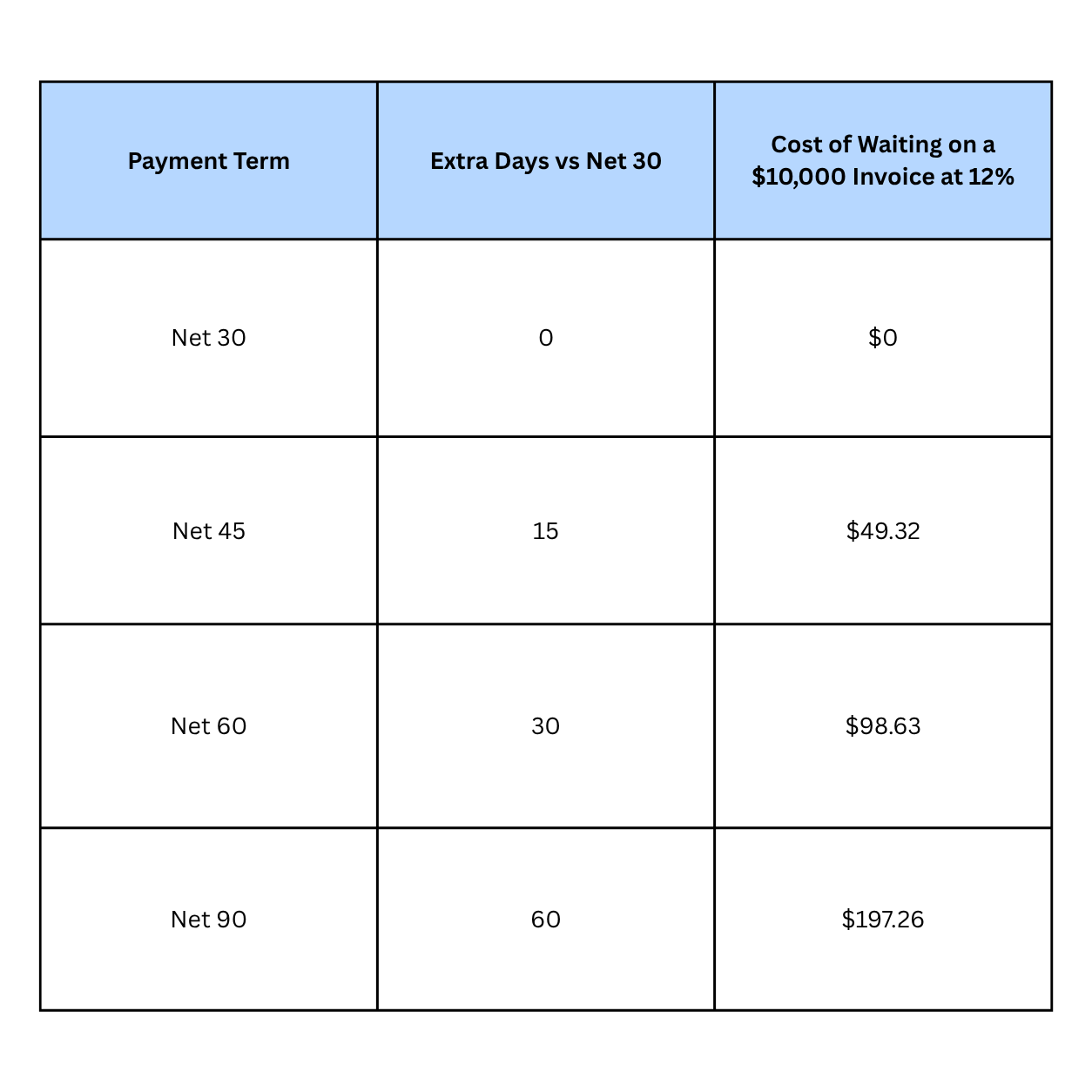
Two points follow from the table. First, you can price the cost into your fee. A $10,000 project on Net 60 instead of Net 30 carries about $99 of financing cost at 12%, so a 1% price increase covers it.
Second, the same math tests early payment discounts. A 2/10 net 30 discount pays the client 2% for paying 20 days early. That works out to about 37% a year. If your own cost of money sits far below that, the discount costs you more than waiting does.
Terms on paper differ from days to pay. Your real average, measured as Days Sales Outstanding, shows the cost you carry today. Client analytics shows payment patterns for each client, so you can see who pays inside the term and who does not.
Flexible Payment Options
Flexible payment options fit different customer needs. They can include installment payment plans, deferred payment, or different payment method options.
These options can make a purchase easier and expand access. They may also lift sales and customer loyalty.
Advantages of flexible payment options:
Easier for more buyers
Increases access
Can boost sales
Using flexible options takes planning. Businesses must make sure the terms fit their cash flow.
Milestone Payment Terms
Milestone payment terms tie pay to project progress. They are common in construction, software, and consulting.
These terms split payments by project phases or outputs. This links cash to work done and lowers risk for both sides.
Benefits of milestone payment terms:
Matches pay to progress
Protects both sides
Supports on-time work
Using milestone terms needs clear project goals. Businesses must list each milestone and the related payment rules.
Subscription Payment Models
Subscription payment models bring in steady income through ongoing service. They are common in media, software, and service work.
These models give the buyer regular access and the seller more stable revenue. They are a common fit for service payment terms.
Advantages of subscription models:
Steady revenue
Better retention
Long-term customer ties
Moving to a subscription model can work well. It asks businesses to keep giving value and strong support.
Short-Term Payment Plans
Short-term payment plans spread a cost over a short period. They help customers buy now and pay later without a long delay.
These plans can be daily, weekly, or monthly. They make big buys easier to pay for.
Features of short-term payment plans:
Higher affordability
Flexible time frames
Better budget control
Offering short-term plans takes care. Businesses must make sure they can handle the staggered payments.
IRS Short-Term Payment Plan
The IRS offers short-term payment plans for tax debt. These plans let taxpayers pay in installments.
People often search for an IRS short-term payment plan when they need more time. It is a different option from an IRS long-term payment plan.
These plans can help people who owe under $100,000 and need more time. They also ease pressure on cash flow.
Key points:
Installment option for taxes
Often available for balances up to $100,000
Usually spread over 120 days: Check the current IRS short-term plan length on irs.gov before publishing. An IRS short-term plan can help taxpayers avoid larger problems while they catch up.
Short-Term Disability Payments Taxation
Short-term disability payments can help during a health issue. Their tax status depends on the source.
People often ask, are short-term disability payments taxable? The answer depends on who paid the benefit.
If an employer pays the benefit, it may be taxable. Recipients should plan for any tax hit and check with a tax pro.
Key points:
Tax status depends on the source
Employer-paid benefits may be taxable
Planning helps reduce surprises
Knowing the tax rules helps people avoid shocks and manage money better.
Payment Terms for Service Businesses, Agencies, and Freelancers
Most guides on this topic assume you ship goods. Cash on delivery and shipping terms mean little when you sell time, advice, or retainers. Service businesses carry a different risk: the work is finished before the money arrives, and you cannot take it back.
This applies to marketing agencies, virtual assistants, and professional services firms alike. Match the structure to the type of work. These ranges are common practice, not rules, so adjust them to your market.
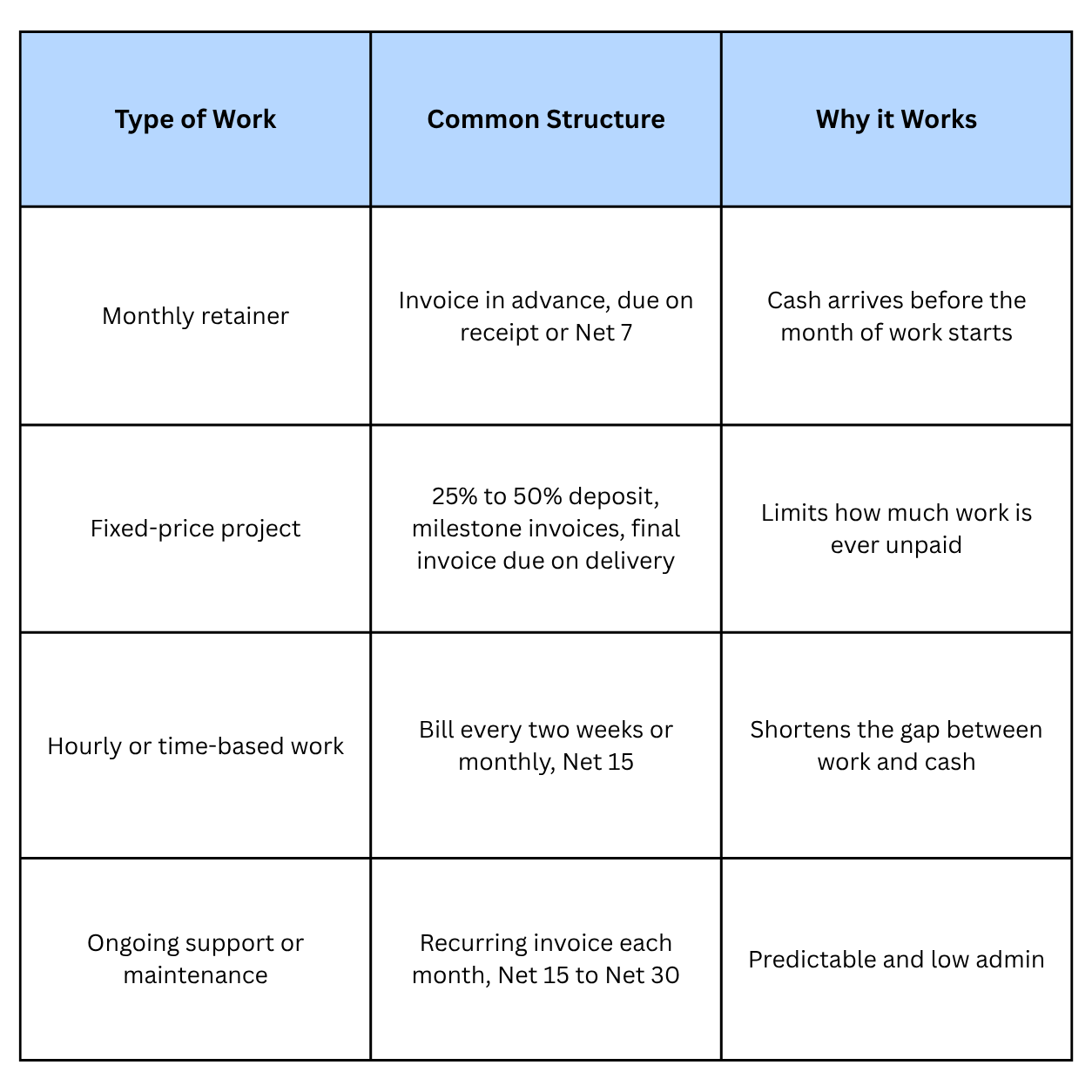
Retainers fit recurring invoices. Set the schedule once, and the invoice goes out on the same day every cycle. Alfaa's recurring billing also handles prorated first invoices and pauses.
Project work fits stage billing. Raise an invoice as each stage ends, and use interim invoices so you never wait for the final invoice to see any cash.
Add a pause clause to every service contract. A line such as "we may pause work when any invoice is more than 14 days overdue" gives you leverage before the debt grows.
Importance of Clear Payment Terms
Clear payment terms are vital in any deal. They cut confusion, reduce disputes, and keep work moving.
They also support stronger cash flow management and healthy ties with clients and vendors. When terms are clear, both sides know what to expect.
Key benefits of clear payment terms include:
Fewer disputes
More trust
Better planning
Review payment terms often so they stay useful and fair.
Cash Flow Management
Good cash flow management keeps a business stable. It means tracking money in and money out and making sure the timing works.
Payment terms are a big part of that. The right payment schedule can help a business cover bills, invest, and grow.
Cash flow strategies should focus on:
Matching payment schedules to work needs
Using electronic payment systems for speed
Forecasting cash needs ahead of time
Businesses should keep refining cash flow management. That helps them stay liquid and ready for new chances.
Invoice Payment Terms
Invoice payment terms set the rules for paying a bill. They show the due date for invoices, the amount due, and any discounts or fees.
Simple, clear invoice terms can speed up pay and cut errors. They also help buyers and sellers stay on the same page.
Key elements to include invoices:
Due date for invoices
Early payment discounts
Late payment fees
Clear invoice payment terms improve cash flow and make planning easier.
Payment Processing Fees
Payment processing fees can cut into profit. They vary by payment method and processor.
Businesses should compare payment method options and choose the ones with lower fees when possible. Clear fee rules also help build trust.
Strategies to manage processing fees include:
Negotiate better rates with processors
Encourage lower-fee payment methods
Bake fees into pricing
Good fee control helps protect profit and keep customers happy.
Early Payment Discounts and Late Payment Fees
Early payment discounts reward clients who pay fast. They bring in cash sooner and can improve liquidity.
Late payment fees do the opposite. They push clients to pay on time and help protect the seller from loss.
Benefits of these tactics include:
Better cash flow management
Faster payment
Less risk from late bills
Used well, these tools can shape customer behavior in a positive way.
Payment Terms and the Law: UK, EU, US, and India
Payment terms are a contract term, but the law limits them in many places. Check the rule in the client's country before you sign. This section gives general information, not legal advice.
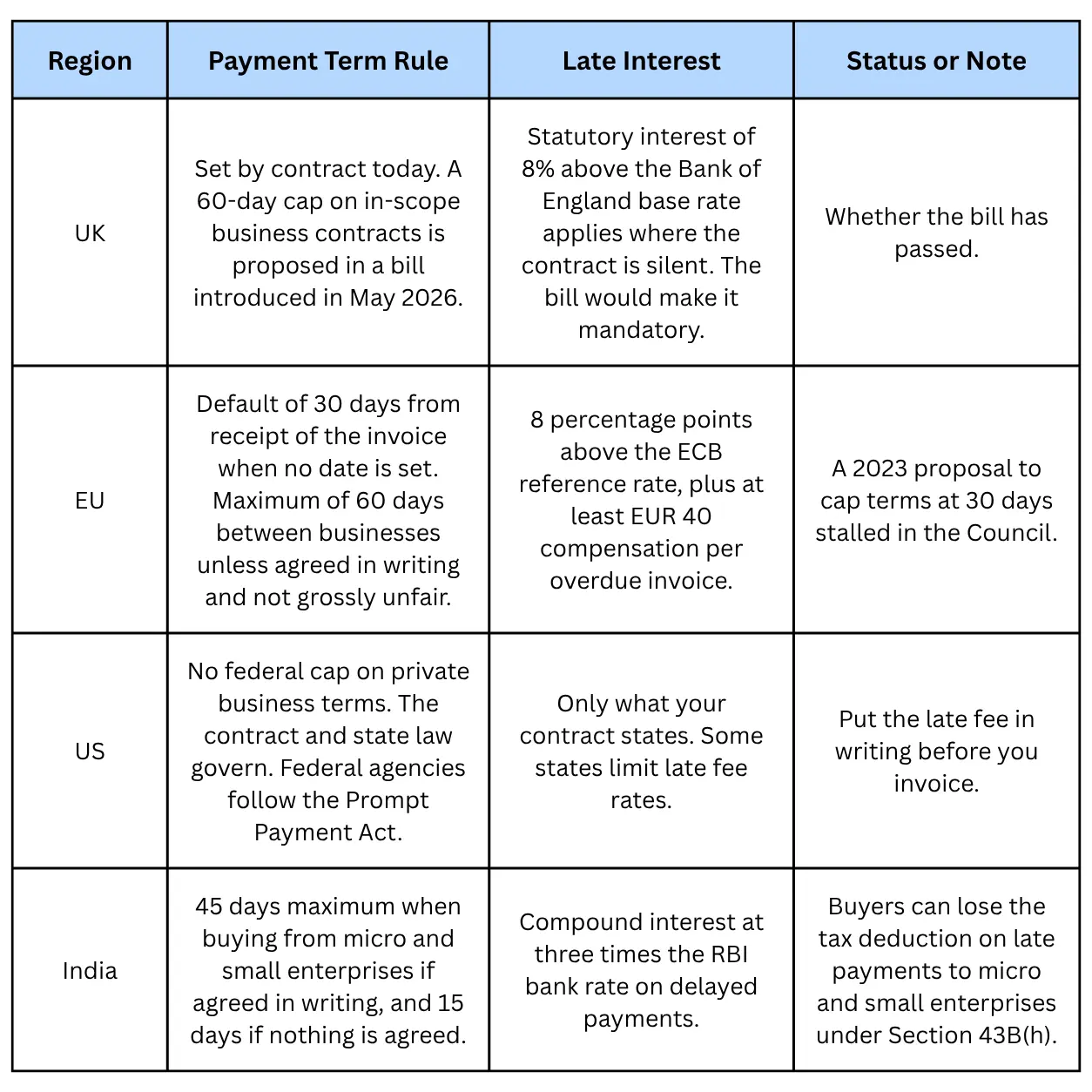
Two habits protect you in every region. Write the late interest clause into the contract, because a clause you can point to beats a right you have to prove. Then check which country's law governs the deal, since the answer can depend on where the client sits. For wording that works, see how late fees and statutory interest fit into an invoicing routine.
How to Enforce Payment Terms After the Due Date
Terms mean little without follow-through. Run the same sequence for every client so no one feels singled out.
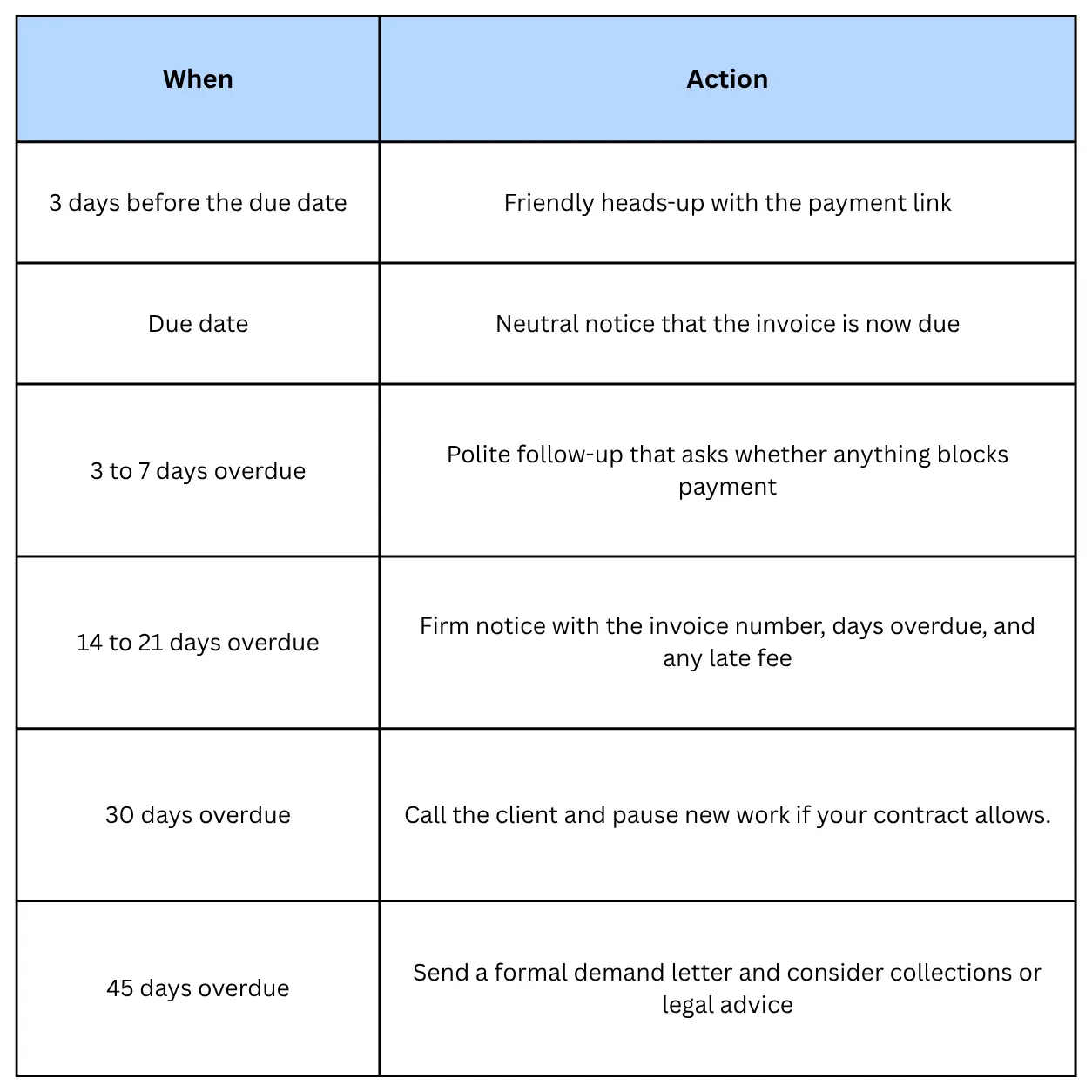
Automated reminders cover the first four steps without awkward emails. They stop on payment, so a client who just paid never gets a second nudge.
Strategies for Negotiating Payment Terms
Strong payment terms negotiation can lead to better deals. The aim is to improve cash flow and profit without hurting the relationship.
Good results come from knowing both sides' needs, the market, and your own limits. A clear plan makes talks smoother.
Key negotiation strategies include:
Set clear goals and limits
Learn the other side's needs
Stay flexible on small points
These steps can improve deals and strengthen long-term ties.
Payment Policy Development
A clear payment policy gives a business a simple rule set. It keeps payment work consistent and lowers risk.
The policy should cover payment terms and conditions, late fees, and accepted payment methods. It should also fit the business's payment method options and deal types.
Essential components of a payment policy include:
Clear payment terms and conditions
Steps for late payments
Accepted payment methods and fees
Review the payment policy often so it stays current.
Payment Terms Negotiation Techniques
Good payment terms negotiation takes skill and calm. The best results come from clear talk, good prep, and a fair tone.
Before talks begin, review common terms in your field. That gives you a stronger base and helps you ask for realistic terms.
Useful negotiation techniques include:
Prepare and know your limits
Build a good rapport
Focus on long-term value
These habits can lead to better deals and stronger business ties.
When the Client's Terms Conflict With Yours
Your invoice says Net 15. The client's purchase order says Net 60. Which one wins?
The answer depends on the contract and the law that governs it. As a general pattern, a signed contract or master services agreement outranks a purchase order, and a purchase order outranks the line printed on an invoice. The invoice usually carries the least weight because the client never agreed to it in advance. [CONFIRM with a lawyer for your jurisdiction.]
Settle terms before work starts:
Put the payment terms in the contract or statement of work
State that those terms apply even when a purchase order says otherwise
Ask for the PO number early, since many business clients will not release payment without one
Alfaa's invoice terminology guide explains how purchase order references appear on an invoice.
When a Large Client Sets Net 60 or Net 90
Large companies often run fixed payment cycles. An accounts payable team rarely changes them for one supplier. Treat the term as a fact and manage the cost:
Price it in. Use the cost table above to add the financing cost to your fee.
Split the invoice. Take a deposit and bill by milestone so less money waits on the long term.
Offer a discount only when the math works. Compare the discount rate with your cost of money first.
Invoice the day work ends. The clock starts at the invoice, so every idle day adds to the wait.
Sell the invoice. Invoice factoring pays you now for a fee. Fees vary by provider. [CONFIRM]
Walk away. Decline when the term would put your own bills at risk.
UK clients may soon face a 60-day cap, which gives you a lever in those talks. See the law section above.
Choosing Terms by Client Type
One term for every client leaves money on the table. Set a starting term by risk, then move clients up or down as they build a record.
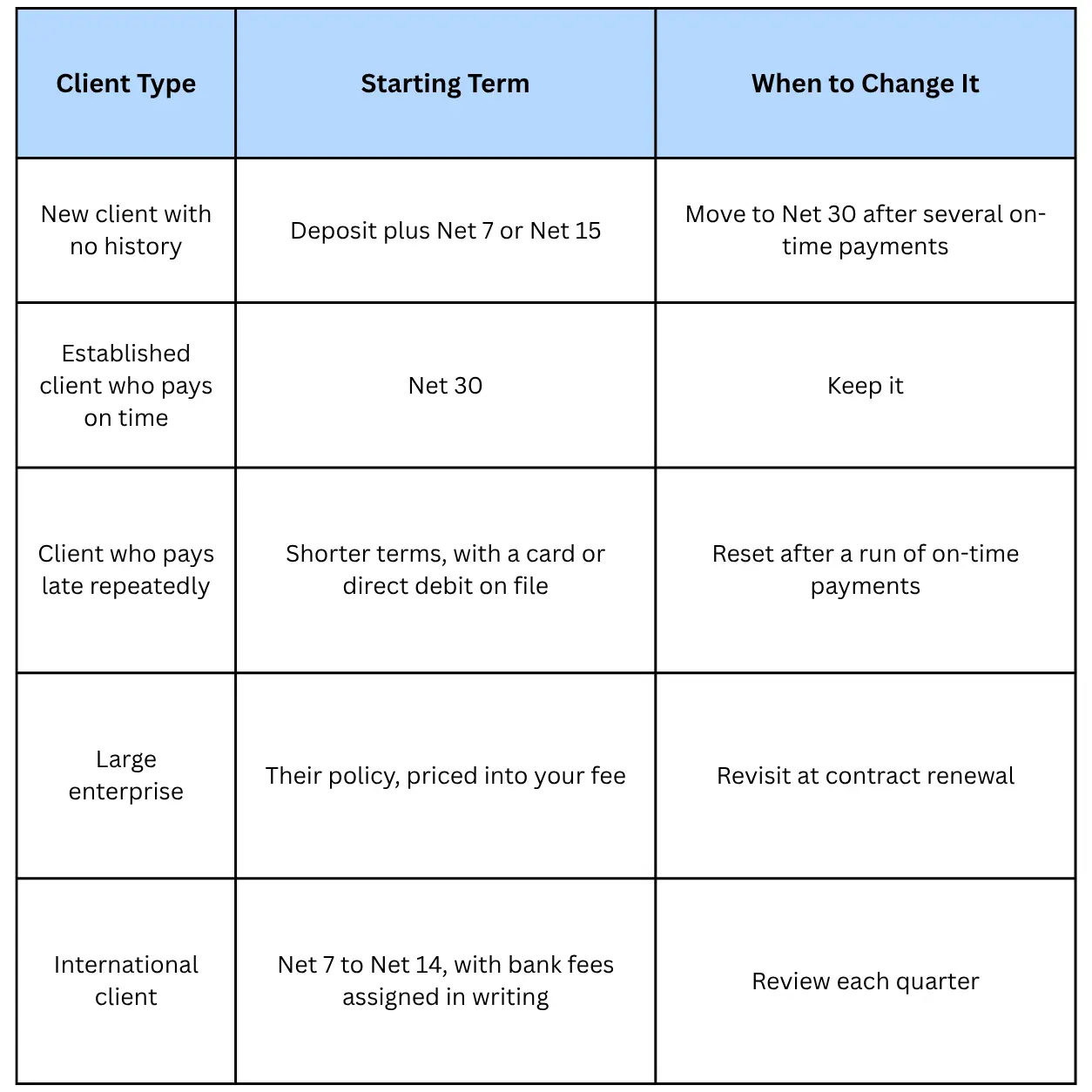
Use your own data to decide. Client analytics shows who pays on time and who needs follow-up, and client management keeps each client's agreed terms saved so you do not retype them.
Business Credit Terms
Business credit terms set the rules when a seller gives a buyer time to pay. They shape cash flow, risk, and trust.
These terms may set a credit limit, a pay period, and late interest or fees. Good trade credit terms should fit the buyer, the seller, and the field.
Key aspects of business credit terms include:
Credit limits and repayment terms
Interest and late fees
Impact on cash flow and risk
The right credit terms can support growth without taking on too much risk.
Payment Agreements
Payment agreements are formal papers that spell out what each side must do. They protect both sides and make the deal clear.
A strong payment agreement should list amounts, payment schedule details, due dates, and any penalties. It should be clear enough to reduce disputes and support legal weight.
Essential elements of payment agreements include:
Exact payment dates and due dates
Clear late fees and penalties
A way to solve disputes
Good payment agreements can support trust and make business ties stronger.
Copy-and-Paste Payment Terms Wording
Most guides tell you to state your terms but never show the words. Add these lines to your invoice footer or contract. Replace the bracketed parts.
Standard invoice footer (Option A)
Payment is due within 30 days of the invoice date, by [due date]. Late payments accrue interest at [1.5%] per month, or the maximum the law allows, whichever is lower.
Milestone project (Option B)
50% is due before work begins. 25% is due on delivery of milestone two. The final 25% is due on delivery and before final files are released.
International client
All amounts are in [currency]. The client pays all bank transfer and intermediary fees. Payment is due within 14 days of the invoice date.
Pause clause
We may pause work while any invoice is more than 14 days overdue.
Use the free invoice generator to place these lines on a branded invoice.
Case Studies of Effective Payment Terms Negotiation
Real examples can show what works in payment terms negotiation. They reveal how firms use smart choices to get better results.
One small maker got longer net payment terms and kept good supplier ties. Another tech firm used early payment discounts to speed up cash inflow.
Key points from these case studies include:
Fit the terms to the deal
Talk openly
Use industry know-how well
These cases show the value of flexible thinking and solid prep.
Examples of Successful Negotiation
Successful negotiation examples show common ways firms win better terms. They often rely on timing, leverage, and trust.
A retail chain used high order volume to get a more flexible payment schedule. A construction firm used milestone payment terms tied to project outputs.
Common successful techniques include:
Use your strengths
Match terms to work goals
Keep terms clear and enforceable
These examples show how smart changes can improve cash flow and long-term results.
Payment Terms in Different Industries
Payment terms vary by field. Knowing the norms in your sector can help you choose the right deal.
In manufacturing, longer net terms and early payment discounts are common. In tech, subscription payment models often bring in steady revenue. In retail, flexible payment options may matter most.
Typical payment terms by industry include:
Manufacturing: longer net terms with discounts
Technology: recurring subscription payments
Retail: volume deals and flexible schedules
Knowing these patterns helps businesses match industry norms and reach better results.
Payment Terms for International Clients
Distance and currency change the math. A Net 30 term gives exchange rates 30 days to move against you. On a $5,000 invoice, a 2% move costs about $100 before any bank fee. Alfaa's multi-currency invoicing guide walks through the full example.
Four rules keep international terms safe:
Shorten the term. Net 7 to Net 14 shrinks the window for rate swings.
Assign bank fees in writing. Intermediary banks on a wire can each take a cut, so a $5,000 invoice can arrive $50 to $100 short. [CONFIRM]
Add days for time zones and holidays. A client's local holiday can stall their approval process.
Match the payment method to the client's bank. The payment methods guide compares speed, fees, and reversal risk.
No local business bank account? The guide to invoicing an international client without one covers what the invoice needs to say.
Conclusion
Payment terms affect cash flow, risk, and trust in every deal. When you choose the right terms, you can support profit and smoother work.
The best results come from clear talks, fair rules, and a payment agreement that fits the deal. With good planning and steady review, businesses can build stronger ties and grow with less stress.
Frequently Asked Questions
Most terms count from the invoice date, but some contracts count from receipt or delivery. Print a fixed due date on the invoice and name the starting event in your contract. That removes the gap between the two readings.
It depends on the country. EU law sets a 60-day maximum between businesses unless agreed in writing and not grossly unfair, and the UK has a 60-day cap in a bill introduced in 2026. The US has no federal cap on private business terms.
Often yes. The UK and EU give a statutory right to interest, and in the US the right comes from your contract. Write the rate into your terms before you invoice, and check the legal maximum where you operate.
A signed contract usually outranks a purchase order, and a purchase order usually outranks the invoice line. Agree terms in the contract before work begins and state that they apply over any PO terms.
Multiply the invoice by your cost of money and by the extra days over 365. At 12% a year, Net 60 costs about $99 more than Net 30 on a $10,000 invoice.
Retainers work best billed in advance and due on receipt or Net 7. Project work fits a deposit plus milestone invoices. Hourly work suits Net 15. Recurring invoices automate the retainer cycle.
Follow a fixed sequence: a reminder before the due date, a notice on it, a follow-up within a week, a firm notice by day 14 to 21, and a call by day 30. Automated reminders handle the early steps.
Yes. Shorter terms of Net 7 to Net 14, a written bank fee clause, and extra days for holidays and time zones reduce exchange rate and delay risk.