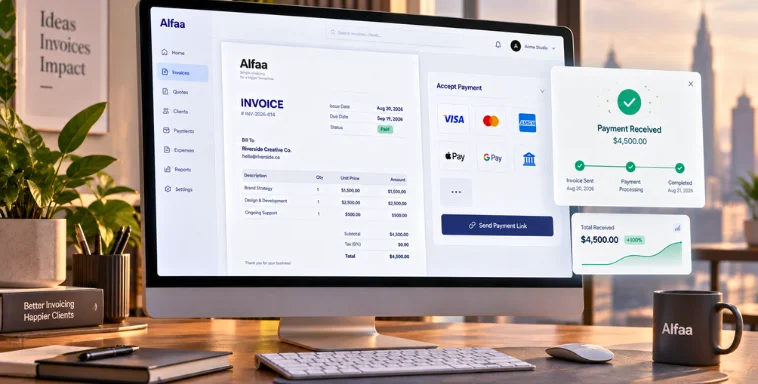
Online vs Traditional Invoicing: Choosing the Right Method for Your Business
By Alfaa Team
Stay in the loop
Get finance tips delivered to your inbox.
Invoicing directly impacts your cash flow, operational efficiency, and financial clarity. For independent consultants, agencies, and small businesses that bill regularly, the way you generate invoice documents can determine how quickly you get paid.
Today, businesses can choose between traditional paper-based invoicing and modern online invoice generator platforms powered by invoice automation software. Understanding the differences will help you choose the right system for your growth stage and workflow.
What is Traditional Invoicing?
'Traditional invoicing' refers to manual, paper-based billing or the use of offline tools such as spreadsheets.
Businesses typically print invoices, mail them physically, manually email attachments, track payments in spreadsheets, and store paper copies for accounting purposes.
Pros of Traditional Invoicing
Simple for very small businesses
Low initial setup cost
Cons of Traditional Invoicing
Time consuming
Prone to calculation and data entry errors
Slower payment cycles
Limited reporting and visibility
For businesses issuing only a few invoices each month, this method may work. But as volume increases, manual processes often slow down operations.
What is Online Invoicing?
Online invoicing uses cloud-based invoice management software to create, send, and track invoices digitally. An online invoice generator allows businesses to generate invoice documents instantly and deliver them to clients within seconds.
Modern invoice automation software includes features such as automated reminders, recurring invoice software for retainers, digital payment options, and real-time tracking of invoice status. Many solutions also integrate with accounting and financial systems.
Pros of Online Invoicing
Faster processing and payments
Reduced errors through automation
Real-time tracking and reporting
Easier collaboration for remote teams
Scalability for growing businesses
Cons of Online Invoicing
Requires subscription or software cost
Initial learning curve
Dependence on internet access
For invoicing software agencies, consultants, and businesses managing monthly retainers, automated invoicing software significantly reduces manual effort.
Key Differences Between Online and Traditional Invoicing
Invoice Delivery
Traditional invoicing is printed or emailed manually and often mailed physically. Online invoicing is sent instantly using invoice management software.
Speed
Traditional processes depend on manual effort and postal delivery. Online systems allow you to generate invoice records immediately and deliver them in real time.
Error Handling
Manual invoicing is prone to typos and miscalculations. Invoice automation tools use templates and automatic calculations to reduce errors.
Payment Tracking
Traditional invoicing requires manual tracking in spreadsheets or paper files. Online invoicing provides real-time tracking of paid, pending, and overdue invoices.
Automation
Traditional systems offer minimal automation. Online solutions support recurring invoice software, automated reminders, and notifications.
Integration with Other Tools
Traditional invoicing rarely integrates with accounting or CRM systems. Online invoice management software integrates with accounting platforms, CRM, ERP, and payment gateways.
Cost
Traditional invoicing has low upfront cost but consumes time and administrative resources. Online invoicing involves subscription fees, often offset by efficiency gains.
Accessibility
Traditional records are stored physically or on local systems. Cloud-based billing software for small businesses allows access from anywhere.
Scalability
Traditional invoicing becomes difficult as invoice volume increases. Automated invoicing software scales easily as your business grows.
Reporting and Analytics
Traditional methods provide limited reporting. Professional invoicing software offers dashboards, analytics, and financial insights.
Security and Compliance
Paper records can be lost or damaged. Online systems provide encrypted storage, audit trails, and improved compliance management.
Environmental Impact
Traditional invoicing relies on paper and printing. Online invoicing is digital and paperless.
Which Businesses Benefit Most from Traditional Invoicing?
Sole proprietors with very low invoice volume
Businesses with minimal digital adoption
Companies operating in cash-heavy or offline industries
In these cases, a basic invoice generator or spreadsheet may be sufficient.
Which Businesses Benefit Most from Online Invoicing?
Growing businesses with higher invoice volume
Consultants and agencies managing recurring retainers
Businesses with remote teams or international clients
Companies requiring integration with accounting software
Businesses looking to automate workflows and improve cash flow
Invoicing for digital marketing agencies and consultants especially benefits from recurring invoice software and invoice automation software.
Factors to Consider Before Choosing
When deciding between traditional and online invoicing, evaluate:
Your invoice volume and billing frequency
Whether you manage recurring billing
Team size and remote collaboration needs
Budget and willingness to invest in software
Integration needs with accounting, CRM, or ERP
Security and reporting requirements
If you frequently generate invoice documents, automation often delivers measurable time savings.
How Modern Tools Like Alfaa Make Online Invoicing Easy
Modern invoice management software for small businesses simplifies billing while maintaining professional standards.
With a solution like Alfaa, you can:
Use an online invoice generator to create invoices quickly
Manage multi-currency billing for global clients
Integrate with financial and operational tools
It combines invoice automation software, invoice automation tool capabilities, and professional invoicing software features in one streamlined platform.
Conclusion
Traditional invoicing may suit very small or offline businesses with limited billing needs. However, online invoicing offers greater speed, accuracy, automation, and scalability.
For consultants, agencies, and small businesses that bill regularly, automated invoicing software reduces errors, accelerates payments, and improves visibility.
Explore how online invoicing can simplify your business operations with Alfaa.
Frequently Asked Questions
Yes, most invoice management software platforms use encrypted storage, audit trails, and controlled access to improve security.
Yes, most online invoice generator platforms allow quick setup and easy transition from spreadsheets.
Yes, automated reminders and real time tracking help reduce delays.
Costs vary by provider, but many billing software for small businesses solutions offer affordable monthly subscription plans.
Yes, digital invoices generated through professional invoicing software are legally valid in most jurisdictions when required details are included.

Olivia Bennett
Content Writer @ Alfaa
Olivia is a content writer at Alfaa who specializes in invoicing, small business, and productivity topics. She enjoys simplifying complex ideas into clear, practical insights that help business owners save time, get paid faster, and stay organized.