Do I Charge Sales Tax on Invoices to International Clients?
By Alfaa Team
Stay in the loop
Get finance tips delivered to your inbox.
In most cases, no. A service sold to a client outside your country is usually treated as an export, and most tax systems don't apply their domestic sales tax, VAT, or GST to exports.
That answer has conditions attached, and the conditions are where independent contractors and small agencies get it wrong, either by charging tax they didn't need to charge or by skipping a registration they actually needed. This piece walks through the direct answer for the US, UK, EU, UAE, and India; what to physically write on the invoice; and how to keep a paper trail in case anyone ever asks.
Quick note before you read further: This covers the general rule in each system, not your specific situation. Tax authorities update these rules (the UAE tightened its export conditions as recently as November 2024), so treat this as a starting point and confirm anything borderline with an accountant licensed where you operate.
The one-line answer, by where you're based
You're based in the United States
Selling services to a business abroad: Generally no sales tax; exports fall outside most states' taxing scope
Selling to an individual abroad: Same, with rare exceptions in origin-based states
You're based in the UK
Selling services to a business abroad: No VAT charged; reverse charge shifts the obligation to the client
Selling to an individual abroad: Depends on the service; digital services may require registration abroad
You're based in the EU
Selling services to a business abroad: No VAT charged; reverse charge applies with a valid VAT ID
Selling to an individual abroad: Registration required from your first sale for digital services (via OSS)
You're based in the UAE
Selling services to a business abroad: Zero-rated (0% VAT), if you meet the export-of-services conditions
Selling to an individual abroad: Same conditions apply; the client's location and status still matter
You're based in India.
Selling services to a business abroad: Zero-rated under LUT, if you meet the five export conditions
Selling to an individual abroad: Same conditions, provided payment arrives in convertible foreign exchange
Two different questions live inside "Do I charge tax?": whether tax applies at all and whether you're required to be registered somewhere to say so on the invoice. The next sections separate those two.
Sales tax, VAT, and GST aren't the same question
US sales tax is charged once, at the final sale to the end consumer, and only in states where you have "nexus," a business presence significant enough to trigger the obligation. It's destination-based: the tax follows where the buyer is, not where you're sitting when you invoice them.
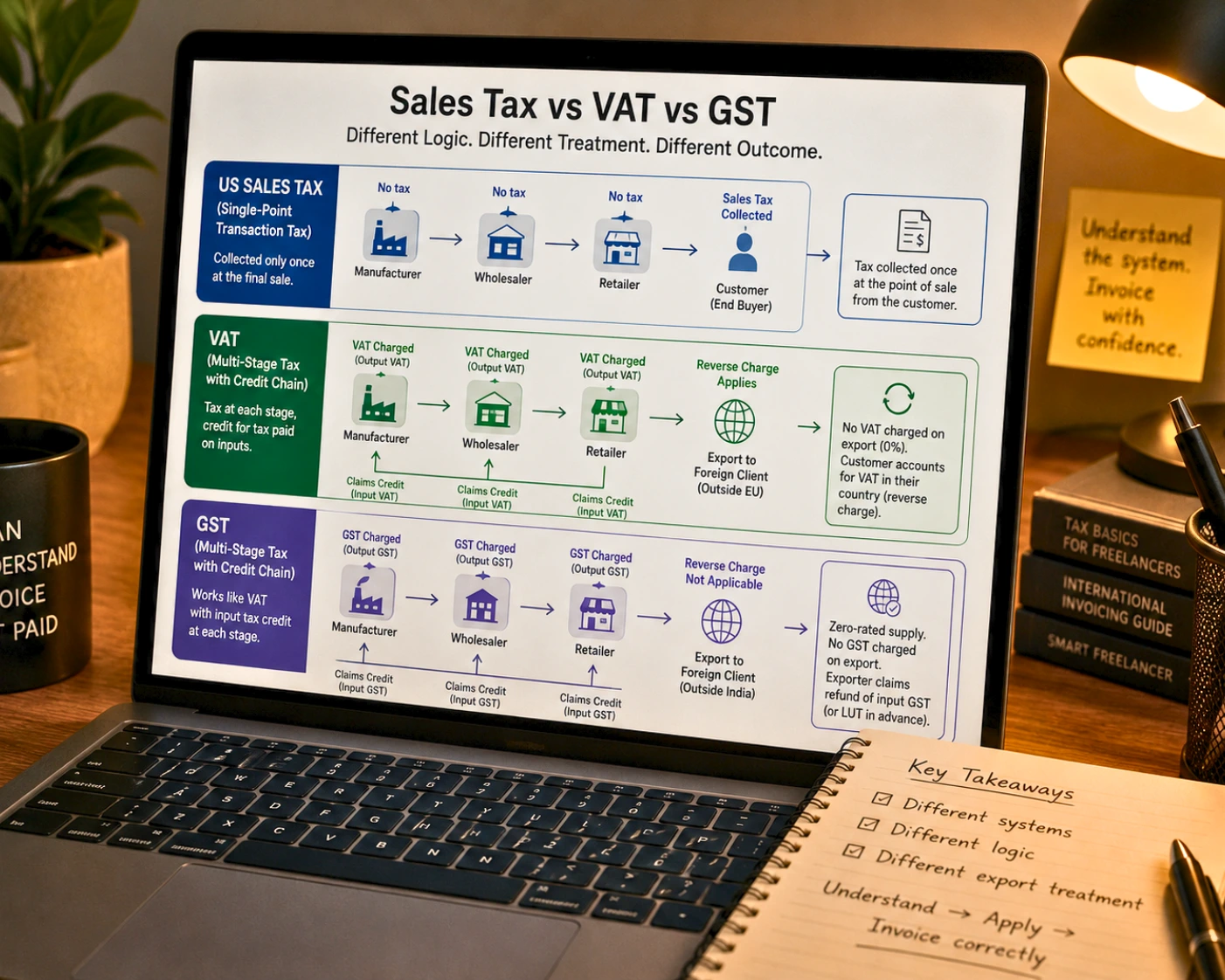
VAT and GST work differently. They're charged in layers through a supply chain, and businesses further down the chain claim credit for what they paid further up. That structure is why the "reverse charge" mechanism exists for VAT and GST but has no real equivalent in US sales tax: it shifts the last layer of the calculation to the buyer instead of the seller.
The practical result for a independent contractor or agency selling services: if you're US-based, you're mostly asking, "Do I have nexus anywhere the client is?" If you're UK, EU, UAE, or India-based, you're mostly asking, "Does this qualify as an export, and do I need to register anywhere before I can treat it that way?"
One more distinction worth making explicit
Charging tax on an invoice and owing tax on your income are two separate obligations. Not charging VAT or sales tax on an export doesn't mean the income is untaxed; it means a different tax (your income tax, self-employment tax, or corporate tax) applies to it instead, calculated at filing time rather than added to the invoice. independent contractors regularly conflate the two and either panic about "not paying tax" on an export or assume that because they filed an export invoice correctly, nothing else is owed. Both are wrong. Keep the questions separate.
United States
Exported services generally fall outside a state's sales tax scope, because sales tax follows the buyer's location and the buyer is outside the country. The exception worth knowing: a handful of origin-based states can theoretically apply tax based on where you, the seller, are located rather than where the client is, though in practice this rarely reaches genuine cross-border service sales.
There's no federal sales tax and no federal requirement to show a foreign-currency equivalent on the invoice itself, but you still need to convert the income to USD at tax filing time, using either the exchange rate on the invoice date or the IRS's published yearly average rates. Alfaa's guide to multi-currency invoicing covers exactly which rate source to use and how to document it for your accountant.
UK and EU
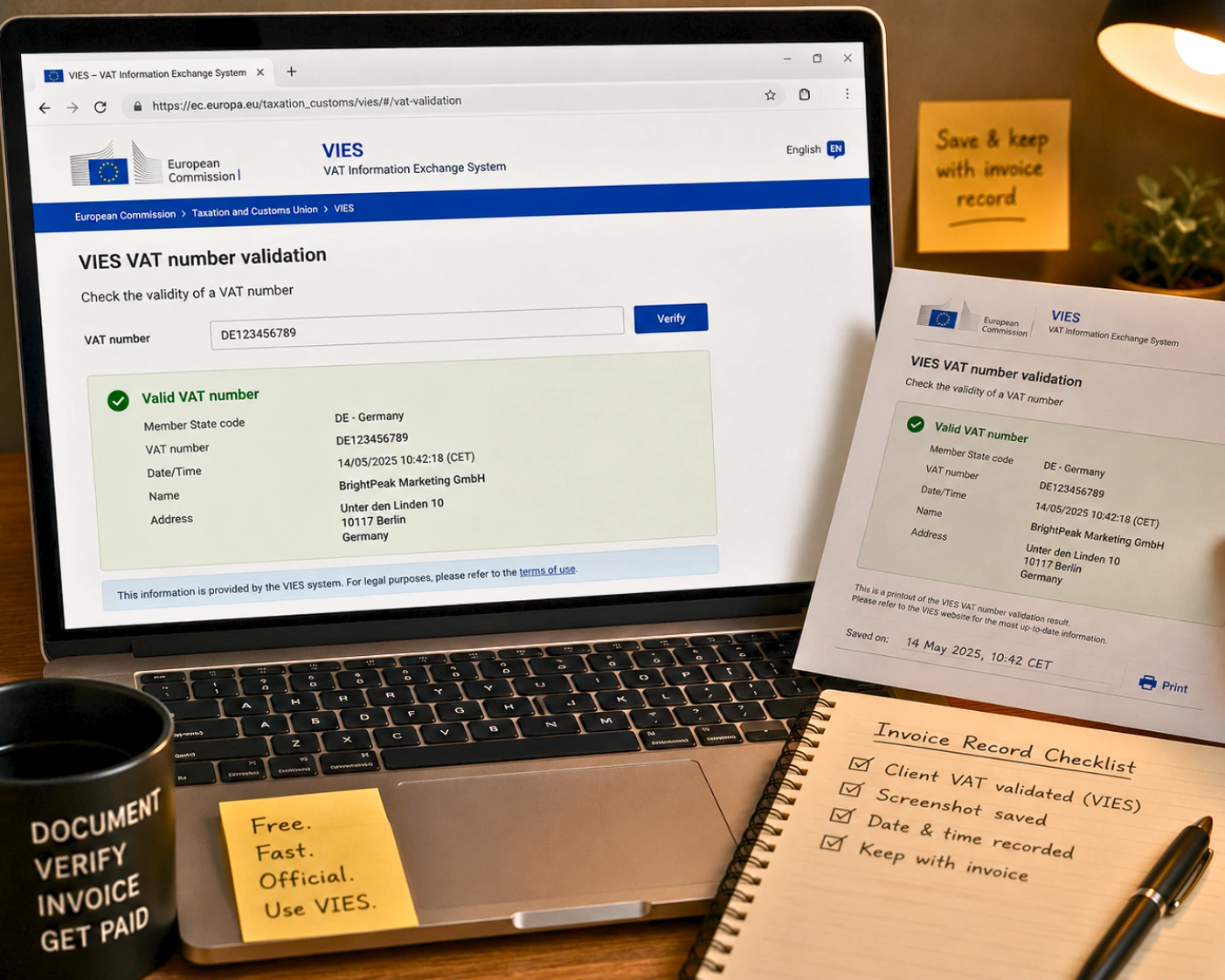
For a business client (B2B), the reverse charge mechanism applies. You issue the invoice without VAT, the client accounts for the VAT themselves in their own return, and your invoice needs a specific note stating that the reverse charge applies. To use it correctly, you need to collect and verify the client's VAT number, which the EU's VIES lookup tool does for free in seconds. No verified VAT number means you can't apply the reverse charge, and the sale defaults to being treated as B2C.
For an individual client (B2C), the picture changes. Digital services sold to consumers in the EU require VAT registration from your very first sale, not after some threshold, through the EU's One-Stop Shop (OSS) scheme, which lets you register once and file a single return covering all member states rather than registering separately in each one. This is the single most common trap for a independent contractor who starts selling an online course, template pack, or digital download on the side: it looks like an ordinary invoice, but it can trigger a registration requirement immediately.
UK VAT runs on the same basic logic post-Brexit: reverse charge for B2B, registration required for B2C digital services sold to UK consumers.
UAE
The UAE zero-rates exports of services (0% VAT rather than the standard 5%), but only when specific conditions in Article 31 of the VAT Executive Regulation are met: the recipient has no place of residence in the UAE, and the recipient is outside the UAE at the time the service is performed.
A cabinet decision effective November 2024 tightened this further. The test now leans more heavily on where the actual benefit of the service is received, not just where the client is technically registered. In practice, if a UAE-based employee or director of an otherwise foreign client is reasonably expected to receive the benefit of the service while in the UAE, zero-rating can be denied even though the client itself is a non-resident entity. Given how recently this changed and how much it affects the answer, this is worth a direct conversation with a UAE tax advisor for anything beyond a straightforward one-off service, rather than relying on a blog post, including this one.
If you're invoicing in USD or another foreign currency from the UAE, remember that the VAT amount itself (even at 0%) still needs to reconcile against the FTA's requirements for showing figures in AED. Alfaa's multi-currency invoicing guide covers the AED conversion requirement in more detail.
India
Export of services qualifies for zero-rating under Section 2(6) of the IGST Act, provided five conditions are met: you're supplying from India, the recipient is outside India, the place of supply is outside India, payment arrives in convertible foreign exchange, and you and the recipient aren't simply two branches of the same legal entity.
To invoice without charging IGST upfront, you file a Letter of Undertaking (LUT) through Form RFD-11 on the GST portal. It's free, but it only covers one financial year at a time and needs refiling before April 1 each year. Without a valid LUT, you can still export, but you'd charge 18% IGST on the invoice and then claim it back as a refund, which is legal but ties up cash you don't need to tie up.
GST registration itself becomes mandatory past ₹20 lakh in annual turnover (₹10 lakh in special category states), but plenty of independent contractors under that threshold register voluntarily specifically to access the LUT route and invoice foreign clients cleanly from day one.
What to actually write on the invoice
This is the part every generic guide skips. The tax line on your invoice needs specific wording, not just a blank or a zero, because the wording is what tells the client's finance team (and your own tax authority, if it ever asks) which rule you applied.
Reverse charge (UK/EU, B2B): "VAT: Reverse charge applies. Customer to account for VAT under Article 44/196 of the EU VAT Directive". Include the client's verified VAT number on the invoice itself.
Zero-rated export (UAE): "VAT: 0% – Zero-rated export of services under Article 31 of the UAE VAT Executive Regulation."
Zero-rated export under LUT (India): "IGST: 0% – Export of service under LUT, ARN: [your LUT reference number]."
Out of scope (US, most exports): It's simplest to state directly: "No sales tax is applicable. This transaction is not subject to US sales tax." A blank tax field can look like an oversight to a client's AP team; a stated line looks intentional.
Each of these is a different legal claim, and using the wrong one on the wrong transaction (writing "reverse charge" on a sale that's actually just out of scope, for instance) creates confusion during any future review rather than protecting you.
Verifying B2B vs. B2C without enterprise tools
You don't need a tax-compliance platform to check this for a handful of international clients a month:
EU clients: Run the VAT number through VIES, the European Commission's free validation tool. Save a screenshot or PDF of the result with the date.
UK clients: HMRC's VAT number checker does the same job for UK VAT numbers.
UAE and India clients: No equivalent free public lookup in the same way, so rely on the client's trade license or GST registration certificate, and keep a copy with the invoice.
No valid ID provided: Treat the sale as B2C and apply whatever the B2C rule is for that country, rather than assuming B2B status without proof.
What to keep on file
If a zero-rated, reverse-charged, or out-of-scope invoice is ever questioned, the tax line itself isn't enough. Keep, per client:
The verified tax ID (VAT/GST number) and the date you checked it
The client's registered business address, showing it's genuinely outside your country
The contract or engagement letter establishing where the service is delivered and consumed
Proof of payment received (bank statement, FIRC/BRC for Indian exporters, SWIFT confirmation) matching the invoice amount and currency
Most jurisdictions expect these records to be kept for five to seven years. None of this needs to be complicated, but it does need to exist before anyone asks for it, not after.
Keeping this consistent across every invoice
The hardest part of getting this right isn't any single invoice. It's applying the correct treatment consistently once you're issuing ten or twenty of these a month across different clients and countries, especially when client details (VAT status, entity type, country) need to stay attached to the client record rather than re-entered by hand each time. Alfaa's client management tools keep that information saved per client, so the same tax treatment and currency settings apply automatically the next time you bill them, rather than starting from a blank invoice and hoping you remember what applied last time.
If you're setting up your first export invoice and want to see the fields laid out correctly before committing to a platform, Alfaa's free invoice generator handles a one-off without requiring signup. And if you're still working out whether you need a full business bank account to invoice these clients in the first place, this guide covers that separately.
Frequently Asked Questions
Usually not, if the sale is B2B and qualifies for the reverse charge or export zero-rating in your country. Registration requirements are more likely to apply for B2C digital sales, particularly into the EU, where registration can be required from the first sale.
Treat the sale as if it were to a consumer (B2C) rather than a business, and apply whatever your country's B2C rule is for that type of service, since you can't legally apply the reverse charge or B2B export treatment without a verified ID.
Yes. Not charging VAT or sales tax on the invoice has no bearing on your income tax obligation. You report and pay tax on that income according to your own country's income tax rules, separately from whatever happened on the invoice itself.
No. Physical goods usually involve customs duties and import taxes assessed at the border in the destination country, on top of or instead of the export/reverse-charge treatment that applies to services. This guide covers services specifically.
More often than most independent contractors expect. The UAE tightened its export-of-services conditions in November 2024, and thresholds, forms, and registration rules shift periodically in most of the countries covered here. Treat any specific figure or condition in this guide as current as of publication, and verify anything that affects a large or recurring client relationship with a local accountant.

Olivia Bennett
Content Writer @ Alfaa
Olivia is a content writer at Alfaa who specializes in invoicing, small business, and productivity topics. She enjoys simplifying complex ideas into clear, practical insights that help business owners save time, get paid faster, and stay organized.