Quick answer
A tax invoice is an official document issued by a GST- or VAT-registered seller to a buyer that itemizes a transaction and shows the tax charged (GST, VAT or sales tax) separately from the price. It is the legal record of a taxable sale. In GST and VAT countries, a business buyer needs a valid tax invoice to claim back the tax it paid as an input tax credit.
Every tax invoice is an invoice, but not every invoice is a tax invoice. A business that is not registered for GST or VAT issues a regular invoice and does not charge tax.
Key takeaways
A tax invoice records the sale and the tax owed, so it matters to the seller, the buyer and the tax authority.
Almost every tax invoice shows the words “Tax Invoice” (or “VAT Invoice”), the seller’s tax ID, a unique number, the date, a description of what was sold, the tax rate and tax amount, and the total.
The exact rules depend on the country: Australia uses ABNs and an A$1,000 buyer-ID threshold, the UK allows simplified invoices up to £250, and India requires GSTINs, HSN/SAC codes, and, for larger businesses, e-invoicing.
The US has no federal tax invoice. US businesses issue standard invoices and show state sales tax as a separate line.
An invoice missing a required field can block the buyer’s tax credit and delay your payment.
What is a tax invoice?
A tax invoice is a formal billing document that a GST- or VAT-registered seller sends to a buyer. It does four jobs at once:
Requests payment, like any invoice.
Records the tax charged, so the seller can report it on their GST or VAT return.
Lets the buyer claim a credit for that tax, in countries where business buyers can recover GST or VAT (an input tax credit).
Creates an audit trail that tax authorities use to verify revenue and detect errors or fraud.
That third job is why tax invoices have strict content rules. If the invoice is missing a mandatory detail, the tax authority can refuse the buyer’s credit claim, and the buyer will usually ask you to reissue it before paying.
Simple example: You sell consulting services for $1,000 in a country with 10% GST. Your tax invoice shows a subtotal of $1,000, GST of $100 and a total of $1,100. Your client pays $1,100, then claims the $100 back as a credit on their own return. You report and pay that $100 to the tax authority.
Other names for a tax invoice
VAT invoice: UK, EU, UAE, South Africa and other VAT countries.
GST invoice / GST tax invoice: India, Australia, Singapore, New Zealand. Canada uses “GST/HST invoice”.
Sales invoice: Common in the US, where sales tax is shown as a line item.
Factura / factura electrónica: Spain and Latin America, usually a government-validated electronic document.
What must a tax invoice include? (Essential components)
Requirements vary by country, but these 12 components appear on almost every compliant tax invoice. Use this as your checklist.
Sr. | Component | What to include | Why it matters |
1 | Document title | The words “Tax Invoice” or “VAT Invoice” | Tells the buyer and tax authority it supports a credit claim |
2 | Seller details | Legal business name, address, contact details | Identifies who made the sale |
3 | Seller tax ID | ABN, VAT number, GSTIN, GST/HST number | Proves the seller is registered to charge tax |
4 | Buyer details | Name and address; buyer’s tax ID for B2B or above a threshold | Required for higher-value and B2B sales in many countries |
5 | Invoice number | Unique and sequential (INV-0001, INV-0002…) | Tax authorities check for gaps and duplicates |
6 | Invoice date | Date of issue | Determines the tax period |
7 | Date of supply | When goods were delivered or services completed, if different | Sets the tax point in VAT systems |
8 | Description | What was sold, quantity and unit price | Shows what the tax relates to |
9 | Amount before tax | Net subtotal per line and overall | Base for the tax calculation |
10 | Tax rate and amount | Rate (e.g. 10%, 20%, 18%) and tax amount per rate | The core of a tax invoice |
11 | Total payable | Gross total including tax, with currency | The amount the buyer owes |
12 | Payment terms | Due date, accepted methods, bank details | Not always legally required, but speeds up payment |
Country-specific extras to watch for
Reverse-charge wording: On cross-border B2B services in the UK and EU, where the buyer accounts for the VAT.
HSN or SAC codes, place of supply and CGST/SGST/ IGST split: On Indian GST invoices.
Exchange rate and local-currency tax amount: When you invoice in a foreign currency. See our guide to billing international clients in multiple currencies.
IRN and QR code: On Indian e-invoices and government clearance codes in much of Latin America.
Exemption or zero-rating reason: When you charge 0% tax.
B2B vs B2C: what changes on the invoice
B2B (selling to a business) | B2C (selling to a consumer) | |
Buyer’s tax ID | Often required, and needed for the buyer’s credit claim | Usually not required |
Buyer’s name and address | Required on full invoices | Often optional on low-value sales |
Simplified invoice allowed? | Rarely | Often, below a threshold (e.g. £250 in the UK) |
Cross-border wording | “Reverse charge” where the buyer accounts for VAT | Seller usually charges the destination country’s tax |
E-invoicing mandates | Apply first in most countries | Phased in later, if at all |
Tax invoice vs other billing documents
Document | What it is | Shows tax separately? | Supports the buyer's tax credit? | When it’s issued |
Tax invoice | Legal record of a taxable sale | Yes, required | Yes | At or soon after the sale |
Regular invoice | Payment request from any business | Optional | No | At or after the sale |
Pro forma invoice | Quote or preview of a future sale | Estimate only | No | Before the sale |
Receipt | Proof that payment was received | Sometimes | Usually no (except simplified tax invoices) | After payment |
Credit note | Reduces or cancels an earlier invoice | Yes | Adjusts the original credit | After an error, return or discount |
Two points cause most of the confusion:
Tax invoice vs regular invoice: The difference is registration, not design. If you are registered for GST or VAT and charge tax, you issue a tax invoice. If you are not registered, you issue a regular invoice and must not label it “Tax Invoice” or charge tax.
Tax invoice vs e-invoice: A tax invoice is defined by its content. An e-invoice is defined by its format: structured data (such as XML) exchanged between systems or cleared by a tax authority. In countries with e-invoicing mandates, your tax invoice must also be an e-invoice to be valid. Learn more in our electronic invoice explainer.
Tax invoice vs receipt
A tax invoice is a request for payment, issued before or when payment is due, that breaks down the tax. A receipt is proof of payment, issued after the customer has paid. A business buyer needs the tax invoice, not the receipt, to claim its input tax credit.
GST invoice vs VAT invoice: what’s the difference?
A GST invoice and a VAT invoice do the same job: both are tax invoices that record a taxable sale and let a registered business buyer recover the tax. The differences come from each country’s rules, not from how the tax works.
Feature | GST invoice | VAT invoice |
Where it’s used | India, Australia, Singapore, New Zealand, Canada (GST/HST) | UK, EU member states, UAE, South Africa |
Seller tax ID | GSTIN (India), ABN (Australia), GST/HST number (Canada) | VAT registration number, often with a country prefix (GB, DE, FR) |
How tax is shown | Can be split into parts, e.g. CGST + SGST or IGST in India | Usually one VAT rate and amount per line or rate band |
Extra codes | HSN/SAC codes in India | Reverse-charge or exemption wording where relevant |
Usual title | “Tax Invoice” | “VAT Invoice” or “Tax Invoice” |
In short, a GST invoice is the GST version of a tax invoice, and a VAT invoice is the VAT version. Follow the rules of the country where the sale is taxed.
Tax invoice requirements by country
The table below summarises the main rules. For deeper coverage, including Canada, the UAE, Saudi Arabia, Turkey and Latin America, see our full guide to invoice requirements by country.
Country | Tax | Document title | Seller tax ID | Key rule |
Australia | GST 10% | Tax Invoice | ABN | The buyer's identity or ABN is required for A$1,000. |
United Kingdom | VAT (20% standard) | VAT invoice | VAT number | A simplified invoice allowed for retail sales up to £250 |
European Union | VAT (rates vary) | Invoice with VAT details | VAT ID | Minimum content set by the EU VAT Directive: “Reverse charge” on qualifying B2B |
India | GST (5%, 18%, 40% and others) | Tax Invoice | GSTIN | HSN/SAC codes; e-invoicing above the turnover threshold |
Canada | GST/HST | Invoice showing GST/HST | GST/HST number | Required detail increases at $100 and $500 |
United States | State sales tax | Invoice | Not required | No federal tax invoice; show sales tax separately |
Australia
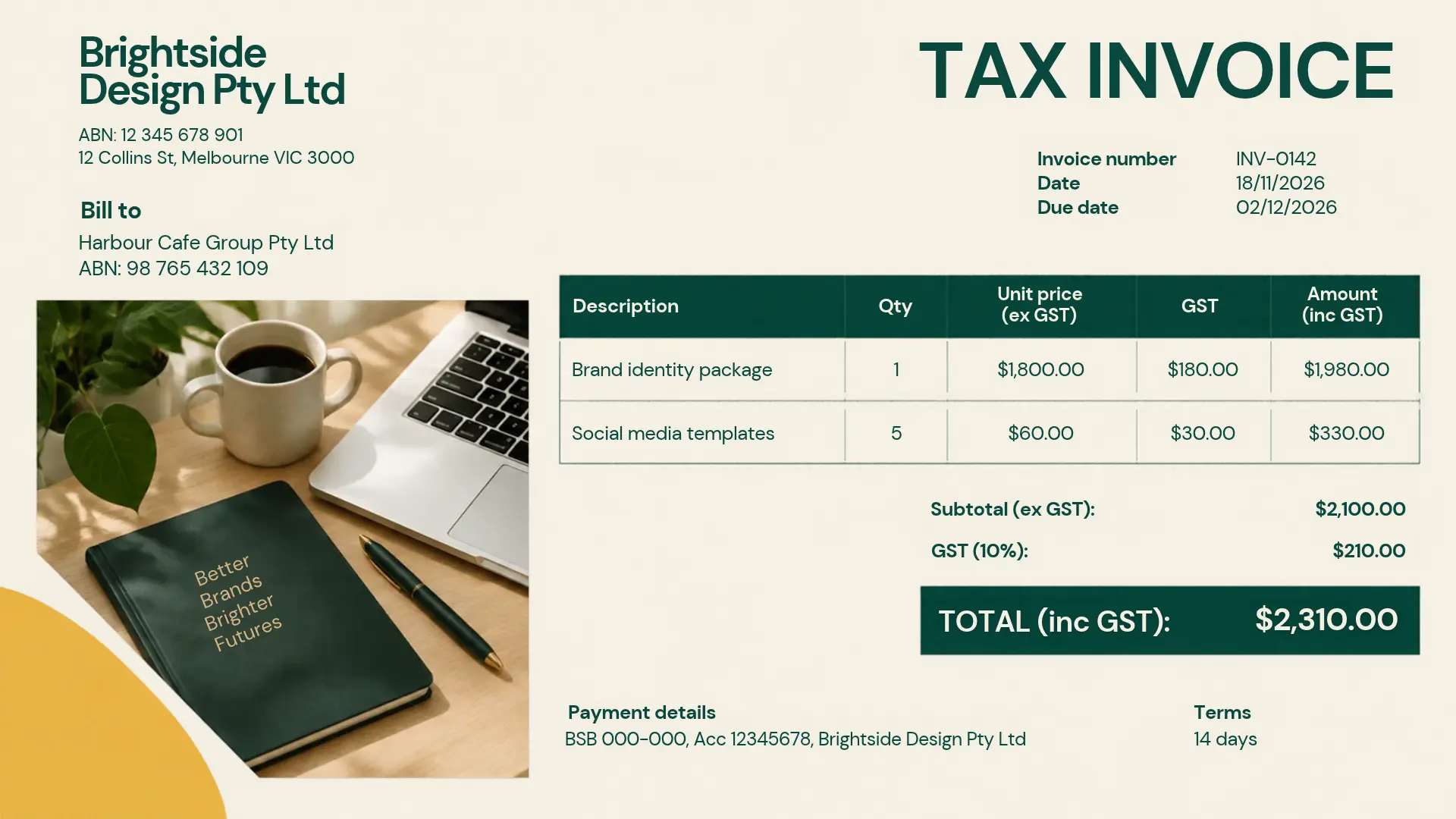
The Australian Taxation Office requires a tax invoice to show that it is intended as a tax invoice, the seller’s identity and ABN, the issue date, a brief description of the items sold, the GST amount (or a statement that the price includes GST), and the extent to which each sale is taxable. For sales of A1,000 or more, it must also show the buyer's identity or ABN. You don't have to issue a tax invoice for sales of A82.50 or less (including GST) unless the buyer asks. If you aren’t registered for GST, issue a plain invoice without GST.
Three details trip up Australian invoices. You can write “Total price includes GST” instead of showing GST separately when GST is exactly one-eleventh of the total. Mark any GST-free items so the buyer can see which lines are taxable. If you aren’t registered for GST, don’t call the document a tax invoice; many businesses add “No GST has been charged” to make that clear. The government also offers free invoice templates on business.gov.au.
United Kingdom
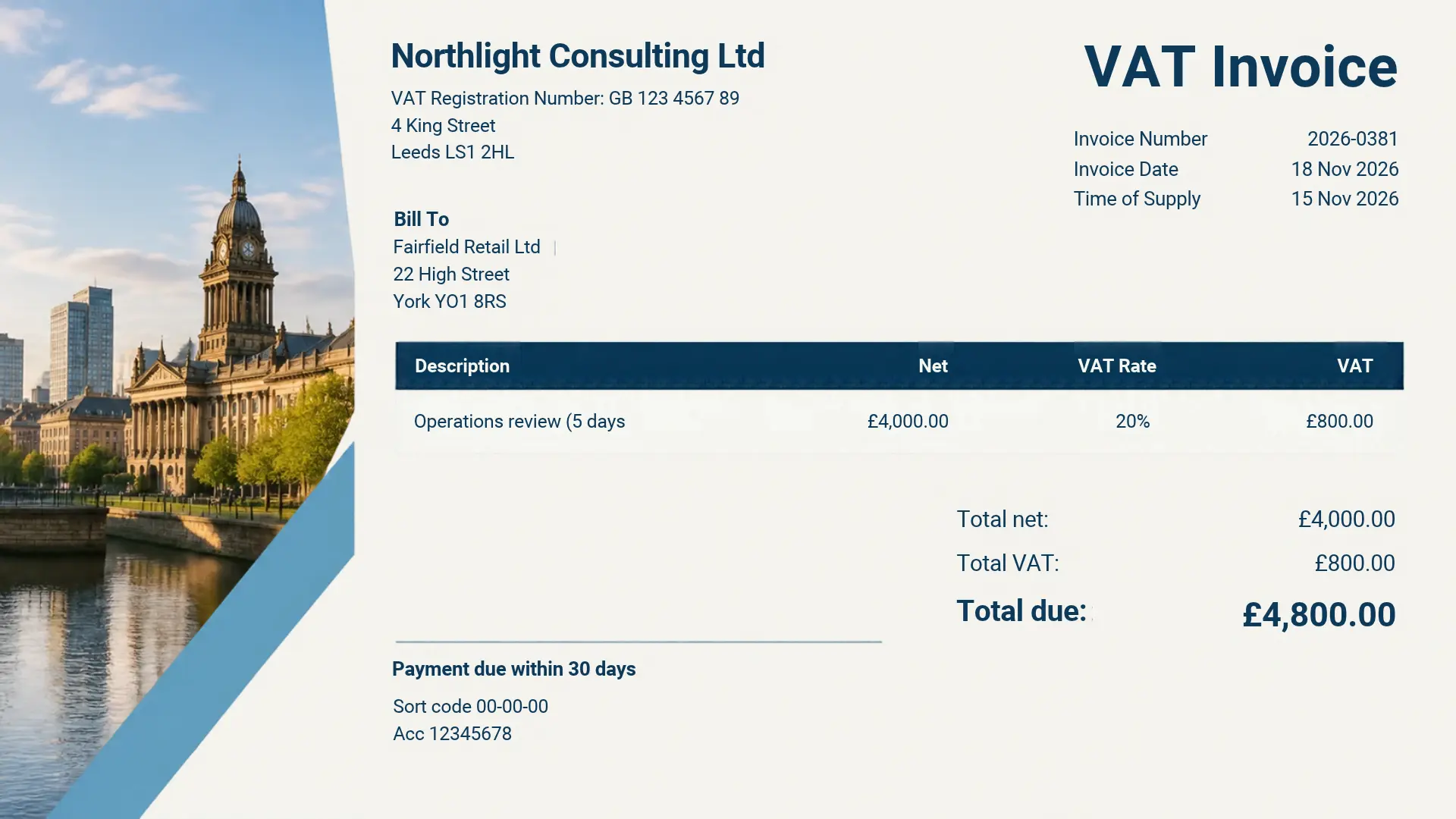
According to GOV.UK, a full VAT invoice includes a unique sequential number, your business name and address, your VAT registration number, the invoice date, the time of supply if different, the customer’s name and address, a description of each item, the price excluding VAT, the VAT rate and amount, and the total. Retailers can issue a simplified VAT invoice for sales of £250 or less including VAT.
European Union
The European Commission’s invoicing rules set the minimum content for VAT invoices across member states, and each country can add its own requirements. For B2B services supplied to a business in another EU country, the invoice usually shows both VAT IDs, charges no VAT, and states “Reverse charge.” Many member states are introducing mandatory e-invoicing, and the EU’s VAT in the Digital Age (ViDA) reforms will extend it to cross-border B2B transactions.
India
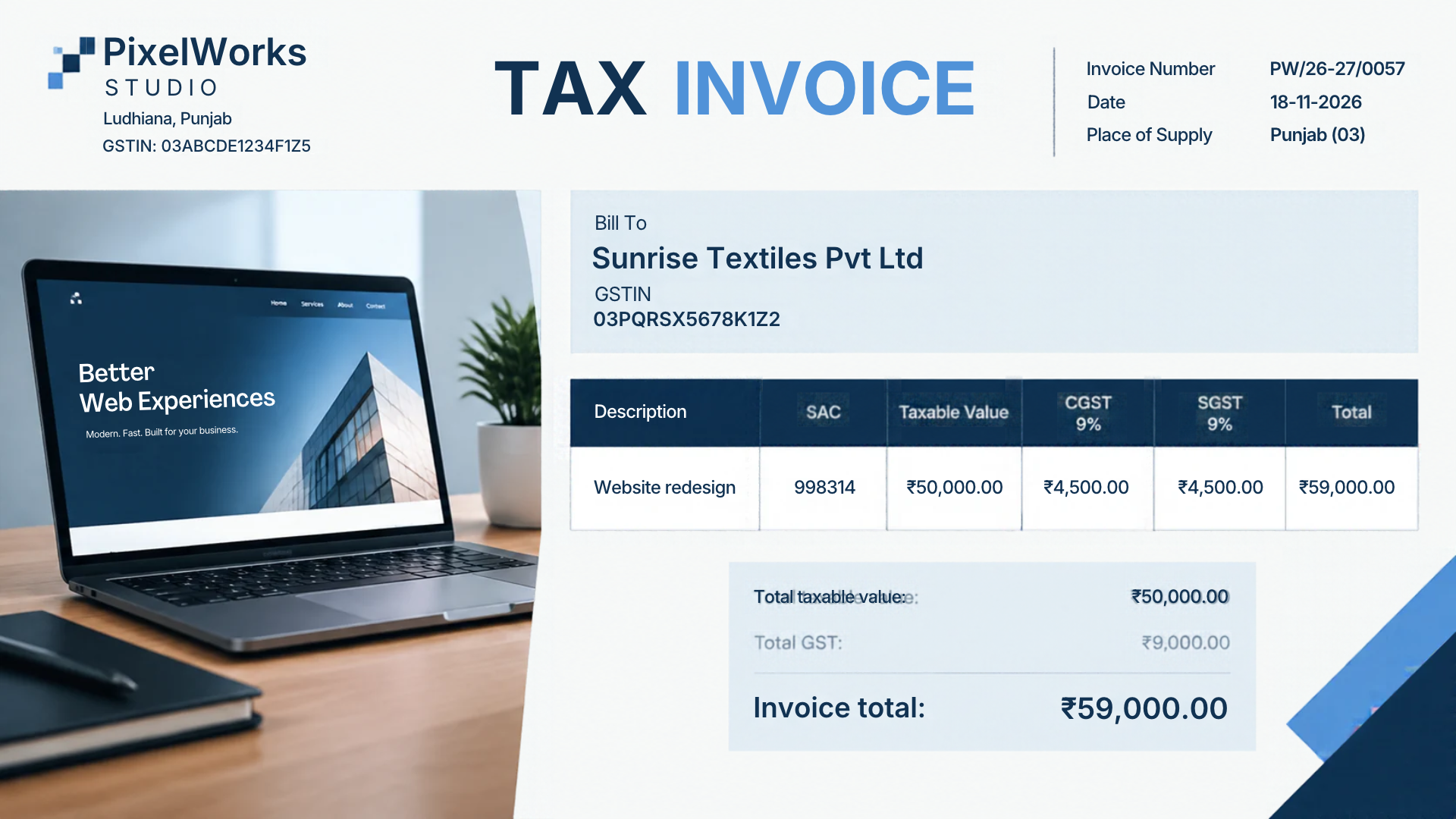
Indian GST invoices follow Rule 46 of the CGST Rules. They must show the supplier’s GSTIN, a consecutive invoice number, the date, the recipient’s GSTIN for B2B sales, HSN or SAC codes, the taxable value, the GST rate and amount (CGST + SGST for sales within a state, IGST for sales between states), and the place of supply. Businesses above the turnover threshold must register each B2B invoice on the GST e-invoice portal to receive an Invoice Reference Number (IRN) and QR code.
The invoice number can be up to 16 characters and must be unique for the financial year, and the invoice needs the supplier’s physical or digital signature. India also uses other GST documents alongside the tax invoice:
Bill of supply: Issued for exempt supplies or by composition-scheme dealers, with no GST charged.
E-invoice: A tax invoice registered on the government portal; currently mandatory for B2B invoices of businesses with aggregate annual turnover above ₹5 crore.
Debit and credit notes: Issued to increase or reduce the taxable value of an earlier invoice.
Canada
GST/HST registrants must show their registration number, and the information required grows with the sale amount. Under $100, invoices need basic details such as the seller’s name, date, amount and GST/HST charged. From $100 to $499.99, they also need the registration number and a description of the supply. From $500, they must include the buyer’s name or trading name and the terms of payment. (Confirm against current Canada Revenue Agency guidance before publishing.)
United States
The US has no federal VAT or GST, so there is no federal tax invoice. Sales tax is set by each state, and where you charge it, it should appear as a separate line. The IRS still expects you to keep records that support your income and expenses, and sequential invoices are the simplest way to do that. If you sell into GST or VAT countries and are registered there, you must issue tax invoices that follow their rules.
What US invoices need depends on the state:
Nexus decides whether you charge sales tax, you collect a state’s sales tax only if you have a physical or economic presence there and the product or service is taxable.
Show sales tax as a separate line, not hidden in the price. Several states expect this, and it protects you in an audit.
Display your state sales tax permit number where the state requires it, especially on resale or exempt sales.
Keep exemption or resale certificates for customers who don’t pay sales tax, and itemize taxable and non-taxable items separately.
Keep records at least 3 years after filing in most cases; the IRS requires longer periods in some situations, and employment tax records need 4 years.
Government (B2G) invoices have stricter rules. Federal contractors follow the Federal Acquisition Regulation and often submit invoices through the Treasury’s Invoice Processing Platform.
Other countries at a glance
Singapore (GST): Tax invoices must show the supplier’s GST registration number, the GST rate and amount, and the total payable.
Japan (consumption tax): Since October 2023, buyers can generally claim credits only on “qualified invoices” showing the seller’s registration number and tax amounts by rate.
Mexico (IVA): Invoices are electronic CFDI documents certified through an authorized provider before they are valid.
Canada, the UAE, Saudi Arabia, Turkey and Latin America: Covered in our guide to invoice requirements by country.
Tax invoice examples
Example 1: Australian tax invoice (GST)
Example 2: UK VAT invoice
Example 3: Indian GST tax invoice (intra-state)
Want to skip the formatting? Create a compliant invoice with your tax ID, tax rate and totals filled in automatically using ALFAA’s free online invoice generator.
How to create a tax invoice in 6 steps
Confirm you’re registered, only GST- or VAT-registered businesses can issue tax invoices and charge tax.
Check the buyer’s country and status (B2B or B2C, domestic or cross-border) and whether their tax ID is valid (use the EU’s VIES service or the ABN Lookup in Australia).
Add the mandatory fields from the checklist above, including the title “Tax Invoice.”
Calculate tax per line. Apply the correct rate to each item, and note any exempt or zero-rated items separately.
Number it sequentially and date it at the time of supply.
Send it promptly and store a copy for the required retention period.
Common tax invoice mistakes to avoid
Missing the seller’s tax ID, this is the most common reason a buyer can’t claim a credit.
Charging tax when you’re not registered or labelling a regular invoice “Tax Invoice".
Gaps or duplicates in invoice numbers, auditors look for them.
Edit or delete a sent invoice and issue a credit note that references the original instead.
Wrong tax rate or tax type, such as charging CGST + SGST on an inter-state sale in India.
Leaving out the buyer’s tax ID on high-value or B2B invoices where it’s required.
Not keeping records long enough, retention periods are typically 5 years in Australia, 6 years in the UK and generally 3 years in the US (longer in some cases).
Tax invoice best practices
Issue invoices at the time of supply, some regimes set deadlines. In Australia, for example, you must provide a tax invoice within 28 days of a buyer’s request.
Use one consistent template with every mandatory field built in.
Validate customer tax IDs before you zero-rate or apply reverse charge.
Show payment terms and methods clearly to shorten the time to payment.
Track invoice status so overdue invoices don’t slip. ALFAA’s payment tracking software shows what’s paid, pending and overdue in one view.
Watch for e-invoicing mandates in the countries you sell to, because a PDF alone may not be valid there.
Frequently Asked Questions
It is an invoice from a GST- or VAT-registered business that shows the tax charged as a separate amount, so the buyer can claim that tax back.
A tax invoice is a regular invoice with extra legal details: the title “Tax Invoice", the seller’s tax registration number, and the tax rate and amount. Only tax-registered businesses can issue one, and only a tax invoice lets the buyer claim an input tax credit.
Only a business registered for GST or VAT in the relevant country. Unregistered businesses issue regular invoices without tax.
Yes. In GST countries such as India and Australia, a GST invoice is the local name for a tax invoice. A VAT invoice is the equivalent in VAT countries such as the UK and EU.
No. The US has no federal GST or VAT. US businesses issue standard invoices and list state sales tax separately when they charge it.
In most countries, yes, provided it contains every required field. In countries with mandatory e-invoicing, such as India above the turnover threshold or much of Latin America, the invoice must also be issued in the government-approved electronic format.
Don’t edit or delete it. Issue a credit note (or adjustment note) that references the original, then issue a corrected invoice if needed.
Not usually. A receipt confirms payment. Some low-value receipts qualify as simplified tax invoices if they include the seller’s tax ID and tax details.
Yes, in practice. “Taxable invoice” usually means an invoice for a sale that is subject to GST, VAT or sales tax. In GST and VAT countries, that invoice is called a tax invoice.
In India, a tax invoice is issued when GST is charged. A bill of supply is issued when no GST is charged, such as for exempt goods or by composition-scheme dealers.
No. You can’t issue a tax invoice or charge GST. Issue a regular invoice instead, and make clear that no GST is included.
Your business name and contact details, the customer’s details, a unique invoice number, the issue and due dates, itemized goods or services, the subtotal, any sales tax shown separately, the total due, and payment terms. Some states also require your sales tax permit number.