How to Invoice an International Client Without a Local Business Bank Account
By Alfaa Team
Stay in the loop
Get finance tips delivered to your inbox.
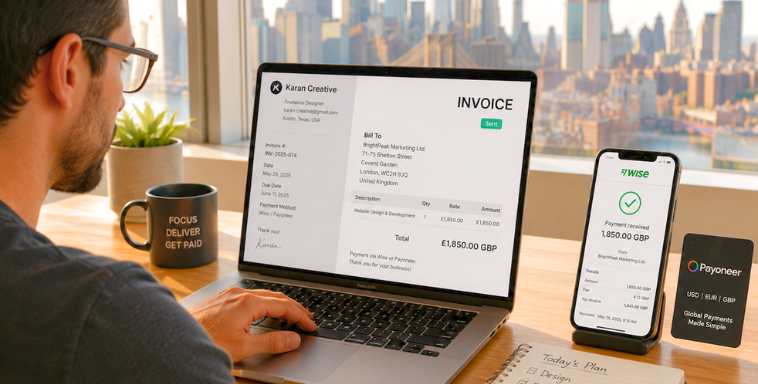
A client in London wants to hire you. You're in Dubai, or Mumbai, or Manila, and you don't have a company. No business bank account, no local registration, nothing but a personal account and a laptop. They ask for an invoice.
Every guide on this topic points you to Wise or Payoneer and calls it solved. It isn't. The tool is the easy part. What nobody explains is whether this is legal where you live, whether the client's finance department will actually pay a personal account, and what happens to your money between the invoice date and the day it lands.
This covers all three.
Is it actually legal to invoice without a business account?
In most countries, yes, with conditions attached. The confusion comes from mixing up two separate questions: Can you earn freelance income as an individual, and can you invoice using personal banking details?
United States: A sole proprietorship requires no registration. You can invoice under your own name and receive payment into a personal account. You report the income on Schedule C. Nothing stops a US-based independent contractor from billing internationally this way, though the IRS still wants that income declared.
United Kingdom: You need to register as a sole trader with HMRC once you start earning, but registration takes a few minutes online and costs nothing. You can invoice before you finish registering, but do it before your first tax deadline.
European Union: Rules vary by member state. Some countries (Germany's Kleinunternehmer status, for example) let you invoice as an individual under a revenue threshold without full VAT registration. Others expect registration from your first invoice. Check your specific country before assuming the US or UK model applies.
UAE: This is the one that trips people up most. The UAE requires a freelance permit or trade license to legally invoice for services, even as an individual. Freelance zones in Dubai (like Dubai Media City or DDA) issue permits specifically for this. Invoicing without one is common in practice but not compliant, and it creates problems the moment a client asks for tax documentation.
India: You can invoice as an individual under your PAN. Above the GST threshold (currently ₹20 lakh for services in most states), GST registration becomes mandatory regardless of whether you have a company.
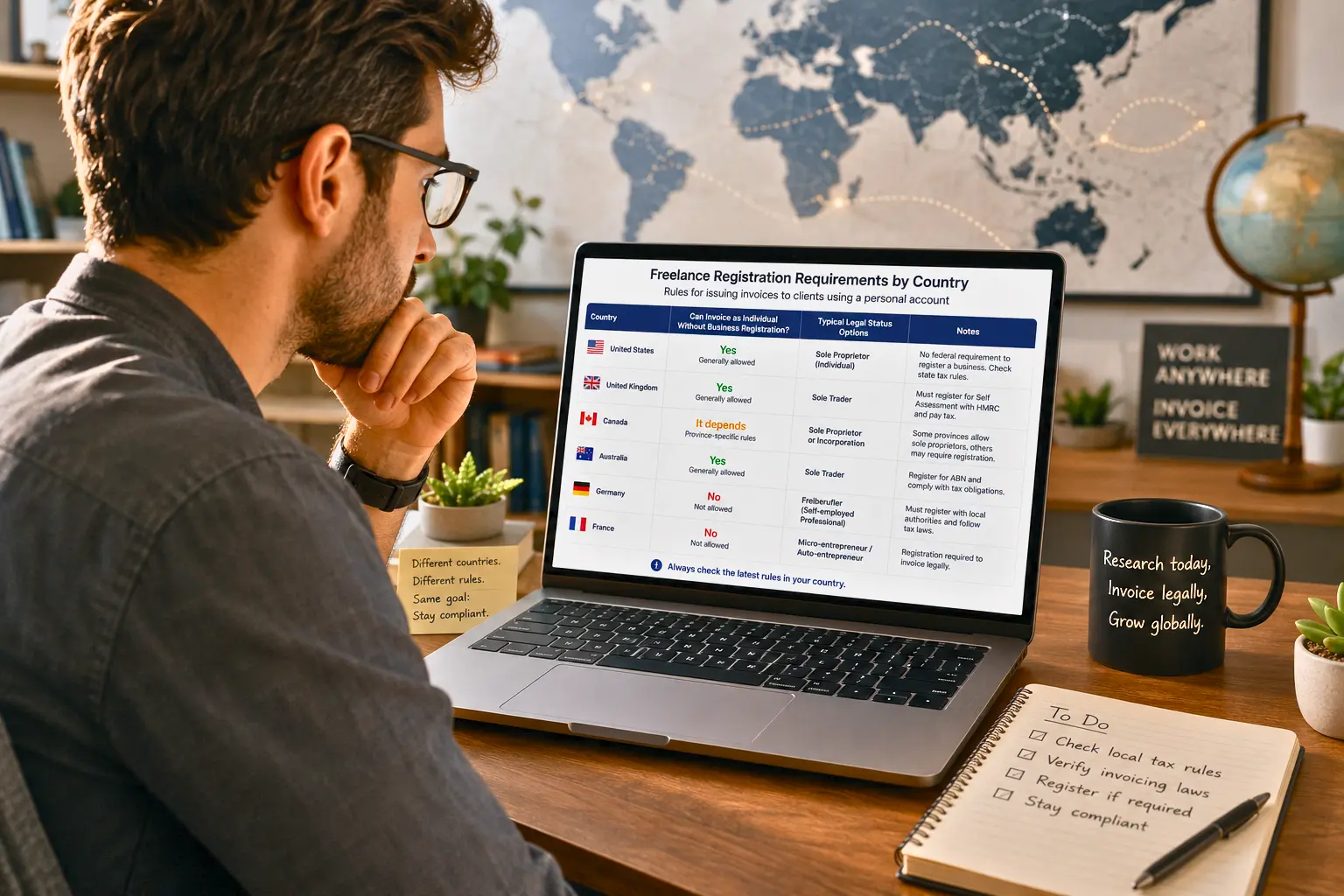
The pattern across all of these: invoicing without a company is usually fine. Invoicing without any registration or tax status at all is where the legal risk sits, and that risk depends entirely on your country, not your client's.
Will your client's finance team actually accept it?
This is the gap every "just use Wise" guide skips, and it's the one that actually stops people from getting paid.
Small clients and individual buyers won't blink at paying a personal account. A large company's accounts payable department runs differently. Before they release a payment, most mid-size and enterprise AP systems require vendor onboarding, which typically means:
A W-9 (US vendors, or anyone with a US tax presence) confirming your taxpayer status
A W-8BEN (non-US individuals billing a US company) certifying your foreign status for withholding tax purposes
A vendor registration form with your legal name, address, and banking details entered into their procurement system
Sometimes a bank verification letter or voided check equivalent, which a personal account can usually still provide
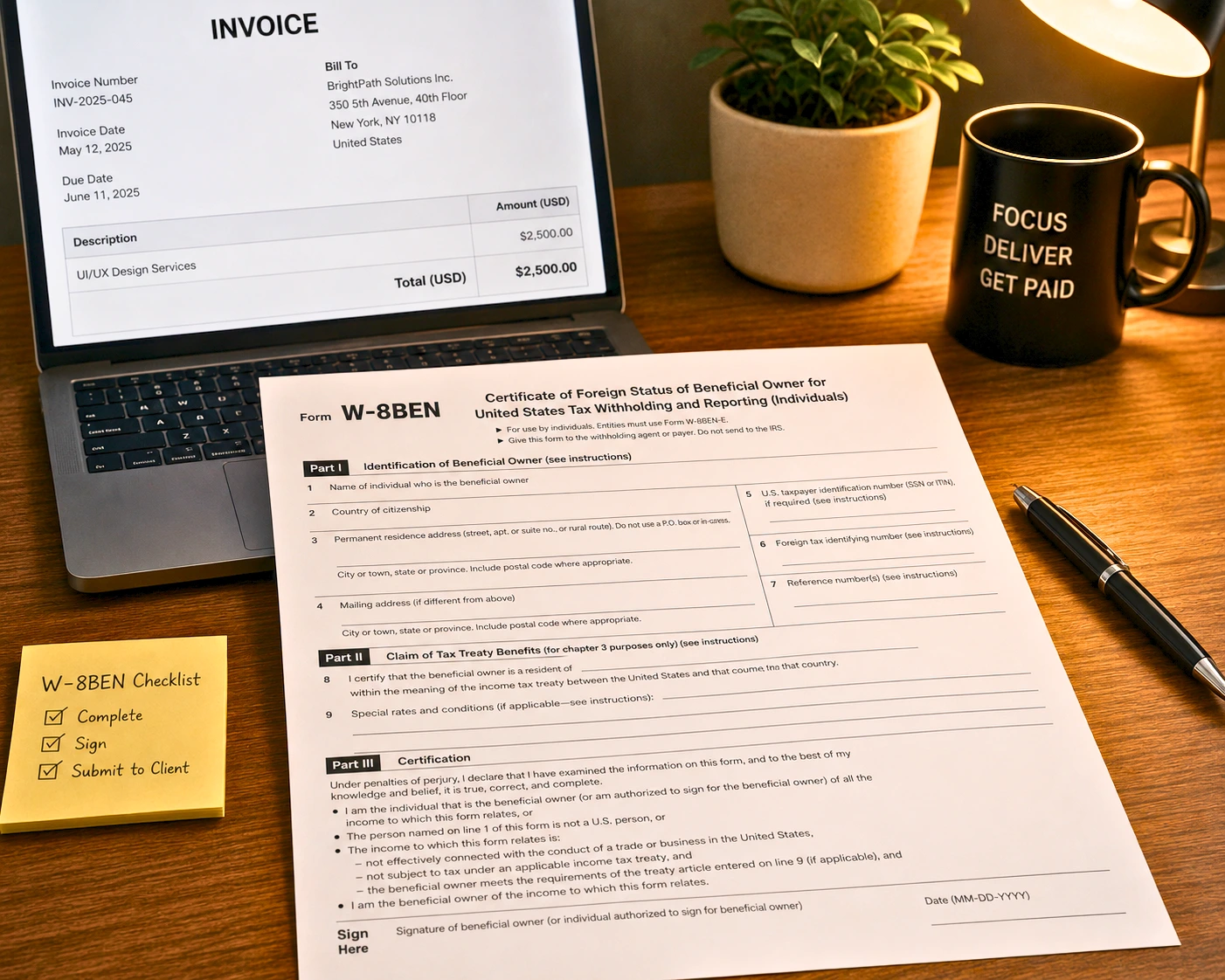
None of this requires a business entity. It requires paperwork most independent contractor have never filled out, because none of the payment-tool blog posts mention it exists. If you're pitching a company above a certain size, ask early in the process: "What do you need from me for vendor setup?" That question alone prevents a finished project from sitting unpaid while someone in procurement waits on a form you didn't know to send.
What personal accounts can and can't handle
Wise, Payoneer, and PayPal all let you receive international payments on a personal-tier account, but each has limits that the comparison sites don't spell out.
Wise (personal)
Personal-tier limits: Full KYC required above certain thresholds; receiving limits vary by currency and country
What pushes you to upgrade: Regular business-labeled invoicing, needing a business name on receiving details
Payoneer (independent contractor account)
Personal-tier limits: Works without a company for most independent contractor/marketplace payouts
What pushes you to upgrade: Higher-volume corridors or corporate clients requiring a registered business name
PayPal (personal)
Personal-tier limits: Receiving works, but "personal" transactions can trigger holds or aren't built for invoicing
What pushes you to upgrade: Any client expecting an itemized, business-branded invoice
The practical issue isn't usually the transfer limit. It's that a personal account often can't put your registered business name on the receiving details, which some clients' compliance teams flag automatically. If you're doing occasional project work, this rarely matters. If you're invoicing the same enterprise client every month, it becomes worth resolving before it becomes a blocker.
The real fee comparison
Every comparison site quotes "up to 5% with banks" and stops there. Here's what a $1,000 and $5,000 invoice actually costs across common methods, using typical rates as of mid-2026. Treat these as ranges, not quotes, since providers adjust pricing regularly.
Method: Traditional bank wire (SWIFT)

Cost on $1,000: $25–$50 in fees, plus 2–4% in FX spread
Cost on $5,000: $30–$60 in fees, plus 2–4% in FX spread
Method: Wise
Cost on $1,000: 0.5–1% total, transparent mid-market rate
Cost on $5,000: Scales linearly, no hidden spread
Method: Payoneer
Cost on $1,000: 1–3% depending on payment source
Cost on $5,000: Scales similarly, lower on marketplace payouts
Method: PayPal
Cost on $1,000: 4–5% combined (transaction fee + FX markup)
Cost on $5,000: Same percentage, so cost grows fast at higher amounts
The SWIFT wire has a second, invisible cost that none of the comparison guides mention clearly: correspondent bank fees. Your client's bank sends the full amount, but one or two intermediary banks along the route can each deduct $10–$35 before the money reaches you, with no notice to either side. If you're using bank wires regularly, add a line to your payment terms stating the client covers all transfer fees, and ask them to select "OUR" on the SWIFT form so their bank absorbs the intermediary costs instead of you. The mechanics of who carries currency movement between invoice and payment date go deeper than fees alone. Alfaa's guide to multi-currency invoicing breaks down exactly where that risk sits and how to write your contract so it doesn't default to you.
Making the invoice itself legally valid
A personal-name invoice still needs to hold up as a real tax document, both in your country and the client's. The fields that matter most:
Your full legal name (matching your tax ID, not a business name you haven't registered)
Your tax identification number if your country requires one on invoices (SSN/EIN for the US, VAT number where applicable, PAN for India)
The client's full legal entity name and address
A sequential invoice number, even as a sole individual
The currency stated explicitly, plus the exchange rate source if it's cross-currency
Clear payment terms, including who absorbs transfer fees and FX movement
If you're unsure which invoice type fits your situation, whether it's a standard invoice, a proforma sent before work starts, or something else entirely, this breakdown of invoice types covers the differences and when each one applies. And if the specific terminology around due dates and payment terms is new territory, this glossary is worth bookmarking before your first international client asks a question you can't answer.
What happens if the client doesn't pay
This is where personal accounts fall furthest behind a real business setup. A registered business has more legal standing to pursue unpaid invoices, and some payment platforms offer stronger dispute processes for verified business accounts than personal ones.
In practice, most independent contractors never test this, because most international clients pay. But if you're taking on a client relationship worth thousands of dollars a month, it's worth knowing upfront that recourse is thinner without a business entity behind the invoice. Clear payment terms and consistent follow-up do more real-world work than legal standing anyway. Proven strategies for reducing late payments apply just as much to international clients as local ones, arguably more, since a late international payment is harder to chase by phone.
When it's time to stop and register a business
There's no universal revenue number, but a few signals reliably mean it's time:
You've crossed your country's mandatory registration threshold (GST in India, VAT thresholds in the EU/UK, or simply earning enough that self-employment reporting requires formal structure)
A client's procurement team specifically asks for a registered business entity, not just tax forms
You're invoicing the same client monthly on an ongoing basis, which starts to look less like project work and more like a business relationship worth formalizing
You want liability separation between your personal assets and client work, which no personal bank account provides regardless of how the invoice is structured
Until one of those hits, invoicing without a business account is a normal, common stage, not a shortcut you're getting away with.
Keeping it organized as you scale
Whether you're invoicing three international clients or thirty, the operational problem is the same: you need every invoice to carry the right currency, the right tax fields, and a clear record of what's paid and what's outstanding, without rebuilding a template from scratch each time. Alfaa supports 200+ currencies with correct formatting, keeps client details saved for reuse, and tracks payment status automatically so you're not cross-referencing a spreadsheet against your bank app every time a payment lands. If you're not ready to commit to a platform, Alfaa's free invoice generator covers a one-off international invoice without signup.
Consultants and virtual assistants running this exact setup, personal accounts, no company, and multiple international clients are exactly who Alfaa's client management tools are built around.
Frequently Asked Questions
In most countries, yes. What matters is your individual tax registration status (sole trader, sole proprietor, or freelance permit where required), not whether the receiving account is labeled personal or business.
Small clients usually will without question. Larger companies often require vendor onboarding paperwork (W-9, W-8BEN, or a vendor registration form) before releasing payment, regardless of whether the account is personal or business.
Yes. Where the money lands has no bearing on your tax obligation. You owe tax on the income based on your country's rules, regardless of account type.
When you cross your country's mandatory registration threshold, when a client specifically requires a registered entity, or when the relationship becomes recurring enough that formal structure starts protecting you more than it costs.
Wise generally offers lower, more transparent fees. Payoneer integrates more directly with freelance marketplaces like Upwork and Fiverr. Neither requires a registered business for a independent contractor-tier account.

Olivia Bennett
Content Writer @ Alfaa
Olivia is a content writer at Alfaa who specializes in invoicing, small business, and productivity topics. She enjoys simplifying complex ideas into clear, practical insights that help business owners save time, get paid faster, and stay organized.