Receipt Maker: What a Legitimate Business Receipt Actually Needs
By Alfaa Team
Stay in the loop
Get finance tips delivered to your inbox.
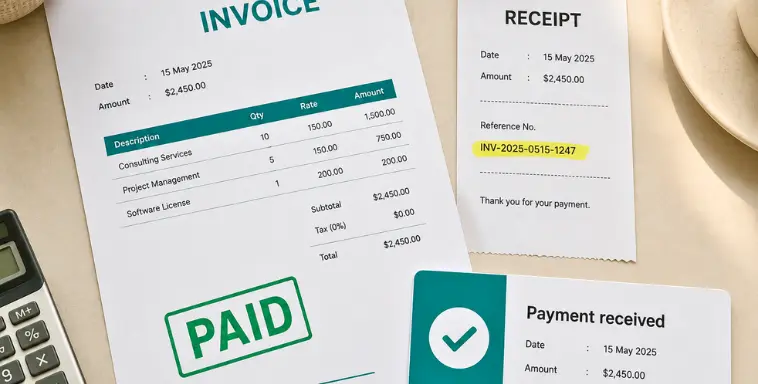
Search "receipt maker" and most of what comes back is a template you fill in by hand, download, and send. A few of these tools go further and market themselves explicitly around recreating a receipt you've lost or reproducing one from scratch with no transaction behind it at all. That's a real gap worth naming: a receipt isn't just a formatted document, it's supposed to be proof that a specific payment actually happened. A blank template fills in the format. It doesn't fill in the proof.
Here's what actually belongs on a legitimate business receipt, what changes depending on where you and your client are, and why the strongest receipt is one that ties back to a record you already have, not one typed into a form from scratch.
Receipt or invoice? The distinction most tools blur
An invoice requests payment. A receipt confirms payment already happened. That's the whole distinction, and it matters more than it sounds like it should, because sending the wrong one creates real confusion: a client who gets a "receipt" for work that isn't paid for yet has no idea whether they still owe you money.
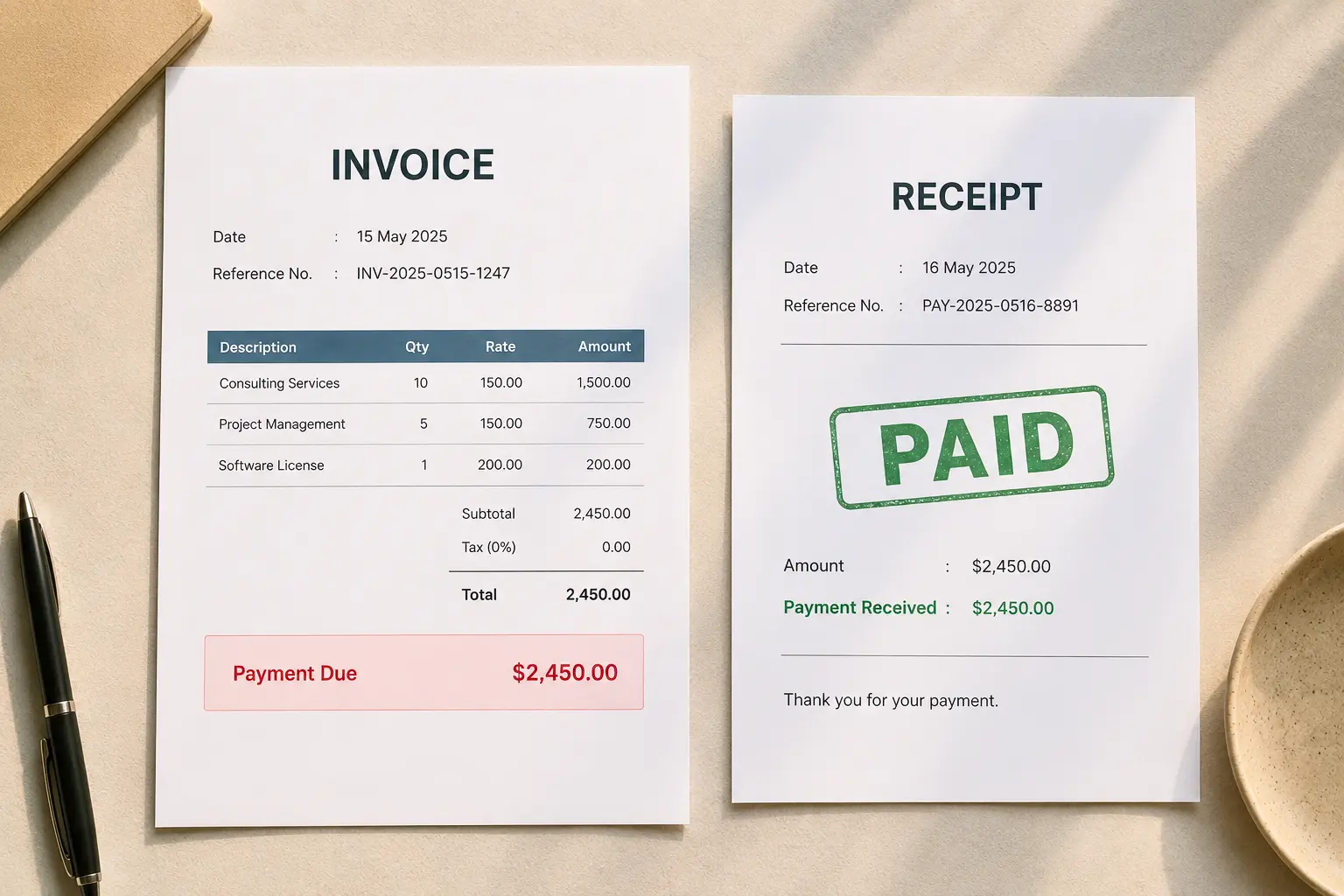
Alfaa's rundown of invoice types covers where a receipt sits relative to a standard invoice, a pro forma, and a credit note, worth a look if you're not sure which document a given situation actually calls for. One quick note on terminology: "due on receipt" is a payment term meaning payment is expected as soon as the invoice arrives, not a reference to the receipt document itself. Alfaa's invoice terminology glossary untangles this and a handful of other terms that get mixed up the same way.
What actually makes a receipt hold up
A receipt gets used for things that carry real consequences if it doesn't hold up: a tax deduction, an expense reimbursement, a warranty claim, or proof for an accountant during a review. For that, it generally needs:
The date and amount of the actual payment, not just the amount owed
What was paid for, itemized if it's more than a single flat fee
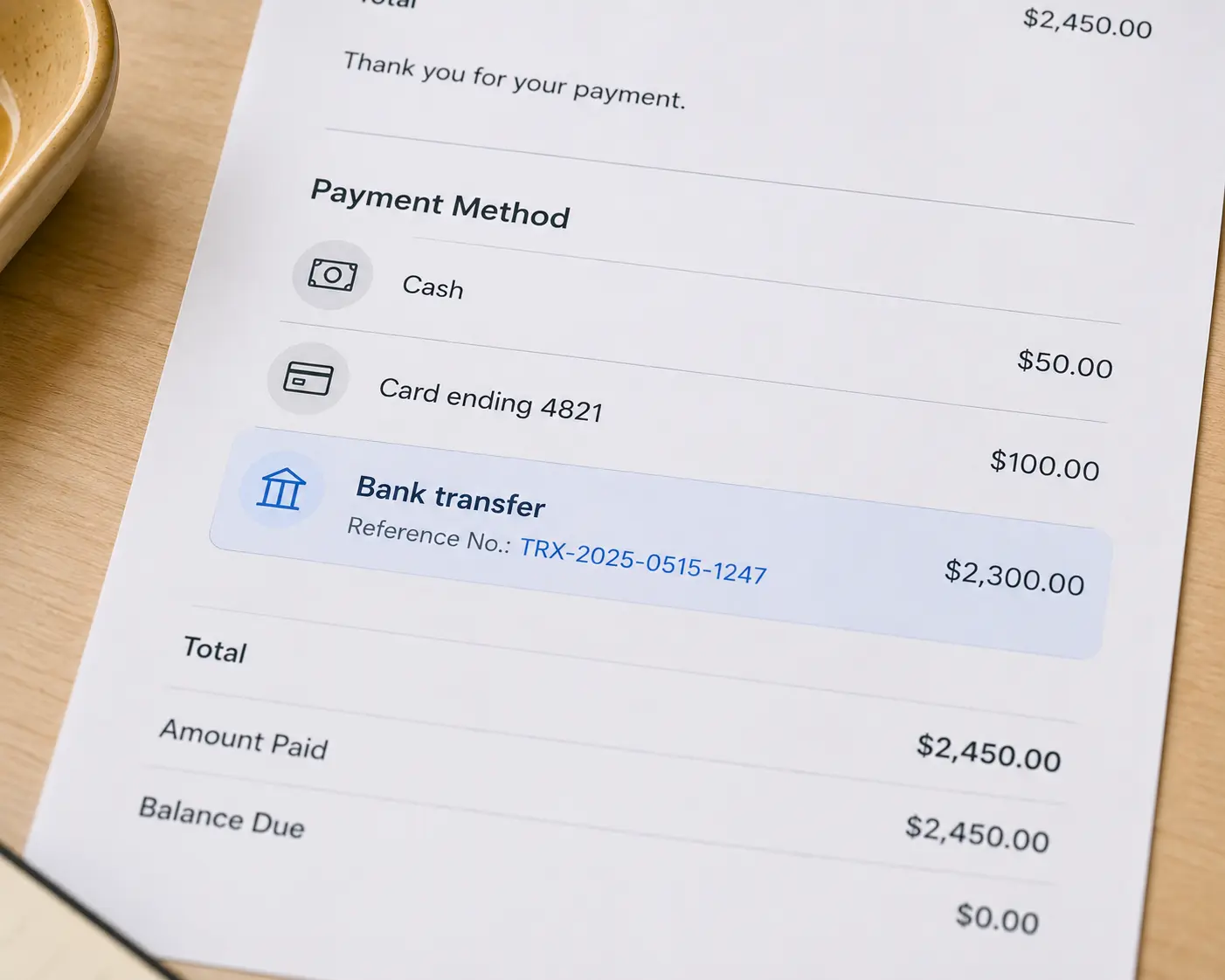
How it was paid (cash, card, bank transfer, digital payment), since this matters for both sides' bookkeeping
A receipt or reference number, ideally one that ties back to the invoice it's settling
Both parties' names and, where relevant, tax identification numbers
Every generic template covers the first three. Almost none of them handle the fourth well, and that's the one that actually connects the receipt to something real.
how it was paid
Payment method changes. What else belongs on the receipt beyond just naming it. A cash receipt is the only proof either side has that money changed hands, so it carries the most weight and is worth being the most precise about. A card or digital wallet payment already has a processor record behind it, so the receipt mainly needs to match the last four digits or transaction reference so it can be tied back to that record if there's ever a dispute. A bank transfer receipt should reference the transfer or reference number the client used, since "paid by bank transfer" alone gives you nothing to search for later.
Why a receipt needs to tie back to a real record
This is the part every standalone generator skips, because a standalone generator has no record to tie back to. You open the tool, type in numbers, and download a document. Nothing on the other end confirms that a matching invoice was ever sent or that the amount on the receipt matches what was actually billed.
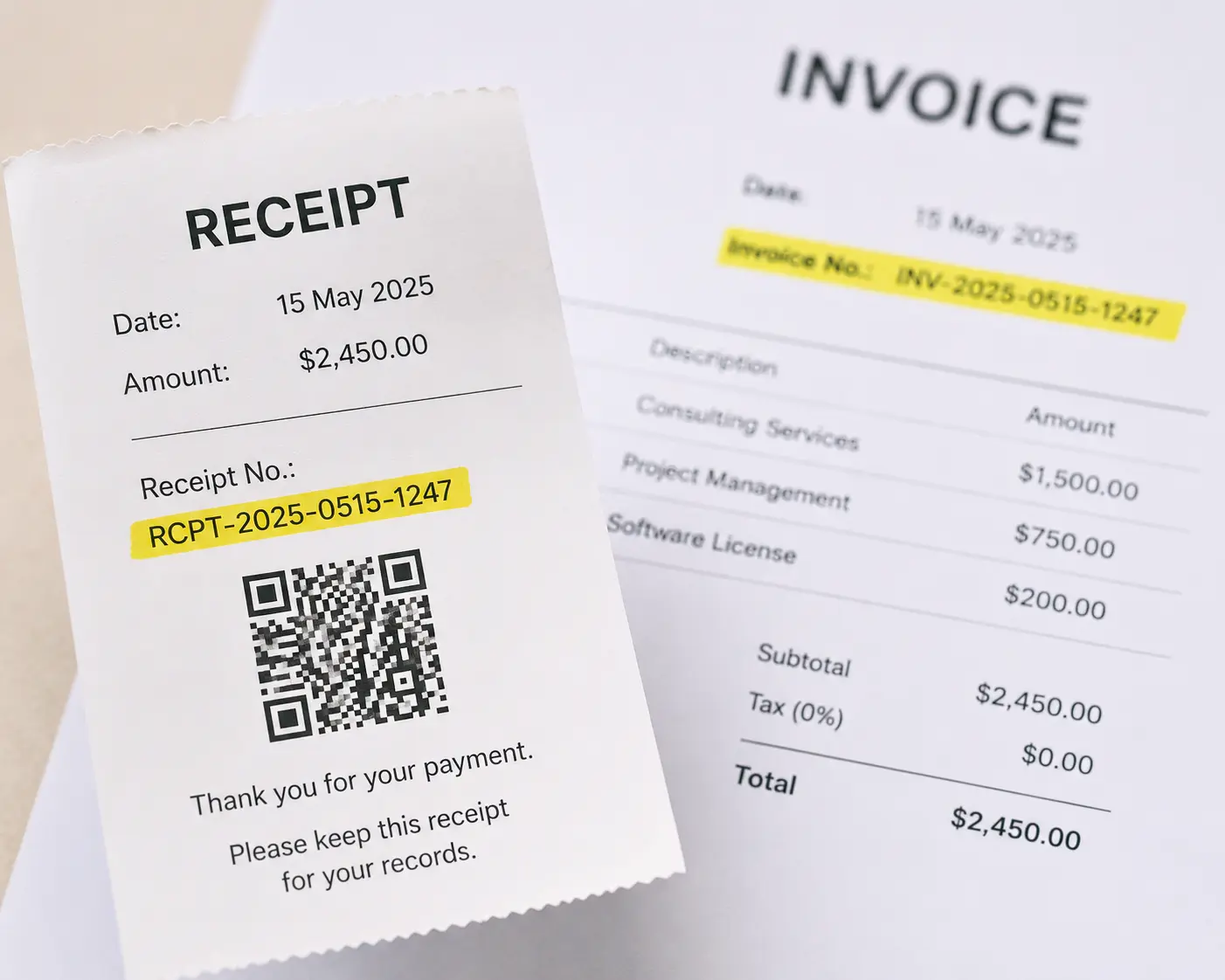
For your own bookkeeping, that gap matters. A receipt with no corresponding invoice or payment record is exactly the kind of mismatch that creates problems in a real financial review, whether that's your own year-end reconciliation or a client's expense audit. The more durable approach: treat the receipt as something that comes out of your existing invoice record once payment is confirmed, not a separate document built from a blank form. In Alfaa's invoice management, marking an invoice as paid keeps that status and payment date attached to the original invoice itself, so the paid invoice functions as your receipt without a second, disconnected document to keep track of. Payment tracking is what actually maintains this link over time, with invoice and payment status in one place instead of a receipt generated once and forgotten.
What changes by country
Receipt requirements follow roughly the same logic as invoice requirements and vary the same way:
VAT or GST-registered businesses generally need their tax ID on the receipt, not just the invoice, since it's the document that confirms the taxable transaction occurred.
Sequential numbering matters for receipts under several countries' tax rules the same way it does for invoices, something a fill-in-the-blank template rarely enforces.
Currency and language requirements shift depending on where your client is, the same considerations that apply to billing an international client apply to the receipt that follows.
If you're already invoicing internationally, this breakdown of when sales tax or VAT applies to a cross-border sale covers the reasoning that determines what your receipt needs to reflect, whether that's a zero-rated export, a reverse charge, or a standard domestic sale.
Rent receipts: a genuinely different case
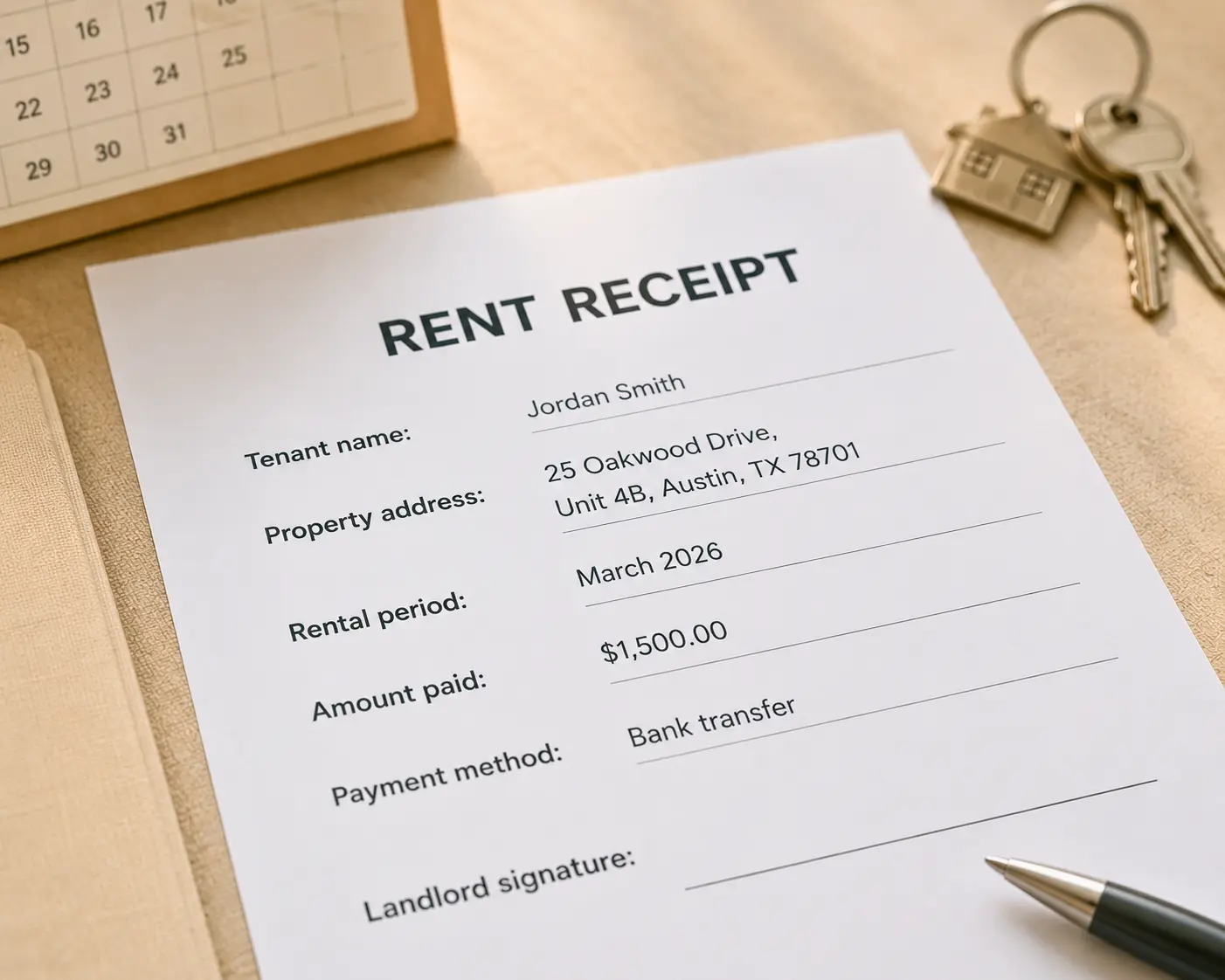
A large share of "receipt maker" searches are landlords and tenants, and a rent receipt needs different fields entirely from a retail or service receipt:
Tenant's full name and the property address the payment covers
The specific period the payment applies to (not just a date, a date range: "rent for March 2026")
The amount paid and the method
Whether any balance remains outstanding from a prior period
The landlord's name and, in many jurisdictions, a signature or equivalent confirmation
Generic retail-style templates rarely include the coverage period, which is the one field that actually matters most for a rent receipt: without it, there's no way to tell which month's rent the receipt is confirming.
Hourly and project-based work
A flat-fee sale and an hourly engagement don't belong on the same receipt template. For hourly work, the receipt should show the hours billed and the rate separately, not just a lump total, since that's usually what a client's own bookkeeping needs to reconcile the payment against the timesheet or statement of work they approved. Alfaa's guide to invoice types covers this under timesheet invoicing, the same logic carries over once that invoice is paid and becomes a receipt.
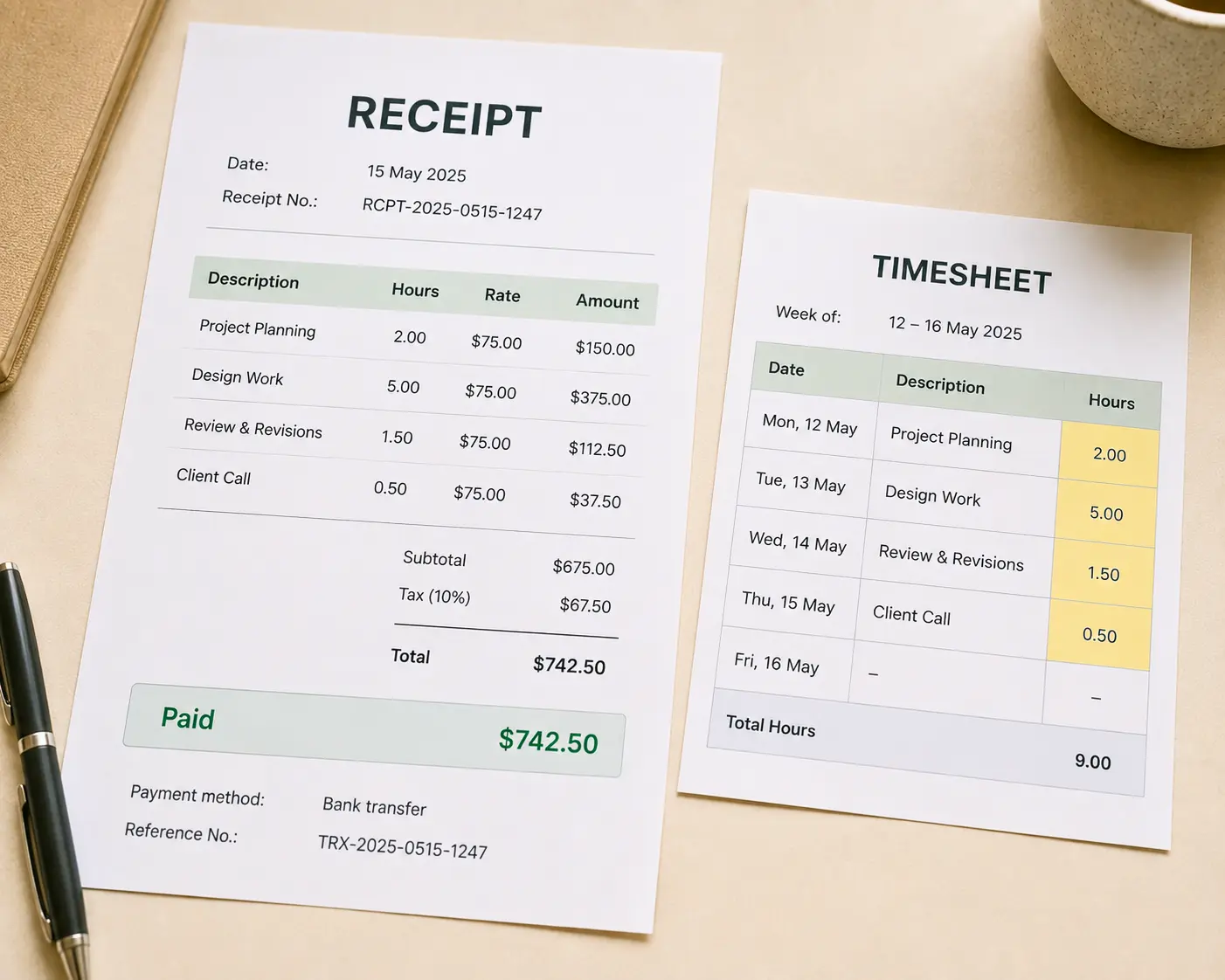
Project-based work with staged payments (a deposit at kickoff, a milestone payment, and a final balance) runs into the same issue as partial payments above: each receipt should reference which stage of the project it covers and what, if anything, remains outstanding. A single "paid in full" receipt at the very end, with nothing showing the deposit and milestone payments that came before it, leaves a gap if anyone ever needs to reconstruct the full payment history.
Partial payments and deposits
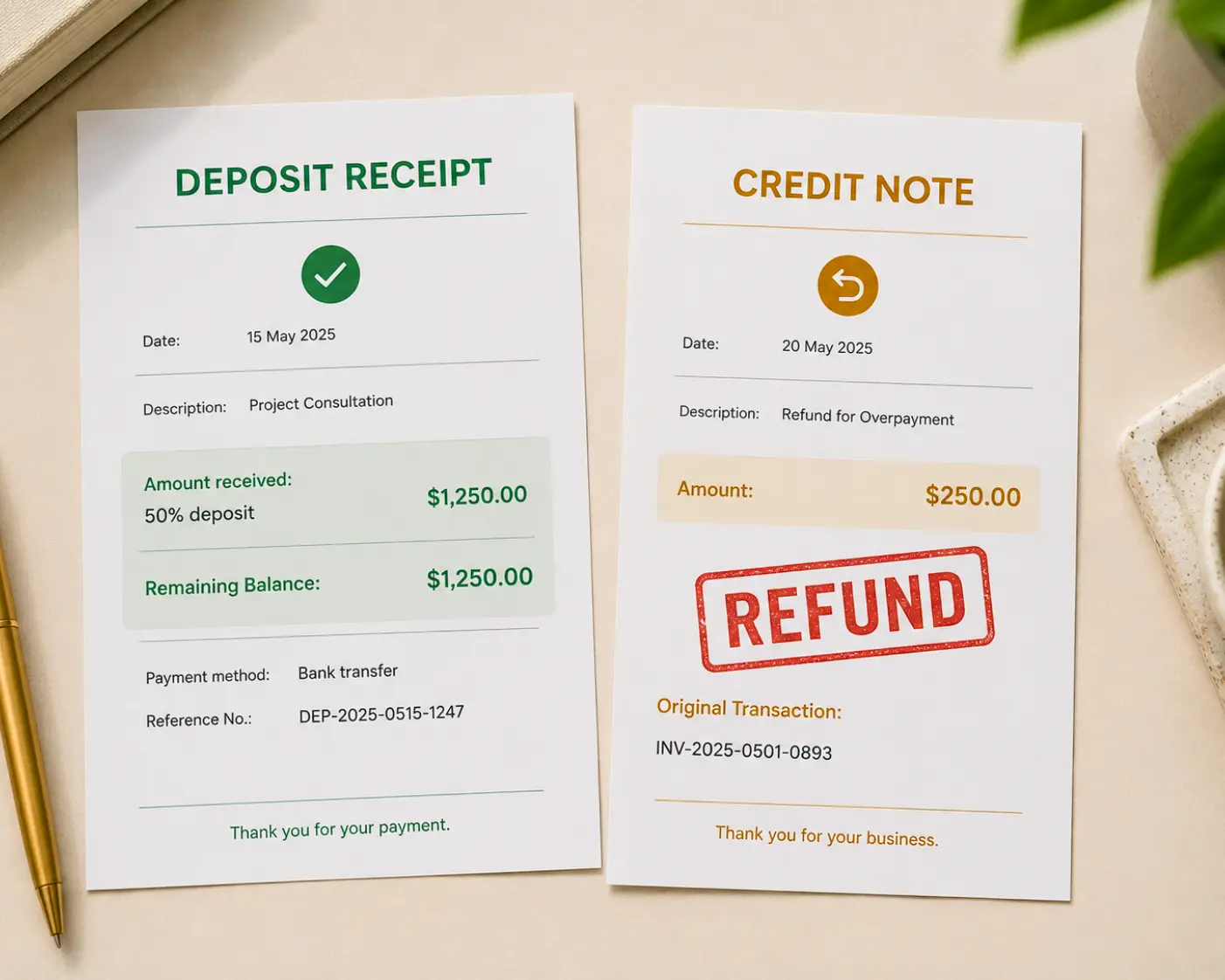
If a client pays a deposit rather than the full amount, the receipt should reflect exactly that, the amount actually received, not the full invoice total. It should also reference the remaining balance and, ideally, the invoice or agreement it's tied to. A receipt that only shows "amount paid" with no context leaves both sides guessing whether the transaction is complete or partway through.
Refunds, exchanges, and voided transactions
A receipt for a refund needs to say it's a refund, not just show a number with a minus sign in front of it. If a customer returns an item or a service gets cancelled after payment, the document you issue should reference the original transaction it's reversing, the amount actually refunded (which may be less than the original payment if a restocking fee or partial credit applies), and the method the refund was issued through, since a cash refund and a refund back to a card don't hit either party's books the same way.
Voided transactions are simpler but easy to skip: if a receipt was issued and then the transaction was never actually completed (a card declined after the fact or an order cancelled before fulfilment), the cleanest approach is to mark that receipt void against the original record rather than just deleting it, so there's no gap in your numbering and no orphaned document if anyone goes looking.
Fixing a receipt after the fact
Wrong amount, wrong date, wrong client—this happens, and it's worth handling deliberately rather than just editing the original and re-sending it. Reissuing a corrected receipt with a note referencing the original (and the reason for the correction) keeps a clean trail, the same logic that applies to correcting an invoice with a credit or debit note rather than silently altering what was already sent.
How long to actually keep these records
Retention expectations vary by country and by whether the transaction was personal or business, but most tax authorities expect records kept for somewhere between five and seven years. A downloaded PDF sitting in a folder technically satisfies this, but only if you can still find it and it's still legible years later. Keeping receipts attached to the invoice and client record they came from, rather than as loose files scattered across download folders and email attachments, is the difference between a five-minute lookup and a real problem when someone actually asks for one. Saved client records exist for exactly this: a place where a client's billing and payment history stays attached and searchable rather than living in whichever folder you happened to save that month's PDFs.
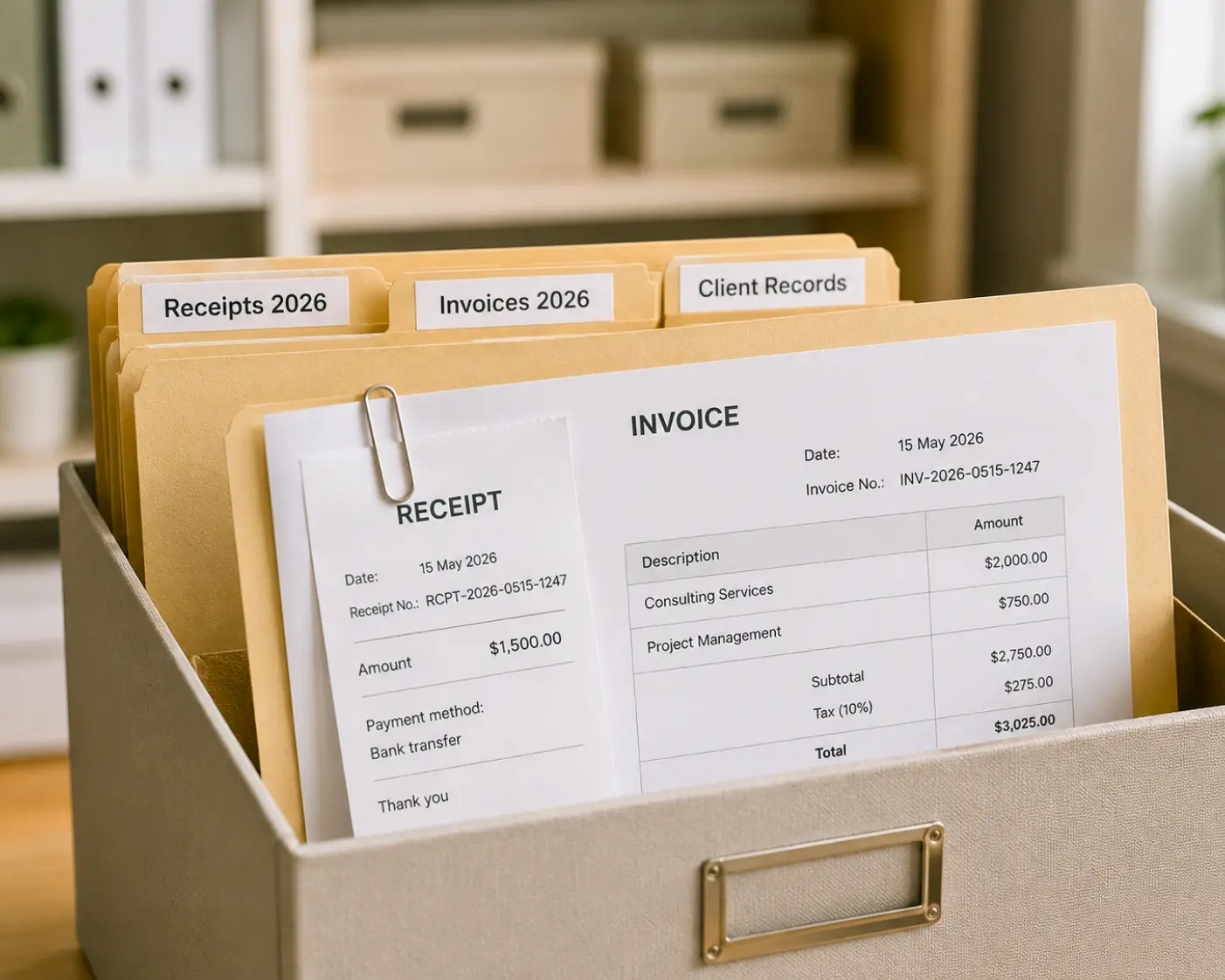
Some of the tools that rank for "receipt maker" lean into recreating receipts with no transaction behind them, framed as replacing something lost. That's a real, legitimate use case (a paper receipt that faded, a receipt that never got issued for a purchase that genuinely happened), but it's worth being honest about where the line sits: a receipt is only doing its job if it reflects a payment that actually took place. Using one to invent a transaction that didn't happen isn't a formatting problem, it's the document failing at the one thing it exists to do.
The safest way to stay on the right side of that line is the same principle covered above: Generate the receipt from the invoice and payment record you already have, rather than typing numbers into a blank form. If the record exists, the receipt is just a formatted version of something true.
Where this fits with Alfaa
Alfaa doesn't treat the receipt as a separate document you build from scratch. Mark an invoice as paid, and that record, amount, date, payment method, and status, is your receipt, still attached to the original invoice rather than floating on its own. If you need a one-off invoice to start with, Alfaa's free invoice generator covers that without requiring signup.
Frequently Asked Questions
An invoice requests payment for work or goods, sent before or at the time of billing. A receipt confirms a payment was received. If money hasn't changed hands yet, it should be an invoice, not a receipt.
Not necessarily. If your invoicing tool tracks payment status, a paid invoice already contains everything a receipt needs, an amount, date, and confirmation of payment, without a second document to generate and keep track of separately.
At minimum: the date and amount actually paid, what it was for, the payment method, and both parties' details. If either party is tax-registered, the relevant tax ID should appear as well.
It needs the specific rental period the payment covers, not just a payment date, since that's the detail that actually confirms which month's rent has been settled.
Generally five to seven years for tax purposes, though this varies by country. Keeping them attached to the original invoice and client record makes them far easier to produce later than loose PDFs saved individually.
It should clearly state that it's a refund, reference the original transaction, and show the amount actually returned and how. This is functionally a credit note, and should be treated as one for your own records.
It should show the hours billed and the rate as separate line items rather than one lump total, since that's usually what the client needs to reconcile against the timesheet they approved.

Olivia Bennett
Content Writer @ Alfaa
Olivia is a content writer at Alfaa who specializes in invoicing, small business, and productivity topics. She enjoys simplifying complex ideas into clear, practical insights that help business owners save time, get paid faster, and stay organized.